Stop guessing. Learn to design and automate SEO keyword ranking reports that connect search performance directly to your business goals and revenue.
January 9, 2026 (8mo ago)
Build Automated SEO Keyword Ranking Reports That Drive Revenue
Stop guessing. Learn to design and automate SEO keyword ranking reports that connect search performance directly to your business goals and revenue.
← Back to blog
Build Automated SEO Keyword Ranking Reports That Drive Revenue
Summary: Design automated SEO keyword ranking reports that link search performance to leads and revenue by focusing on high-impact keywords, KPIs, and automation.
Introduction
Stop guessing. Learn to design and automate SEO keyword ranking reports that connect search performance directly to your business goals and revenue.
An effective SEO keyword ranking report isn’t just a list of where you stand. It’s a strategic tool that draws a straight line from your SEO work to real business growth. It’s about moving past simple vanity metrics to forecast traffic, generate qualified leads, and ultimately drive revenue.
Moving Beyond Vanity Metrics in SEO Reporting
Let’s be honest: a lot of SEO reports are vanity dashboards. They’re packed with endless lists of keywords but have no real connection to what the business actually cares about. This kind of reporting doesn’t impress leadership, and worse, it doesn’t help you make smarter strategic decisions. Our reports need to catch up.

There’s a reason the fight for top search positions is so intense. The #1 organic result on Google gets a massive share of clicks1, while lower positions capture far less. When many marketers say organic search delivers the best ROI for their efforts, leadership wants to see reports that connect the dots to forecasted traffic, qualified leads, and closed deals—not just impressions.2
Focus on High-Impact Keywords
Instead of chasing thousands of low-impact keywords, focus on the critical few that can realistically grow your pipeline. Zero in on keywords with clear commercial intent that reflect what your business sells.
For example, a SaaS company will get more value from ranking for “enterprise accounting software demo” than for a broad term like “what is accounting.” One signals a user is ready to buy; the other is just researching.
“Transform your SEO keyword ranking reports from a passive summary into a strategic tool. It should prove the ROI of your efforts and justify further investment by showing a clear path from keyword to customer.”
Aligning Reports with Business Goals
To build masterful reports, understand the moving parts of search visibility and how ranking changes feed into business outcomes. With that context, your reports should answer what leadership is actually asking:
- How is our organic visibility contributing to new leads?
- Which content is bringing in the most valuable traffic?
- What’s the forecasted ROI from our current SEO strategy?
By focusing on these questions, the conversation changes from “where do we rank?” to “how much revenue is SEO generating?” This strategic shift makes your reports valuable and proves your impact on the bottom line.
Defining Goals and KPIs That Matter to Leadership
Before building a report, create a blueprint. Without one, your SEO keyword ranking reports are just a jumble of data points. Leadership doesn’t care that a keyword jumped from position 7 to 4; they care what that movement means for the bottom line.
A great report tells a story that connects directly to the sales funnel. Move past vague goals like “increase traffic” and define specific, measurable KPIs that matter to business leaders. Instead of tracking rankings for “CRM software features,” track organic-driven demo requests or Marketing Qualified Leads (MQLs) from that topic cluster.
Connecting SEO KPIs to the Sales Funnel
Mapping KPIs to the sales funnel is the single most effective way to demonstrate value. Structure reporting like this:
- Top of Funnel (Awareness): Track keyword visibility for informational searches, ownership of SERP features (featured snippets, People Also Ask), and overall organic impressions to show growing reach.
- Mid Funnel (Consideration): Measure CTR from search results, pages per session, and time on page to show engagement and interest.
- Bottom of Funnel (Decision): Track organic-driven conversions—leads, demo sign-ups, form fills, or sales—to directly tie SEO to revenue.
The most powerful reports blend primary and secondary KPIs. A primary KPI might be organic-driven leads, while a secondary KPI like branded vs. non-branded traffic share provides context about brand authority.
Choosing the Right Metrics for Your Business
KPIs must align with your business model. A B2B SaaS company focuses on MQLs and demo sign-ups. An ecommerce store focuses on organic revenue and average order value. Pick the metrics that match your goals. If your company builds interactive tools, track leads generated from those assets to show their impact.
Consider linking SEO outcomes to cost metrics when relevant—for example, use a Customer Acquisition Cost (CAC) Calculator to compare initial SEO spend versus early acquisition costs.
One-size-fits-all SEO reports are a recipe for disaster. Your CEO, marketing manager, and content creators all care about different things. Design reports that give the right information, in the right format, to the right person.
Designing Reports for Different Audiences
A report for a hands-on SEO specialist will overwhelm an executive. Create audience-centric reports.
Tailoring Reports for the C-Suite
For executives, think “less is more.” They want the big picture: business impact, not daily keyword movements. Deliver a clean, visual dashboard that answers pressing questions at a glance.
Focus on metrics that connect to revenue and market position:
- Organic ROI: Show the financial return on SEO investment.
- Market Share: Compare search visibility to top competitors.
- Lead & Revenue Growth: Connect organic traffic to new leads and sales.
Embed interactive tools to demonstrate value. For example, an internal dashboard could include a Business Valuation Estimator to help owners quickly estimate company value while capturing high-value leads.
Reports for Marketing and Content Teams
Marketing and content teams need granular, diagnostic data to inform tactics. Their reports should highlight:
- Campaign Performance: Keyword rankings for content clusters and initiatives.
- Content Effectiveness: Blog posts, landing pages, or tools driving the most valuable traffic.
- SERP Feature Ownership: Featured snippets, People Also Ask, and other search real estate wins.
The best reports don’t just present data; they translate it into action. Instead of noting a rank drop, provide context—competitor movement, content decay, or shifts in intent—so teams can answer “Why did we drop?” and take corrective steps.
The SEO market is growing rapidly, and content volume is exploding. To handle scale, teams need automated, well-structured reporting that surfaces the most important signals.
If you need tools for evaluating digital assets, consider the Digital Business Valuation Tool as an example of an embeddable interactive instrument.
How to Automate Your Reporting Workflow
Manual reporting is a time drain and error-prone. Automating SEO keyword ranking reports is essential if you want to spend less time fetching data and more time analyzing it.
Start by connecting core data sources: Google Analytics, Google Search Console, and your SEO platform of choice. Most tools offer APIs or integrations so you can pipe keyword rankings, organic traffic, and conversions into a central dashboard.
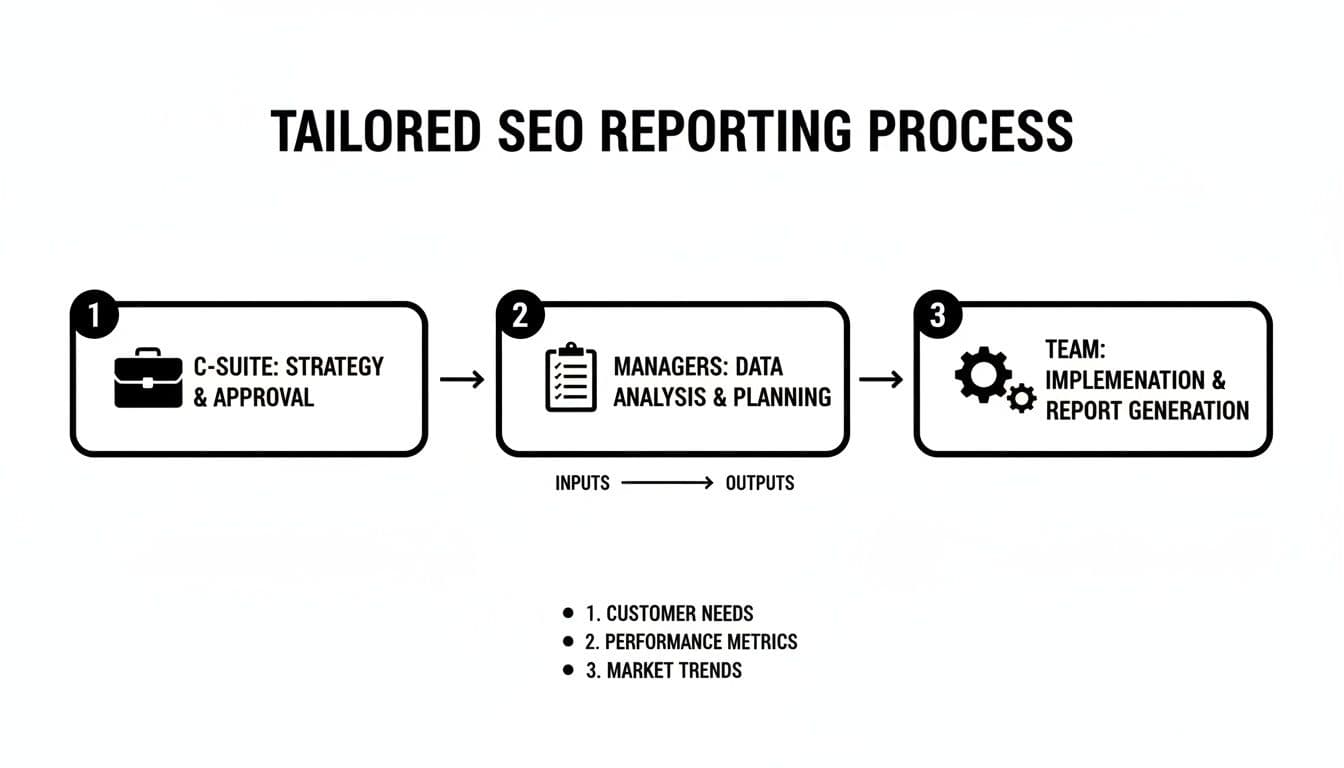
Automation lets you tailor outputs: a high-level summary for the C-suite, trend views for managers, and granular datasets for hands-on teams—without producing three separate manual reports.
Setting Up Delivery and Alerts
Once data flows in automatically, schedule delivery. Email stakeholders or ping a Slack channel at a set cadence—for example, every Monday at 9 AM—so everyone has the latest numbers.
Automation isn’t “set it and forget it.” Build quality-assurance checks into the workflow. For instance, set an alert if organic traffic drops by more than 15% week-over-week. That turns a passive report into an active watchdog for SEO health.
Turning Reports into Revenue Tools
Automation becomes a game-changer when you connect SEO data to revenue-generating assets. Embed interactive tools on your site to capture leads and automate data collection so your SEO report shows, in near real time, how a keyword strategy contributes to qualified prospects.
When you automate data collection from lead-capture assets, you can show exactly how SEO fuels the sales pipeline and prove ROI daily.
For marketing cost comparisons, a useful tool is the Facebook Ads Cost Estimator to benchmark paid spend against organic gains.
Evolve for AI and Long-Tail Search
Search is changing fast. AI Overviews and long-tail queries are reshaping results. If you’re still focusing only on high-volume head terms, you’re missing opportunities.

Most searches are long, specific, and conversational. A large share of keywords have very low monthly volume, and long-tail queries can generate more clicks than single-word head terms3.
From Keywords to Topic Clusters: A New Reporting Mindset
Future-proof reporting by focusing on user intent and topic clusters rather than isolated keywords. Measure your authority across topics like “small business financial planning” instead of single terms. Track visibility in AI answers and featured snippets—your goal is to become the definitive authority on a subject.
Why Interactive Tools Are Your Secret Weapon
Embedding custom tools gives you an edge. An interactive asset answers highly specific, long-tail queries in ways static pages can’t. It attracts high-intent traffic, increases time on site, and earns backlinks.
For example, an embedded ROI tool directly solves a user’s need and captures leads. Use interactive assets strategically to stand out and demonstrate the financial impact of your work.
Answering Your Top Questions
How often should I run my reports?
It depends on the audience. Tactical teams benefit from weekly reports to spot quick issues and wins. Leadership prefers monthly or quarterly summaries that highlight trends and revenue impact. Consistency is more important than frequency—pick a reliable cadence and stick to it.
What’s the single most important metric?
Organic-driven conversions—qualified leads, demo requests, and sales. Rankings and traffic are useful leading indicators, but conversions prove the business impact.
How long until SEO shows results?
Be patient. Expect 3 to 6 months for meaningful movement from a new SEO push, depending on site authority, competition, and content quality. Design reports to surface early wins like rank improvements for long-tail terms and rising impressions.
Quick Q&A Summary (Three Concise Sections)
Q: What should my SEO reports prove?
A: Show how SEO drives leads and revenue by linking keyword clusters to conversions, not just ranks.
Q: Who should see which report?
A: Executives get high-level ROI and market-share summaries; managers get trend and campaign views; SEO teams get granular, diagnostic data.
Q: How do I scale reporting?
A: Automate data collection from Analytics, Search Console, and your SEO platform, set delivery schedules and alerts, and embed interactive tools to capture revenue signals automatically.
Ready to create interactive tools that supercharge your SEO and make your reports impossible to ignore? Consider embedding a Digital Business Valuation Tool to capture high-intent visits and demonstrate measurable impact.
1.
SISTRIX, “Google organic click‑through rate study,” https://www.sistrix.com/blog/google-organic-click-through-rate-study/
2.
HubSpot, “Marketing statistics,” https://www.hubspot.com/marketing-statistics
3.
Ahrefs, “Long‑tail keywords: what they are and how to use them,” https://ahrefs.com/blog/long-tail-keywords/
Ready to Build Your Own Tools for Free?
Join hundreds of businesses already using custom estimation tools to increase profits and win more clients
✨ No coding required • 🚀 Ready in minutes • 💸 Free to create