Kicking off a product without a clear plan risks wasted effort and missed outcomes. Use a PRD template to align teams, define success metrics, and prevent scope creep.
November 2, 2025 (11mo ago) — last updated November 24, 2025 (11mo ago)
PRD Template Guide: Build Better Products
Use this PRD template to align teams, prevent scope creep, and deliver features tied to measurable business outcomes.
← Back to blog
Your Guide to a Product Requirements Document Template
Build a better product with our complete product requirements document template. Align your team, reduce scope creep, and deliver features that matter.
Introduction
Kicking off a new product build without a clear plan is asking for trouble. A product requirements document (PRD) template is the blueprint that gets your entire crew — from engineering to marketing — rowing in the same direction. It becomes the single source of truth that prevents costly mix-ups and scope creep that can sink even the most promising projects.
A clear PRD helps you prioritize work, justify investment, and stay focused on outcomes that move the business.
Why a PRD Template Is Your Project’s North Star
Imagine trying to build a house without architectural drawings. You might get four walls and a roof, but it’s probably not the house you wanted and it will likely cost more than you planned. A good PRD template forces stakeholders to answer the tough questions before a single line of code is written, creating a shared understanding of what “win” actually looks like.1
This isn’t just about avoiding a few headaches; it’s about protecting your budget and timeline. Industry research links a significant share of project failures to unclear objectives and fuzzy requirements.1
Getting Everyone on the Same Page
A solid PRD template does far more than list features. It’s the connective tissue that links every requirement back to a core business goal and a genuine user need. That context is valuable for everyone involved:
- For engineers: it answers the “why” behind the “what,” empowering smarter technical choices.
- For designers: it spells out user personas and problems, ensuring designs solve real user needs.
- For marketers: it clarifies the product’s value and target audience, giving them a head start on go-to-market strategy.
When requirements are defined with this level of clarity, you can scope the project more accurately and build a realistic financial picture.
“A great PRD doesn’t just describe a product; it defines a business outcome. It’s the contract between the team and the stakeholders that says, ‘This is what we’re building, this is who it’s for, and this is how we’ll know we’ve won.’”
From Blueprint to Bottom Line
Defining features and scope in a PRD directly impacts revenue potential and costs. It’s not just a technical document; it’s a financial planning tool.
Once you’ve outlined core features, you can model revenue and test pricing and trade-offs before launch using tools such as the Business Valuation Estimator and the Digital Business Valuation Tool. A clear PRD also makes cost estimation easier by tying complexity to development hours and resource allocation.
In short, a PRD is a fundamental business tool that helps you see the whole picture.
Anatomy of an Effective PRD Template
A strong PRD is more than a checklist of features. Think of it as the structured narrative that tells your product’s story from beginning to end. It provides context, goals, and constraints that guide your team from idea to a successful product.
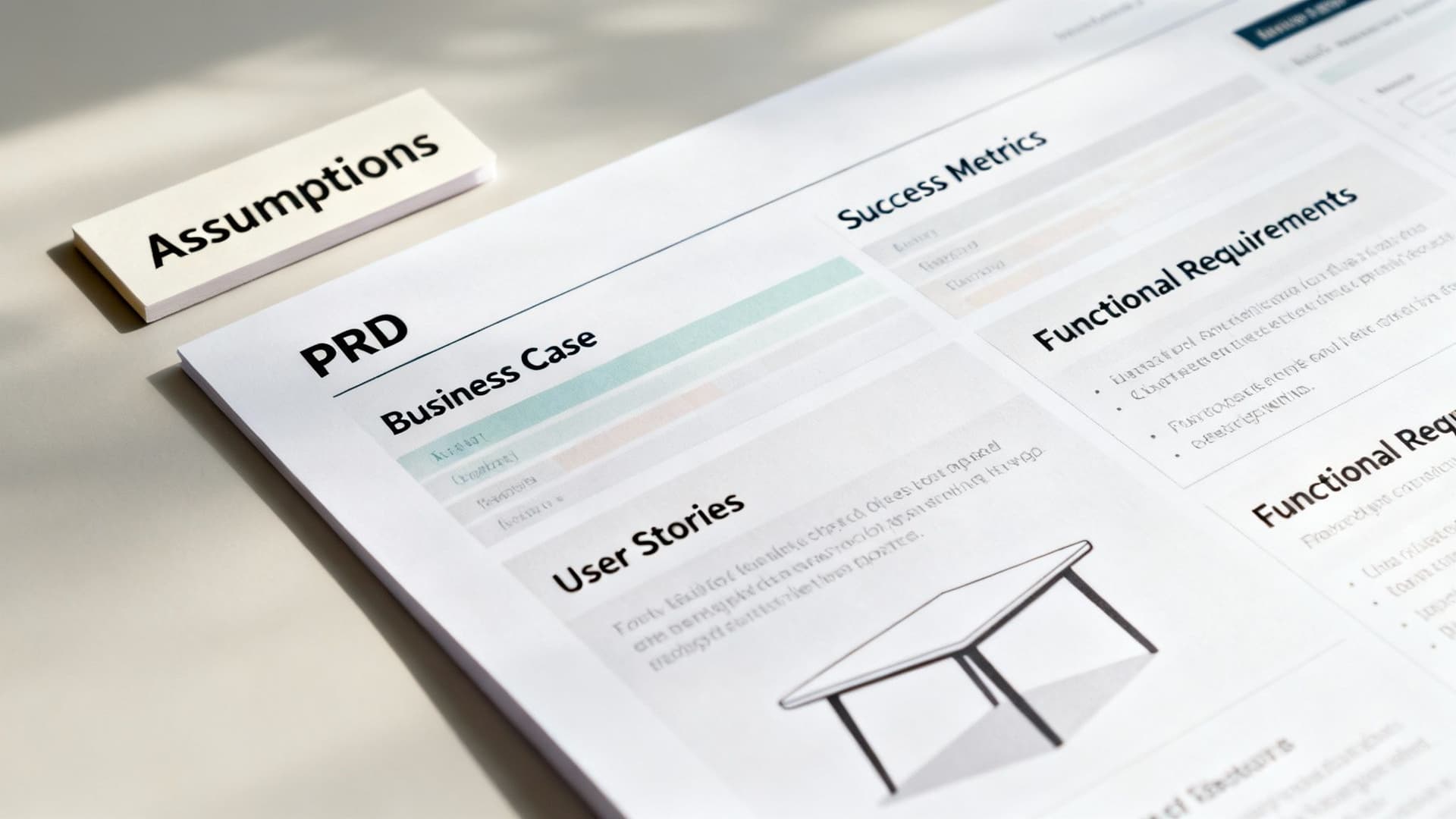
The template’s structure is designed to force critical conversations and get everyone aligned before development starts. Without that framework, you risk building something nobody actually wants.
Essential Components of a PRD Template
| Section Name | Purpose | Key Information to Include |
|---|---|---|
| High-Level Vision | Ground the project in a clear “why” | Problem statement, target user, connection to company goals |
| Success Metrics | Define what “done” and “successful” look like | Measurable KPIs (e.g., retention, conversion, MAU) |
| User Stories & Requirements | Translate goals into actionable work | User stories, functional specs, acceptance criteria |
| Assumptions & Scope | Set boundaries and manage expectations | Technical assumptions, dependencies, out-of-scope items |
Now let’s dive into what makes each section tick.
High-Level Vision and Business Case
Start with the question: why are we building this? This section links the product to company strategy, explains the customer problem, and outlines the business opportunity.
For example: increase user retention by 15% by introducing a team collaboration feature. That clarity helps secure leadership buy-in and keeps the team motivated. It also lays the groundwork for measurable success and financial projections.
A strong business case doesn’t just justify the project; it becomes the north star for every decision. If a proposed feature doesn’t directly support the core purpose, it’s probably scope creep.
Defining Success and Measuring Impact
Once you’ve established the why, define how you’ll know you’ve succeeded. Vague goals like “improve the user experience” aren’t helpful. Use hard numbers—Key Performance Indicators (KPIs) that leave no room for ambiguity.
- Business metrics: MAU, CLV, conversion rates.
- User engagement metrics: daily use of a new feature, average session length, task completion rates.
- Quality metrics: app ratings, bug report volume, uptime.
Tracking these metrics is how you prove the project’s value long after launch.
User Stories and Functional Requirements
Translate high-level goals into the specific functionality engineering will build. User stories work well because they frame requirements from the customer’s perspective.
Classic format: “As a [user], I want to [action] so that I can [goal].”
Example: “As a project manager, I want to assign tasks to multiple team members at once so that I can save time setting up new projects.”
After each user story, list functional requirements and acceptance criteria. That removes confusion and ensures developers know exactly what to build.
Assumptions and Out-of-Scope Items
A great PRD is as clear about what it isn’t as what it is. Document assumptions—technical limitations, dependencies, or market conditions—so you can reassess if they change.
Equally important is an explicit out-of-scope section. Listing what you agreed not to build is a powerful defense against scope creep and helps manage stakeholder expectations.
Making Your PRD a Living Document
If your PRD is a static file gathering dust, you’re missing its potential. In agile environments, the best PRDs are living, collaborative blueprints. Teams that adopt collaborative PRD practices report faster iterations and less rework.2
Keeping the document current makes it the central hub for decisions, discussions, and updates. When the PRD is always up to date, everyone—from engineering to marketing—works from the same playbook.
Fostering a Collaborative Culture
Turning your PRD into a living document is a cultural shift. The product manager owns the document, but it becomes a team asset. Everyone should feel empowered to add comments, ask questions, and suggest changes directly in the document.
This practice builds shared ownership and keeps communication flowing. Conversation happens alongside context rather than in long email chains. Keep updates aligned with operational standards so the document remains consistent and auditable.
“A living PRD is a single source of truth that reflects reality, not a snapshot from three months ago.”
Tools and Workflows for Real-Time Updates
Use collaborative platforms like Confluence, Notion, or Google Docs for real-time editing. Keep a simple workflow:
- Keep a change log: summarize what changed, when, and by whom.
- Create an “Open Issues” section: list unresolved questions or decisions.
- Integrate with your PM tool: link user stories to their tickets in Jira or Asana.
When your PRD defines success metrics, you can estimate financial impact using tools such as the Business Valuation Estimator and the Digital Business Valuation Tool. For marketing planning, consider the Facebook Ads Cost Estimator to align launch spend with product goals.
Writing Requirements Your Engineers Will Actually Understand
Writing clear, concise, and testable requirements is a core product skill. Get it wrong and you’ll face confusion, rework, and features that miss the point. Get it right and the team builds with confidence and speed.
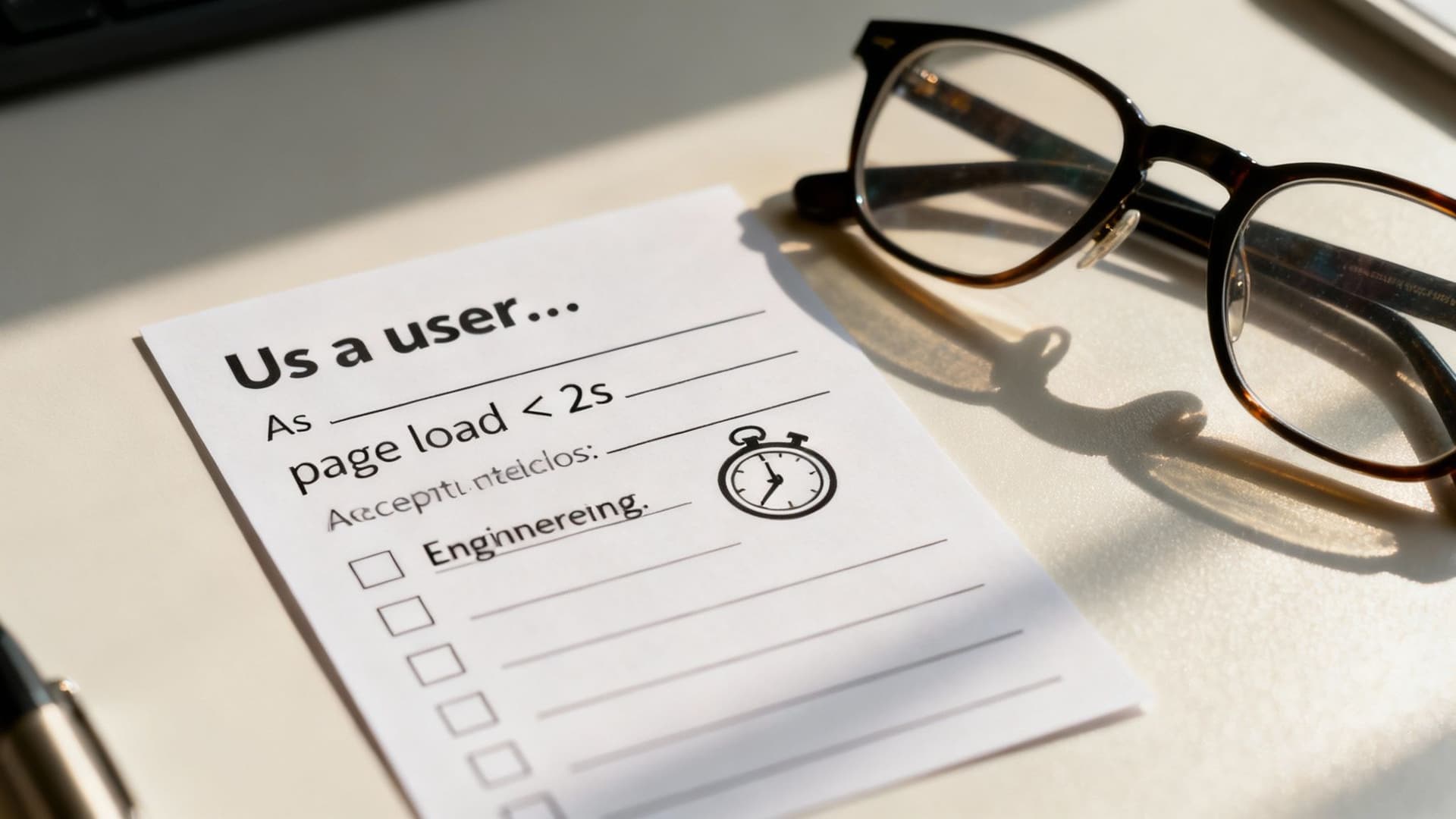
Start with user stories and pair each with sharp acceptance criteria that leave no room for interpretation.
Differentiating Functional and Non-Functional Needs
Distinguish functional requirements (what the system does) from non-functional requirements (how the system behaves). Functional requirements define specific behavior, such as “When a user clicks Export, the system generates a CSV file.” Non-functional requirements cover performance, security, and scalability.
Avoid vague statements like “the feature should be fast.” Instead, be specific: “Page load time under 2 seconds for 95% of users.” That clarity directly affects architecture and cost.
The Power of Measurable Goals
Clear, measurable requirements lead to better outcomes. Specify goals like “system capable of supporting 10,000 concurrent users” so engineering can design and test appropriately. Teams that document both functional and non-functional needs see measurable improvements in delivery and quality.3
Making Requirements Testable
A requirement isn’t complete until it’s testable. If you can’t test it, you can’t verify it. Practical tips for testable requirements:
- Use active voice: “The system shall...” rather than “The system should...”
- Avoid jargon: write for QA, design, and marketing as well as engineering.
- One requirement per statement: keep each requirement atomic and distinct.
This discipline empowers engineering and QA with a crystal-clear understanding of success.
Get Your Free PRD Template
I’ve put together a free product requirements document template refined across dozens of projects. It’s a battle-tested starting point filled with prompts and real-world examples for every section we covered.
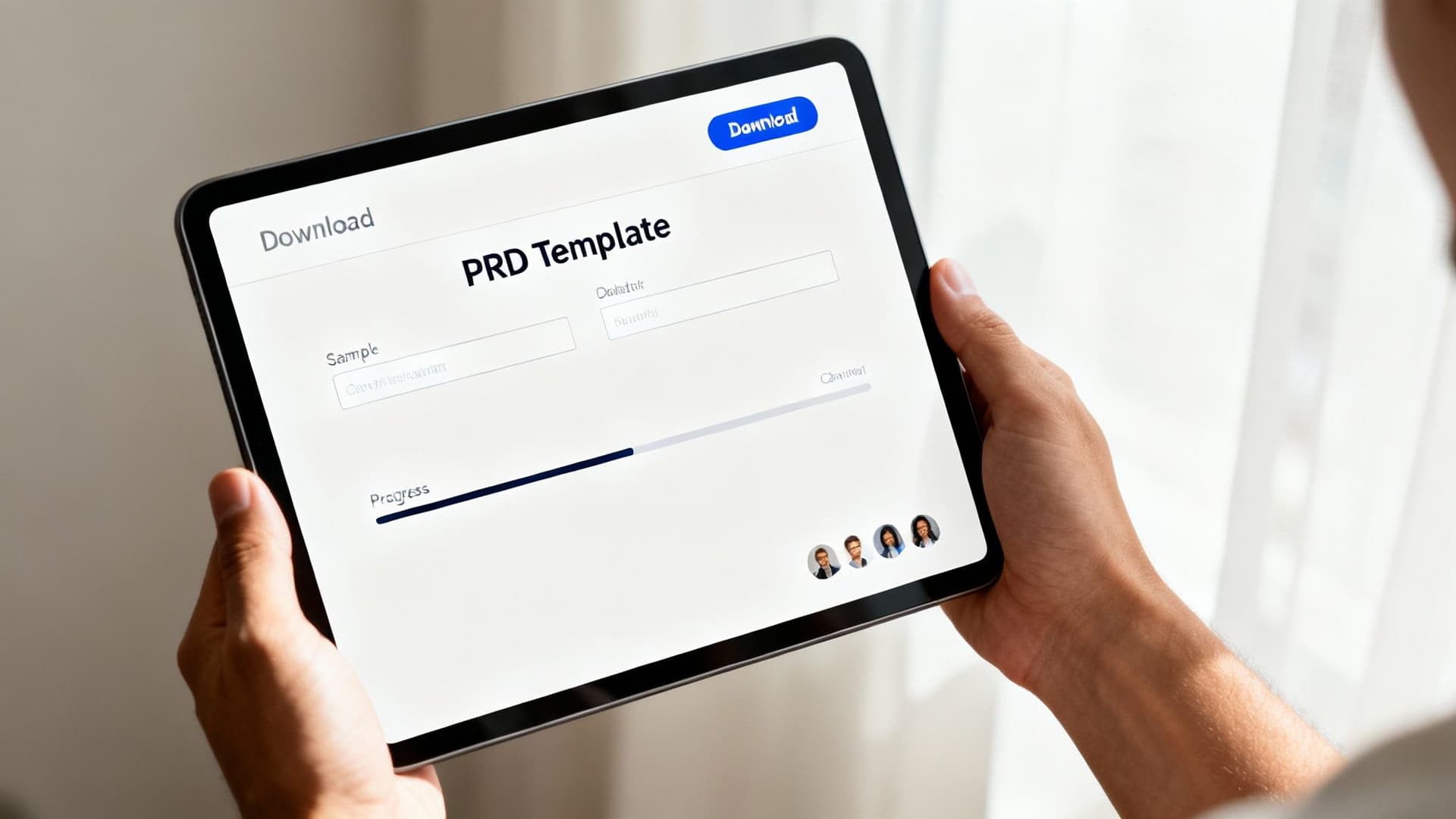
How to Customize Your PRD Template
Make the template your own. It’s a flexible framework, not a rigid set of rules.
- Cut the fluff. Remove irrelevant sections when they don’t apply.
- Add what’s missing. Include compliance, platform-specific notes, or direct links to your design system.
- Rewrite the prompts. Tailor placeholder text to questions that get your team thinking.
A well-defined PRD is your first step toward a solid go-to-market plan. Once you know what you’re building, you can estimate launch costs with tools like the Facebook Ads Cost Estimator.
“The best template is a living document. Start with this one, then iterate after each project so it becomes a true asset.”
Rolling Out the Template to Your Team
Don’t just email the template and expect adoption. Run a quick kickoff: walk teams through the template section by section and explain the why behind each part.
Show engineers how clear user stories and acceptance criteria reduce ambiguity. Show business teams how feature-level impact ties back to company value using the Business Valuation Estimator.
A sharp PRD gives you a clearer financial picture. When you lock in the feature set, you can project revenue and connect product scope to company impact.
Common PRD Questions Answered
How Is a PRD Different from an MRD or a Tech Spec?
Think of it as a relay race. The Market Requirements Document (MRD) describes the market opportunity. The PRD translates that into a product plan—features, UX, and success criteria. The technical spec is the engineering handoff that details the how.
Can I Use a PRD Template in an Agile Workflow?
Yes. Modern PRDs are living guides that set the North Star. Agile teams pull user stories into sprints that trace back to the PRD so every iteration advances the same vision.2
Who Actually Owns the PRD?
The product manager usually owns the PRD, but the best documents are a team effort. The PM holds the pen, but the PRD must represent a shared understanding across product, engineering, design, and business teams.
How Detailed Should My PRD Be?
Find the balance: give enough detail to guide design and engineering, but not so much that you stifle creativity or create a document that’s impossible to maintain. Focus on the “what” and the “why,” and leave the “how” to the experts.
Quick Q&A — Common User Questions
Q1: What’s the single most important section of a PRD?
A1: The high-level vision and success metrics. If those aren’t clear, the rest won’t align.
Q2: How do I prevent scope creep?
A2: Define assumptions and out-of-scope items explicitly, and use measurable success criteria to defend what belongs in the release.
Q3: How often should the PRD be updated?
A3: Update it whenever major decisions or trade-offs are made—treat it as the living source of truth throughout the project lifecycle.
Bottom-Line Q&A — Fast Answers
What should I write first in a PRD?
Start with the problem statement and success metrics. They clarify purpose and make prioritization straightforward.
How do I make a PRD actionable for engineers?
Use user stories plus specific acceptance criteria and clear non-functional requirements so engineers can design and estimate work.
How do I convince stakeholders to use the PRD?
Show how the PRD reduces rework and links features to measurable business outcomes; present a simple change log and a short kickoff to demonstrate value.
1.
Project Management Institute, “Pulse of the Profession” and related PMI research on causes of project failure. https://www.pmi.org/
2.
monday.com blog, “PRD template & product requirement document” discussing PRD evolution and collaboration benefits. https://monday.com/blog/rnd/prd-template-product-requirement-document/
3.
State of DevOps / DORA research on engineering delivery and quality improvements when teams adopt clear processes and measurable goals. https://cloud.google.com/blog/topics/devops-sre/accelerate-state-of-devops-report
Ready to Build Your Own Tools for Free?
Join hundreds of businesses already using custom estimation tools to increase profits and win more clients
✨ No coding required • 🚀 Ready in minutes • 💸 Free to create