Дотримуйтесь цього практичного посібника, щоб створити модель ціноутворення, яка підвищує прибутковість і масштабує бізнес. Ми пройдемо від збору даних до валідації через A/B‑тести та автоматизацію, щоб зробити ціноутворення стратегічним активом.
December 21, 2025 (9mo ago) — last updated September 20, 2026 (22d ago)
Модель ціноутворення для зростання прибутку
Покроковий посібник: збір даних, вибір стратегії, тестування й автоматизація для підвищення доходів.
← Back to blog
Як побудувати модель ціноутворення, яка підвищує прибутковість
Summary: Дізнайтеся, як побудувати модель ціноутворення: збір даних, вибір стратегії, тестування й автоматизація для реального зростання доходів.
Introduction
Дотримуйтесь цього практичного посібника, щоб створити модель ціноутворення, яка підвищує прибутковість і масштабує бізнес. Ми пройдемо від збору даних до валідації через A/B‑тести та автоматизацію, щоб зробити ціноутворення стратегічним активом.
A pricing model is more than a price tag; it’s the engine that connects the value you provide to the revenue you generate. Think of it as a repeatable, data‑driven system for figuring out how much to charge. When you get it right, pricing stops being a gut‑feel decision and becomes one of your most powerful strategic assets.1
A practical blueprint for your pricing model
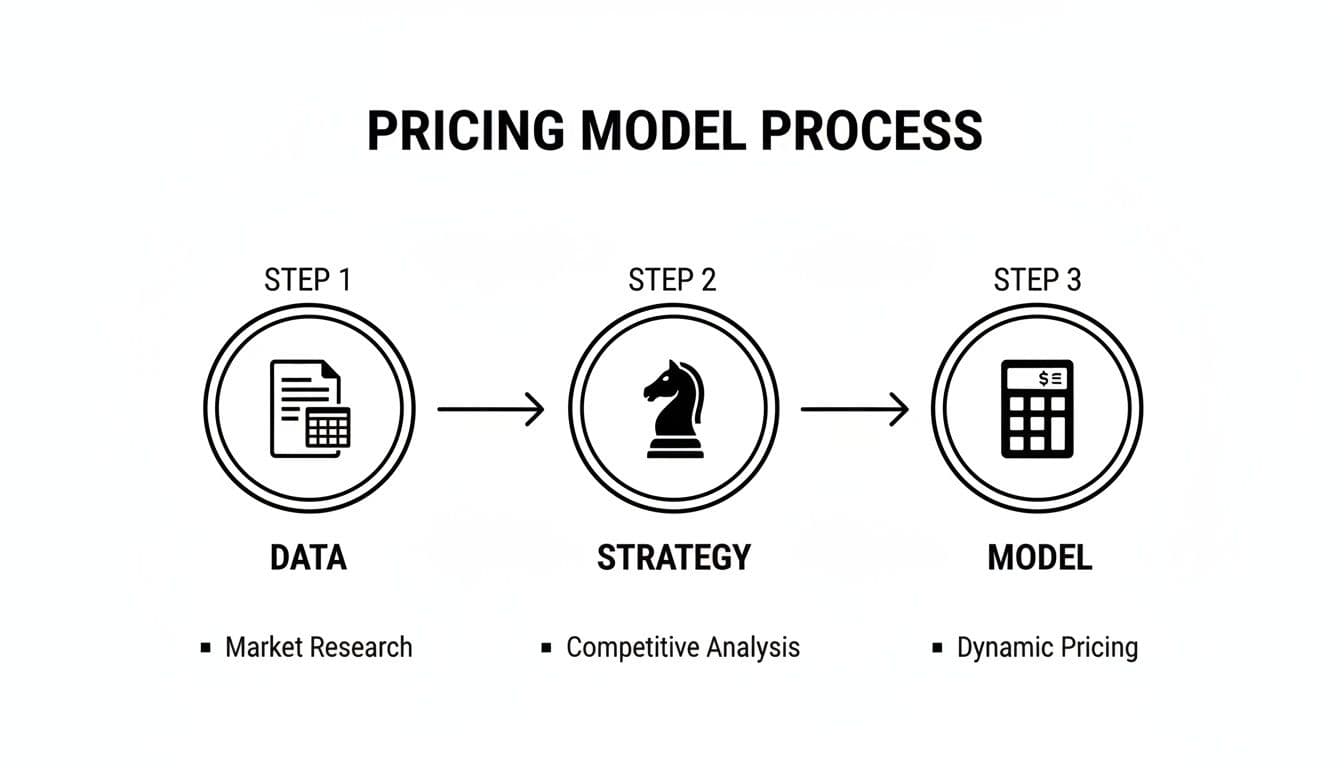
Building a pricing model from scratch can feel daunting. It’s not about pulling a number out of thin air. It’s about creating a structure that drives growth and protects margins. The process moves from foundational research to hands‑on implementation:
- Gather your inputs: internal costs, competitive context, and customer value.
- Define your strategy: cost‑plus, competitor‑based, value‑based, tiered, or hybrid.
- Build the mechanics: translate inputs and strategy into a working financial model and test scenarios.
This flow is simple but powerful—your data informs strategy, and strategy dictates the model.
Core components of a pricing model
| Component | Description | Example |
|---|---|---|
| Cost inputs | All direct and indirect expenses required to deliver your product or service. | Software subscriptions, employee salaries, office rent, marketing spend. |
| Value metrics | The unit of value your customer receives and is willing to pay for. | Per user, per GB of storage, per project, per hour of service. |
| Pricing structure | The framework you use to charge for your value metrics. | Flat‑rate subscription, tiered plans, usage‑based billing. |
| Calculations | Formulas that combine costs, value metrics, and structure to produce a final price. | (Cost of Goods Sold / (1 - Gross Margin %)) = Price |
| Scenario analysis | Ability to model different assumptions to see impacts on revenue and profit. | “What happens to LTV if price increases 10% and churn rises 2%?” |
| Final outputs | Actionable pricing presented to customers and business metrics. | Public pricing page, quote generator, projected ARR. |
Turning theory into a revenue‑generating tool
Focus on practical moves that change outcomes. For example, a marketing agency can embed an interactive estimator on its site to show ROI and capture high‑quality leads. Useful tools you can embed include the Facebook Ads Cost Estimator, the Email List Value Estimator, the Consulting Rates Estimator, and the Business Valuation Estimator. Interactive tools empower customers and free your sales team to focus on complex deals.
Gathering your essential pricing data
Before building a model, gather reliable data. Setting prices without it is like building a house on sand.
Start with your internal costs
Calculate fully burdened costs—everything it takes to deliver your product or service:
- Variable costs: materials, shipping, usage fees.
- Fixed costs: rent, insurance, software licenses.
- Labor costs: salaries plus benefits and taxes; use a fully burdened labor rate for service businesses.
- Customer Acquisition Cost (CAC): total sales and marketing spend divided by new customers.
If CAC is $500, your pricing and payback period must reflect that or you’ll lose money despite strong sales.
Analyze the competitive landscape
Customers compare you to alternatives. Use competitor pricing as context—not as the sole decision maker. Ask:
- What are direct competitors charging?
- How do they structure prices?
- Where do you fit: premium, budget, or best value?
Historical and seasonal data help you plan launch pricing and planned declines.
Quantify customer value
Customers buy outcomes, not features. Translate features into tangible benefits—time saved, costs avoided, revenue gained. If you can quantify that benefit, you can often capture more value through pricing. For B2B software that reduces labor costs by $10,000 a year, charging $2,000 becomes a compelling proposition.2
Tools such as the Consulting Rates Estimator help build data‑backed fees for service providers.
Choosing the right pricing strategy
Your choice depends on industry, product, and customer. The main families are:
Cost‑plus and competitor‑based pricing
Cost‑plus ensures you cover costs by adding a markup. It’s simple but inward‑facing and can leave money on the table. Competitor‑based pricing uses market rates; useful in commoditized markets but risks a race to the bottom.
Value‑based and modern service models
Value‑based pricing anchors price to customer outcomes and ROI. This is ideal for solutions with measurable impact. Modern approaches include:
- Tiered pricing: Basic, Pro, Enterprise.
- Usage‑based pricing: pay per GB, per API call, per transaction.
Choose a strategy that balances costs, competition, and customer value.
Building and testing your financial model
Start in a spreadsheet. Create clear inputs for costs, value metrics, and competitor data, then build formulas that represent your chosen strategy.
Stress‑test assumptions
Run sensitivity analysis to find weak spots:
- What if a material cost jumps 15%?
- How does a 5% drop in conversion affect CAC and profit?
- What is the break‑even change if fixed costs rise by $2,000/month?
A resilient model survives realistic shocks.
Prototype to real‑world validation
A model is a hypothesis until customers validate it. Use A/B testing to compare prices and measure conversions and revenue. Combine quantitative tests with qualitative feedback: “At what price would this feel like a bargain?” or “At what price would you stop considering this?”

Turn internal logic into an interactive estimator to speed quoting and capture leads. Tools like the Facebook Ads Cost Estimator, Business Valuation Estimator, and Consulting Rates Estimator can be embedded for transparency and lead generation.
“By transforming your internal model into an interactive web tool, you shift from simply presenting a price to demonstrating value.”
Implementing and automating your pricing
A model in a spreadsheet is only useful if it’s implemented consistently. For B2B, that often means a Configure‑Price‑Quote (CPQ) system; for e‑commerce, it means encoding rules in your platform’s pricing engine. Automation reduces errors and speeds transactions.
From manual quoting to self‑service
The “Contact us for pricing” barrier costs conversions. Self‑service tools give instant answers, reduce friction, and free sales teams. For example, a freelance web developer can embed the Consulting Rates Estimator to provide instant ballpark quotes and filter out non‑serious inquiries.
Strategic benefits of automation
Automated pricing boosts lead quality, shortens sales cycles, and can help SEO by increasing time on page and attracting backlinks—positive signals for search engines.3
Fine‑tuning: from launch to mastery
Pricing is never finished. Build a feedback loop: measure, analyze, tune. Track key KPIs:
- ARPU (Average Revenue Per User)
- LTV (Customer Lifetime Value)
- CAC (Customer Acquisition Cost)
Aim for an LTV:CAC ratio of about 3:1 for sustainable growth. Use historical data to refine tiers, seasonal pricing, and feature packaging.
Tough pricing questions
How often should I revisit pricing?
Do a deep review at least annually, and monitor core KPIs monthly or quarterly. Revisit immediately if costs change materially, a competitor shifts pricing, you launch a major feature, or customer behavior changes.
What’s the biggest pricing mistake?
Focusing only on internal costs or competitor prices while ignoring customer value. Anchor pricing to the outcomes you deliver.
Can I combine models?
Yes. Hybrid models—tiered subscriptions with usage add‑ons or fixed packages with custom quotes—are common. Keep pricing clear so customers understand what they pay for.
Three concise Q&A summaries
Q1: What should I measure first when building a pricing model?
A1: Start with fully burdened costs and Customer Acquisition Cost (CAC). Without accurate costs, you can’t price for profit.
Q2: When does value‑based pricing make sense?
A2: When you can quantify customer benefits—time saved, cost reductions, or revenue gains—value‑based pricing often captures more profit than cost‑plus.
Q3: How do I validate a new price quickly?
A3: Run an A/B test or a small pilot, track conversion and revenue, and collect direct customer feedback.
Ready to turn your pricing model into an interactive asset? Use these embedded tools to quantify outcomes and create interactive experiences: Business Valuation Estimator, Consulting Rates Estimator, Facebook Ads Cost Estimator.
1.
McKinsey & Company, “The power of pricing,” McKinsey & Company. https://www.mckinsey.com/business-functions/marketing-and-sales/our-insights/the-power-of-pricing
2.
Harvard Business Review, “How to Price with Confidence,” Harvard Business Review. https://hbr.org/2019/10/how-to-price-with-confidence
3.
Moz / HubSpot research on engagement and SEO: longer time on page and interactive tools correlate with improved search performance; see https://moz.com and https://hubspot.com for related resources.
Готові створити свої власні інструменти безкоштовно?
Приєднуйтеся до сотень підприємств, які вже використовують користувальницькі інструменти оцінки для збільшення прибутків та залучення більшої кількості клієнтів
✨ Програмування не потрібне • 🚀 Готово за хвилини • 💸 Безкоштовно створити