이 가이드는 가격 모델을 전략적 자산으로 전환하는 실무 단계별 방법을 제공합니다. 데이터 수집, 경쟁 분석, 가치 측정, 모델 구축 및 자동화까지 연결해 실제 수익 증대로 이어지는 프로세스를 설명합니다.
December 21, 2025 (9mo ago) — last updated June 23, 2026 (3mo ago)
수익성 높은 가격 모델 구축 가이드
데이터 기반 수집·전략·도구·자동화로 수익성 높은 가격 모델을 구축하고 검증하는 실무 가이드입니다.
← Back to blog
수익성 높은 가격 모델 구축 가이드
Summary: 데이터 기반 수집, 전략 선택, 도구 활용 및 자동화로 실제 수익 성장을 실현하는 실무 가이드입니다.
Introduction: 이 가이드는 가격 모델을 전략적 자산으로 전환하는 방법을 설명합니다. 데이터 수집, 경쟁 분석, 가치 측정, 모델 구축과 검증, 그리고 자동화까지 한 흐름으로 정리해 실제 수익 증대로 연결하는 단계별 방법을 제공합니다.
A pricing model is more than a price tag; it’s the engine that connects the value you provide to the revenue you generate1. Think of it as a repeatable, data-driven system for figuring out how much to charge. When you get it right, pricing stops being a gut-feel decision and becomes one of your most powerful strategic assets.
A practical blueprint for your pricing model
Building a pricing model from scratch can feel daunting, but it needn’t be mysterious. The best models create a clear, logical link between the price a customer pays and the value they receive. The process moves through a few core stages, from foundational research to hands-on implementation:
- Gather inputs: map your fully burdened costs and understand customer value.
- Define strategy: choose a structure that fits your product, market position, and customers.
- Build mechanics: implement formulas, run scenario analysis, and prototype pricing options.
This flow is simple and powerful: your Data informs your Strategy, and your Strategy dictates your Model.
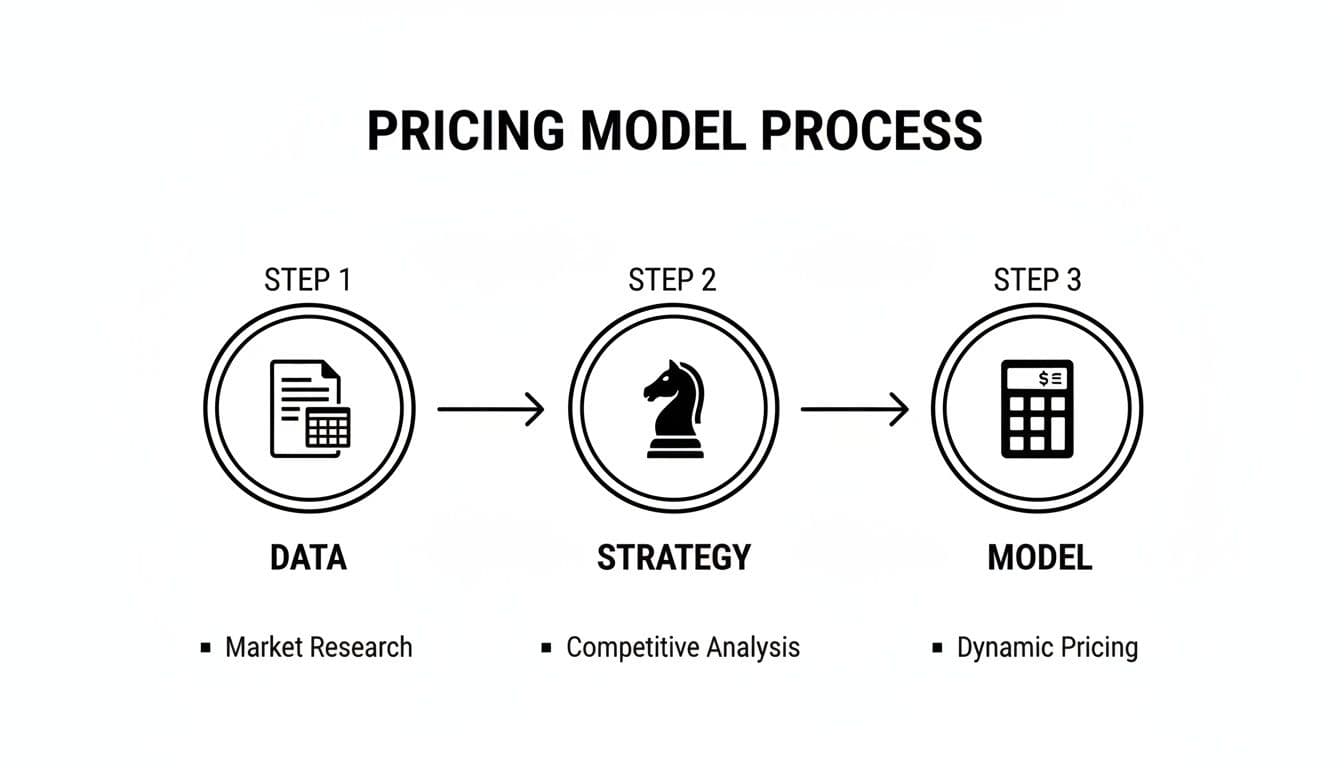
Following these stages ensures your model is built on solid ground, not just a hunch.
From core components to a working model
Every effective pricing model relies on a few key inputs and outputs. Understand these pieces before you build:
| Component | Description | Example |
|---|---|---|
| Cost inputs | All direct and indirect expenses to deliver your product or service. | Software subscriptions, salaries, rent, marketing spend. |
| Value metrics | The unit of value customers receive and will pay for. | Per user, per GB, per project, per hour. |
| Pricing structure | The framework you use to charge for value. | Flat-rate subscription, tiered plans, usage-based billing. |
| Calculations | Formulas that combine costs and value metrics to produce prices. | (COGS / (1 - Gross Margin %)) = Price |
| Scenario analysis | Model different assumptions to see impact on revenue and profit. | “What if churn increases 2% after a 10% price rise?” |
| Final outputs | Customer-facing prices and business metrics. | Public pricing page, quote generator, ARR projection. |
With these components defined, you have the raw materials to construct a model that’s both strategic and functional.
Turning theory into a revenue-generating tool
This guide focuses on what actually works. For example, a marketing agency can embed an interactive ROI calculator on its site to give prospects an immediate “aha” moment and capture qualified leads. Complementary tools that help quantify campaign impact include Facebook Ads Cost Estimator and Email List Value Estimator. Interactive tools empower customers with self-service options, build trust, and free your sales team for high-value deals3.
Gathering your essential pricing data
Before building a model, gather reliable data. Skipping this is like building a house on sand.
Start with your internal costs
Know what it truly costs to deliver your product or service. Calculate fully burdened costs, including:
- Variable costs: materials, shipping.
- Fixed costs: rent, insurance, software licenses.
- Labor costs: wages, benefits, taxes, true billable rates.
- Customer acquisition cost (CAC): the average spend to acquire one customer.
If CAC is $500, your pricing must reflect that cost or your unit economics break down.
Analyze the competitive landscape
Understand how competitors price and structure offers. Key questions:
- What are direct competitors charging?
- How do they structure pricing (tiers, usage, flat)?
- Where do you fit: premium, budget, or best value?
Use competitor pricing as context, not a rule. Historical market data helps you plan seasonal or staged pricing moves.
Quantify your customer value
Customers buy outcomes, not features. If you can quantify the financial benefit your product delivers, you unlock premium pricing. Translate features into tangible benefits—time saved, cost avoided, revenue generated. Tools such as the Consulting Rates Estimator and Business Valuation Estimator help frame that value for service businesses and long-term client assessments.
Choosing the right pricing strategy
With cost, market, and value data in hand, decide on the architecture for your pricing model. The right choice depends on your industry, product, and target customers.
Cost-plus and competitor-based pricing
Cost-plus pricing adds a markup to ensure costs are covered. It’s simple and common in manufacturing, but it ignores customer willingness to pay. Competitor-based pricing sets rates relative to peers; useful in commoditized markets but risky if it triggers a race to the bottom.
Neither approach alone tells you what customers will actually pay for the value you provide.
Value-based and modern service models
Value-based pricing starts with the customer and anchors price to measurable outcomes. If your software saves a client $10,000 a year, charging $2,000 can be a strong position. This aligns with tiered plans, usage-based billing, and other modern structures that capture value more precisely2.
Choose a hybrid when needed: tiered subscriptions with usage add-ons, or fixed packages plus custom quotes for complex work. Clarity for the customer is essential.
Building and testing your financial model
Most teams start in a spreadsheet to prototype the model. Create inputs for fixed and variable costs, value metrics, competitor prices, and the formulas that produce final prices.
Stress-testing your assumptions
Run sensitivity analysis to find weak spots. Ask “what if” questions and build scenarios into your model, for example:
- What if a key material cost increases 15%?
- What if conversion rates fall 5%?
- What is the new break-even point after adding $2,000/month in fixed costs?
A model that survives realistic shocks is one you can trust.
From prototype to real-world validation
A pricing model is a hypothesis until customers respond. Use A/B testing to validate: show different prices to separate groups and measure conversions and revenue. Combine quantitative results with qualitative feedback through surveys and interviews to understand perceived value.

This blend of hard data and customer stories turns an educated guess into a pricing structure you can confidently use.
Turning your model into a customer-facing asset
Spreadsheets are great internally but become a bottleneck for sales quoting. Embedding an interactive calculator on your website turns internal logic into a dynamic tool that helps prospects and generates leads. Examples of useful tools include Facebook Ads Cost Estimator, Business Valuation Estimator, and Consulting Rates Estimator.
By demonstrating value rather than only presenting a price, you improve the customer experience and create a proactive growth asset3.
Implementing and automating your pricing
Implementation is where your model scales. Move from manual quotes to systems: Configure-Price-Quote (CPQ) for B2B and platform pricing engines for e-commerce. Automate rules so pricing applies consistently across transactions.
From manual quoting to self-service empowerment
The “Contact us for pricing” barrier frustrates modern buyers. Self-service calculators reduce friction, save sales hours, and weed out low-quality leads. A freelance developer could embed the Consulting Rates Estimator to provide instant estimates and reduce back-and-forth.
Strategic benefits of automated pricing tools
Automation delivers more than efficiency:
- Improved lead quality, since calculator users are actively evaluating solutions.
- Shorter sales cycles by answering “What will this cost me?” instantly.
- SEO and traffic gains from interactive tools that increase time on page and attract backlinks3.
- Differentiation through transparency and self-service.
Fine-tuning your pricing model: from launch to mastery
Launching pricing is the start, not the finish. Pricing must adapt to market shifts, customer feedback, and business goals. Build a continuous feedback loop: measure, analyze, and tune.
Track the right KPIs:
- Average Revenue Per User (ARPU)
- Customer Lifetime Value (LTV)
- Customer Acquisition Cost (CAC)
Aim for an LTV:CAC ratio of roughly 3:1 or higher to support sustainable growth. Review KPIs regularly and use pricing analytics to identify your most profitable segments and features.
The power of historical data
Historical trends help you set tiers, plan seasonal pricing, and decide when to introduce discounts. The loop—measure, analyze, tune—separates businesses that merely survive from those that scale.
Answering your toughest pricing questions
Even the best models face real-world challenges. Here are practical answers to common issues.
How often should I revisit my pricing?
Treat pricing as a living process. Do a deep review at least annually, and monitor core KPIs monthly or quarterly. Revisit pricing when costs shift materially, competitors change pricing, you launch a major feature, or customer behavior changes.
What’s the single biggest pricing mistake?
Tunnel vision: focusing only on internal costs or competitor rates while ignoring customer value. Anchor pricing to the value you deliver.
Can I combine different pricing models?
Yes. Hybrid models are common and effective. The key is clarity—customers must easily understand what they’re paying for.
Quick Q&A: Common pricing questions
Q: What’s the first thing I should do when building a pricing model?
A: Start with fully burdened costs and Customer Acquisition Cost (CAC). If you don’t know true costs, you can’t price for profit.
Q: How do I know if value-based pricing will work for my product?
A: If you can quantify customers’ financial benefit or time saved, value-based pricing often captures more profit than cost-plus.
Q: What’s the simplest way to validate a new price?
A: Run an A/B test or a limited pilot, measure conversion and revenue, and collect direct customer feedback.
Three concise Q&A summaries
Q: What are the essential inputs for a pricing model?
A: Fully burdened costs, CAC, competitor benchmarks, and quantified customer value.
Q: How should I test a new pricing idea?
A: Prototype in a spreadsheet, run sensitivity analysis, then validate with A/B tests and customer interviews.
Q: When should I automate pricing?
A: Automate when manual quoting slows sales, introduces errors, or prevents scaling—typically after you’ve validated the model.
Ready to turn your pricing model into a powerful, interactive asset? Helpful tools include Business Valuation Estimator, Consulting Rates Estimator, and Facebook Ads Cost Estimator.
1.
McKinsey & Company, “The power of pricing,” McKinsey & Company. https://www.mckinsey.com/business-functions/marketing-and-sales/our-insights/the-power-of-pricing
2.
Harvard Business Review, “How to Price with Confidence,” Harvard Business Review. https://hbr.org/2019/10/how-to-price-with-confidence
3.
Moz / HubSpot research on engagement and SEO: interactive tools and longer time on page correlate with improved search performance. See https://moz.com and https://hubspot.com for related resources.
무료로 나만의 도구를 만들 준비가 되셨나요?
이미 맞춤형 견적 도구를 사용하여 수익을 늘리고 더 많은 고객을 획득하고 있는 수백 개의 기업에 참여하세요
✨ 코딩 경험 불필요 • 🚀 몇 분 만에 준비 • 💸 무료로 생성