Think of a content marketing strategy as your master plan for attracting the right people, keeping them engaged, and converting them into customers. It’s not about volume; it’s about the right content for the right audience at the right time.
January 26, 2026 (9mo ago) — last updated February 8, 2026 (8mo ago)
Content Marketing Strategy: How It Works Today
Learn what a content marketing strategy is and how to build a plan that attracts customers, generates leads, and drives measurable growth.
← Back to blog
What Is a Content Marketing Strategy and How Does It Work Today?
Explore what is content marketing strategy and how to build a powerful plan that attracts customers, generates leads, and drives growth.
Introduction
Think of a content marketing strategy as your master plan for attracting the right people, keeping them engaged, and converting them into customers. It’s not about pushing out as much content as possible; it’s about creating the right content for the right audience at the right time to meet clear business goals.
So, what exactly is a content marketing strategy?
A content marketing strategy is the roadmap that connects your audience’s problems to your solutions. Every blog post, video, or interactive tool should have a defined purpose and move a visitor closer to a business goal—whether that’s lead generation, sales, or retention.
The Blueprint for Attracting Your Ideal Customer
Imagine your strategy as an architectural plan for a bridge. On one side are people searching for answers; on the other side is your business offering the solution. Each piece of content is a plank on that bridge, placed intentionally to guide users across.
Without a plan, you’re just creating noise. A strategy ensures every asset contributes to measurable outcomes like higher-quality leads or increased revenue.

Strategy vs. Tactic: What’s the Difference?
It’s easy to confuse strategy (the “why”) with tactics (the “how”). Strategy is the long-term vision and destination. Tactics are the specific actions that get you there.
| Aspect | Content Marketing Strategy (The “Why”) | Content Marketing Tactic (The “How”) |
|---|---|---|
| Focus | Defines long-term vision, business goals, and target audience. | Specific action or piece of content. |
| Scope | Broad and overarching; guides all content decisions. | Narrow and execution-focused. |
| Example | “Become the go-to resource for small business owners seeking financial clarity.” | “Create a Business Valuation Estimator to capture qualified leads.” |
| Timeline | Ongoing and adaptable, planned quarterly or annually. | Short-term and project-based, like a single campaign. |
Putting a clear strategy in place isn’t just nice to have; it produces measurable returns. The global content marketing market has expanded significantly in recent years1, and businesses that plan methodically see more scalable results.
The 5 Pillars of a Winning Content Strategy
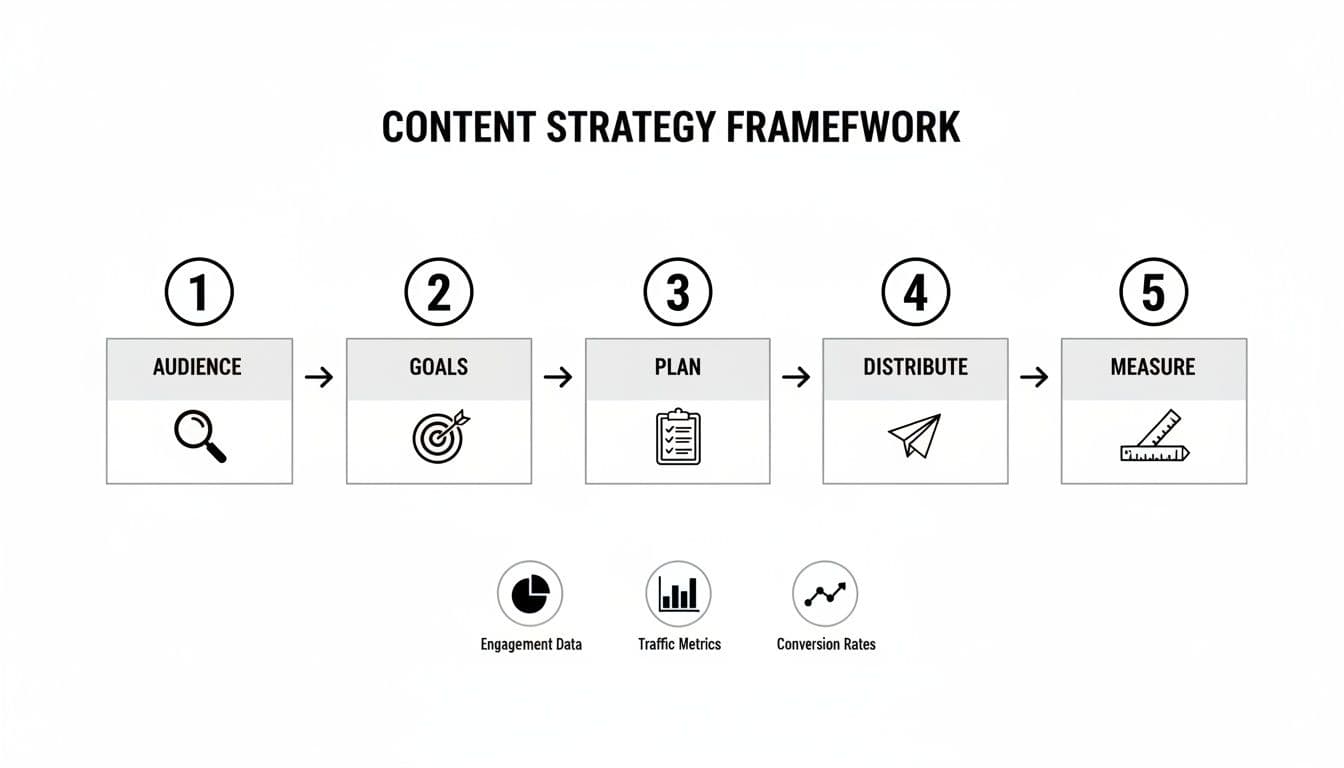
A powerful content strategy rests on five pillars. When these are aligned, your efforts are focused and more likely to drive business results.
1. Define Your Audience
Go deeper than demographics. Create detailed buyer personas that capture motivations, pain points, buying triggers, and the language your audience uses. For example, a B2B persona might be “Operations Olivia,” an overworked manager who needs data to justify software investments.
2. Set SMART Goals
Replace vague goals like “get more traffic” with SMART goals: Specific, Measurable, Achievable, Relevant, and Time-bound. Example: “Increase qualified leads from organic search by 15% in Q3 by targeting bottom-of-funnel keywords.” Track progress so content becomes a predictable growth engine.
3. Plan Your Content
Map audience problems to content formats and funnel stages. Brainstorm topics, pick formats (articles, videos, interactive tools), and organize everything in a content calendar so publishing is consistent and strategic. See our guide to creating a content calendar for a practical template: /blog/content-calendar.
4. Choose Distribution Channels
Great content needs distribution. Combine owned channels (blog, email, social), earned channels (guest posts, PR), and paid channels (search and social ads) to reach your audience where they already are.
5. Measure Performance
Track metrics that tie to your goals—organic traffic, engagement, conversions, and revenue. Measurement creates the feedback loop that lets you refine topics, formats, and promotion.
How to Build Your Strategy Step by Step
A practical, repeatable process ensures every asset has a job to do.
Step 1: Define Your Mission and Business Goals
Write a content mission that answers who you’re helping, what you give them, and how it makes their lives better. Tie that mission to specific business goals—qualified leads, retention, or revenue.
Step 2: Conduct Audience and Competitor Research
Study your audience’s questions and the competitors who already serve them. Identify gaps where you can provide a clearer, more useful answer.
Step 3: Perform a Content Audit
Inventory existing content and decide what to keep, update, consolidate, or remove. Look for high-performing pages to expand and gaps that need new assets.
Step 4: Create a Content Calendar
A calendar turns ideas into an executable plan. Schedule topics, formats, authors, and promotion channels so content is consistent and coordinated.
Step 5: Embed Value with Interactive Tools
Interactive tools — calculators, estimators, and quizzes — deliver immediate value and differentiate your content. For example, embedding a tool like the Business Valuation Estimator can turn a blog post into a lead-generation engine.
Using Interactive Content to Power Your SEO
Static posts inform; interactive tools involve users. When visitors use a calculator or estimator, they stay longer, engage more, and are likelier to convert. Search engines notice those engagement signals and may reward pages that keep users on-site.

Why Interactive Tools Are SEO Gold
Interactive content creates:
- Longer dwell time — users actively engage with the page.
- Lower bounce rates — users don’t leave immediately.
- More backlinks — useful tools attract links from other sites.
A logistics page that includes a Logistics Shipping Cost Predictor becomes a practical resource for visitors and an asset for search.
The Real-World Impact
Content marketing typically costs less than many traditional channels and produces sustained lead flow over time2. With AI-driven search emphasizing Experience, Expertise, Authoritativeness, and Trustworthiness, demonstrating EEAT is vital3. Embedded tools like the Digital Business Valuation Tool provide measurable value and evidence of expertise.
Measuring What Matters for Real Growth
A content strategy without measurement is guesswork. Focus on KPIs that map to business outcomes rather than vanity metrics.
From Clicks to Customers: A KPI Framework
Group KPIs into stages that trace the customer journey:
- Search impact: organic traffic, keyword rankings, backlinks.
- Audience engagement: time on page, social shares, comments.
- Lead generation: conversion rate, cost per lead, form submissions.
- Revenue impact: customer acquisition cost and return on investment.
Essential Content Marketing KPIs and What They Tell You
| KPI Category | Key Metrics | What It Measures |
|---|---|---|
| Search Impact & Visibility | Organic Traffic, Keyword Rankings, Backlinks | Ability to attract relevant searchers. |
| Audience Engagement | Time on Page, Bounce Rate, Social Shares, Comments | How well content holds attention. |
| Lead Generation | Conversion Rate, Cost Per Lead (CPL), Form Submissions | How effectively visitors become qualified leads. |
| Revenue & ROI | Customer Acquisition Cost (CAC), Return on Investment (ROI), Pipeline Value | The financial impact of content. |
Interactive tools make ROI easier to track. For example, embedding a YouTube Channel Value Estimator in a post about video strategy can capture contact information and measure how many leads originated from that resource.
Common Questions Answered (Concise Q&A)
How long until I see results?
Expect consistent effort to pay off in about 6–12 months for reliable organic growth and a steady flow of leads. You're building an asset—brand authority and trust take time.
How is content strategy different from content marketing?
Content strategy is the blueprint—the why and what. Content marketing is the execution—the how and where.
I have a small budget. Where should I focus?
Pick a narrow niche and solve one painful problem exceptionally well. Create one pillar asset and repurpose it, or build a single interactive tool that delivers measurable value.
Quick Q&A
Q: What is a content marketing strategy in one sentence?
A: A content marketing strategy defines who you’re helping, what you’ll create for them, and how that content will drive measurable business outcomes.
Q: Which metrics matter most?
A: Prioritize metrics tied to business goals—organic traffic and rankings for visibility, engagement for resonance, conversion rates for lead quality, and CAC/ROI for revenue impact.
Q: What’s the fastest way to increase engagement?
A: Add interactive tools or calculators that give users personalized results—these increase dwell time, lower bounce rates, and attract backlinks.
1.
Statista, “Content marketing market size and growth,” https://www.statista.com/
2.
Demand Metric, “Content marketing costs and lead generation” infographic, https://www.demandmetric.com/
3.
Google Search Central, guidance on Experience, Expertise, Authoritativeness, and Trustworthiness (EEAT), https://developers.google.com/search/docs/essentials/eeat
क्या आप अपना खुद का उपकरण मुफ्त में बनाने के लिए तैयार हैं?
सैकड़ों व्यापारों से जुड़ें जो पहले से ही मुनाफा बढ़ाने और अधिक ग्राहक जीतने के लिए कस्टम अनुमान उपकरणों का उपयोग कर रहे हैं
✨ कोडिंग की आवश्यकता नहीं • 🚀 मिनटों में तैयार • 💸 बनाना मुफ्त