If your team still processes invoices by hand, chases leads one‑by‑one, or onboards every hire manually, you’re leaving profit on the table. This article gives 10 practical automation examples across finance, HR, marketing, customer support, and supply chain—with clear flows, KPIs, and tools to start fast.
November 28, 2025 (4mo ago) — last updated March 10, 2026 (1mo ago)
10 Practical Business Process Automation Examples
HR, वित्त, और मार्केटिंग में 10 व्यावहारिक बिजनेस प्रोसेस ऑटोमेशन उदाहरण — लागत बचत, दक्षता और ROI मापने के तरीके।
← Back to blog
10 Practical Business Process Automation Examples
Discover 10 practical business process automation examples across HR, finance, marketing, customer support, and supply chain. Learn how to cut costs, speed up workflows, and measure ROI with clear steps you can implement today.
If your team still processes invoices by hand, chases leads one‑by‑one, or onboards every new hire manually, you’re not just wasting time—you’re leaving profit on the table. Business process automation (BPA) helps teams reduce operating cost, accelerate revenue, and deliver more consistent outcomes. The biggest question isn’t what automation is; it’s where to start and which processes deliver the fastest, clearest return.
This article gets straight to the point. Below are 10 practical business process automation examples you can roll out quickly across finance, HR, marketing, customer support, and supply chain. For every example you’ll get:
- The specific use case and common pain points
- A step‑by‑step automation flow
- Real benefits and KPIs to track
- Actionable tips and tools to get started
We’ll also show how simple, no‑code calculators and embed tools can strengthen your business case and capture value during sales and operations—for example, by quantifying cost savings in proposals with an interactive calculator.
1. Robotic Process Automation (RPA) in Finance
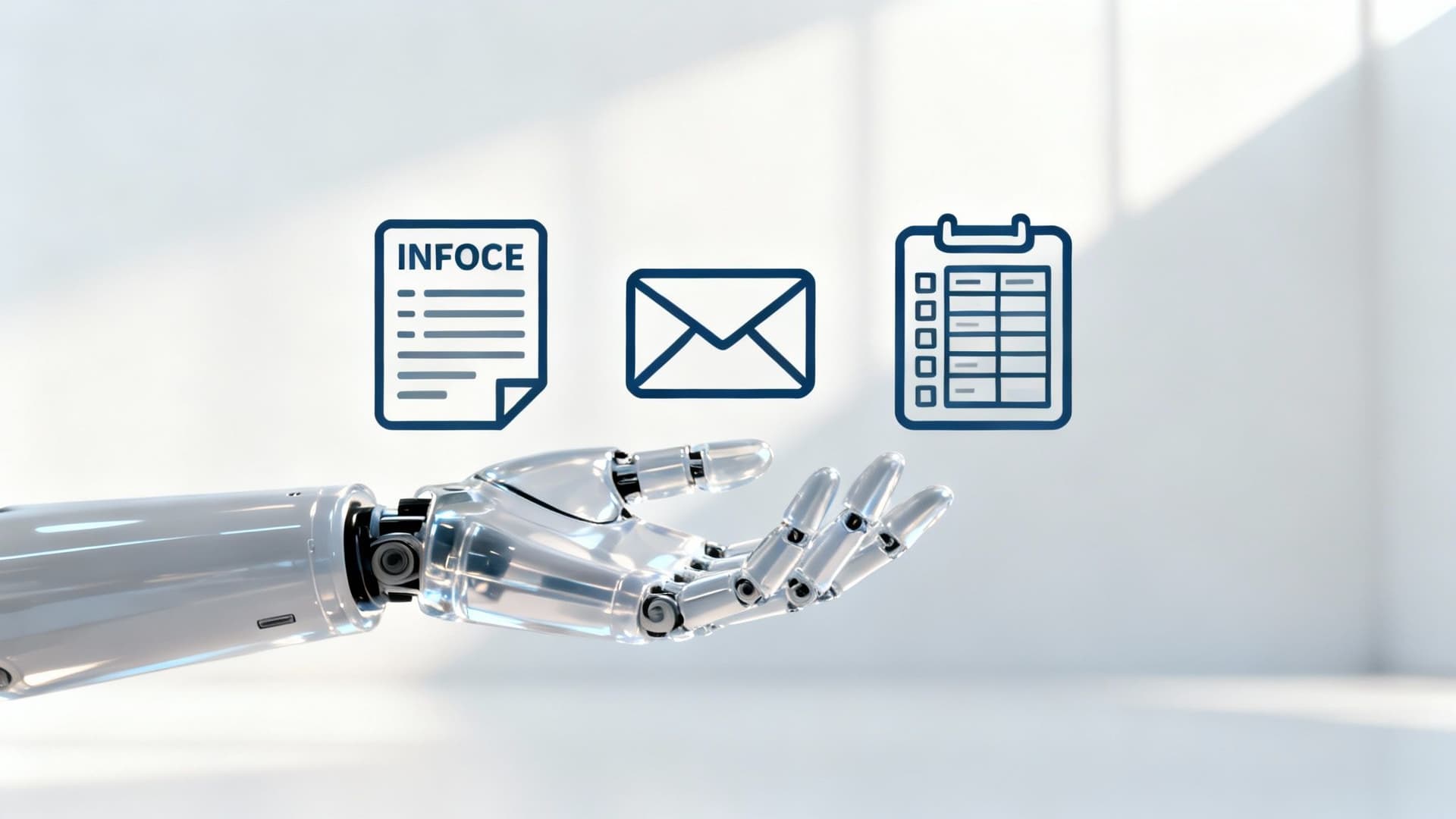
Imagine a digital employee that never sleeps, never makes a typo, and can process thousands of invoices overnight. RPA uses software bots to handle repetitive, rule‑based tasks like data entry, invoice processing, and report generation. It speeds up month‑end close and dramatically reduces human error in high‑volume finance work.1
Strategic breakdown
- Use case: Accounts payable (AP) invoice processing for a global manufacturer handling 10,000+ invoices a month.
- Automation flow:
- A bot monitors a dedicated inbox for incoming invoices.
- OCR extracts invoice number, date, amount, and PO number.
- The bot validates the data against the ERP purchase order.
- If it matches, the invoice is posted and scheduled for payment.
- Exceptions are flagged and routed to a human for review.
Measurable benefits & KPIs
- Processing time per invoice: from ~15 minutes to under 2 minutes
- Error rate: reductions up to 90% in many deployments2
- Cost per invoice: often drops by 50–70% depending on scale
Implementation & tooling
Common RPA platforms include UiPath, Automation Anywhere, and Blue Prism. Start with a high‑volume, well‑documented process like AP to demonstrate rapid ROI. Use a valuation calculator to quantify expected savings—try the Business Valuation Estimator to build a financial case.
Notes: RPA is non‑invasive and can be deployed quickly, but plan for bot maintenance and exception handling.
2. Workflow Automation (Cross‑Functional Processes)
Workflow automation coordinates tasks, documents, and approvals across people and systems so multi‑step processes run reliably and transparently. It eliminates manual handoffs and reduces bottlenecks in approvals, onboarding, and contract routing.

Strategic breakdown
- Use case: New employee onboarding at a fast‑growing tech company with inconsistent provisioning.
- Automation flow:
- When HR marks a candidate as “Hired,” a workflow starts.
- Tasks are issued to IT (accounts, device), Facilities (desk), and the hiring manager (orientation).
- Notifications include instructions and deadlines.
- A central dashboard tracks completion and status.
- Hiring manager receives a final confirmation before day one.
Measurable benefits & KPIs
- Onboarding cycle: from one week to two days
- Task completion rate: near 100% on‑time completion
- New‑hire satisfaction: large improvements in first‑day experience
Implementation & tooling
Map your current process before automating. Start with tools like Microsoft Power Automate, Zapier, or Workato for cross‑system workflows. Quantify the opportunity with a valuation or time‑savings approach using the Business Valuation Estimator.
3. Intelligent Document Processing (IDP)
IDP combines OCR with AI, machine learning, and natural language processing to not only read documents but understand them. IDP is essential when you need structured data out of unstructured documents—contracts, invoices, applications—so downstream systems can act automatically.3
Strategic breakdown
- Use case: Customer onboarding at a regional bank, verifying IDs and proof of address.
- Automation flow:
- Customer uploads documents through a secure portal.
- IDP classifies each document type and extracts fields.
- Extracted data is validated against core systems.
- If validated, the account is approved automatically; exceptions go to compliance.
Measurable benefits & KPIs
- Onboarding time: from days to minutes
- Data extraction accuracy: 95–99% with training and human‑in‑the‑loop review
- Verification cost per application: reductions of 60–80% in many cases
Implementation & tooling
Start with a single, high‑volume document type. Consider tools like ABBYY FlexiCapture, Amazon Textract, or UiPath Document Understanding. Use human‑in‑the‑loop validation early to train models and maintain quality.4
4. Email and Communication Automation
Automate inbox triage, routing, and follow‑up sequences so messages reach the right people at the right time. This reduces response time, prevents missed leads, and standardizes customer experiences.
Strategic breakdown
- Use case: A SaaS company with a single “contact” inbox facing hundreds of inquiries daily.
- Automation flow:
- Platform (Zendesk, Help Scout) monitors the inbox.
- Keyword or intent analysis classifies messages (billing, bug, demo).
- Messages route to the appropriate queue.
- Automated acknowledgments set expectations for reply time.
- Urgent keywords trigger manager alerts.
Measurable benefits & KPIs
- First response time: from hours to minutes
- Ticket resolution: improved by routing to the right expert faster
- Lead conversion: rises with faster, more consistent follow‑up
Implementation & tooling
Use HubSpot, Mailchimp, Zendesk, or Help Scout and design trigger‑based replies. To estimate the value of email‑driven leads, try the Email List Value Estimator.
5. Finance and Accounting Automation
Automate expense reports, reconciliation, and close tasks so finance teams move from data entry to strategic analysis. Automation improves accuracy, shortens cycles, and strengthens controls.
Strategic breakdown
- Use case: Expense reimbursement for a mid‑sized consulting firm using paper receipts and spreadsheets.
- Automation flow:
- Employee snaps a receipt in a mobile app (e.g., SAP Concur).
- OCR extracts vendor, date, and amount.
- The report routes through an approval workflow based on rules.
- Approved reimbursements sync with payroll for payment.
Measurable benefits & KPIs
- Reimbursement cycle time: from weeks to days
- Policy compliance: major improvements using rule‑based flags
- Admin overhead: large reductions in finance time spent on manual processing
Implementation & tooling
Start with low‑risk, high‑volume processes like expense management and AP. Leading platforms include Bill.com, Coupa, and Workiva. Map total cost using valuation tools like the Business Valuation Estimator to compare upfront cost with expected savings.
6. Customer Data and Lead Management Automation
Capture, enrich, score, and route leads automatically so sales focuses on the prospects most likely to convert. This reduces wasted effort and shortens the sales cycle.
Strategic breakdown
- Use case: A B2B SaaS firm swamped with inbound leads of mixed quality.
- Automation flow:
- A demo request form is submitted.
- The platform enriches the contact profile (company size, industry).
- A lead scoring model ranks the lead.
- High‑scoring leads are tagged as SQLs and assigned to reps.
- Real‑time notifications prompt immediate outreach.
Measurable benefits & KPIs
- Lead response time: from hours to minutes
- Conversion rate: increases by focusing on higher‑quality leads
- Sales productivity: fewer low‑value touches per rep
Implementation & tooling
Define clear MQL and SQL criteria with sales and marketing alignment. Use HubSpot, Marketo, or Salesforce and measure lead value with tools like the Email List Value Estimator.
7. Human Resources and Payroll Automation
Automate onboarding, time‑off requests, payroll, and offboarding to ensure accuracy, compliance, and a better employee experience. This frees HR to focus on talent and culture.
Strategic breakdown
- Use case: Inconsistent onboarding and risky offboarding at a fast‑growing startup.
- Automation flow:
- Offer acceptance triggers an onboarding workflow.
- The system sends digital forms for e‑signature and payroll setup.
- IT and hiring managers receive tasks for provisioning.
- Offboarding runs a checklist to return assets and remove access.
Measurable benefits & KPIs
- Time‑to‑productivity: new hires become productive faster
- Compliance: consistent offboarding reduces security and legal risk
- HR admin time: significant reductions in routine tasks
Implementation & tooling
Leaders include Workday, BambooHR, and ADP. For long‑term financial analysis, use internal TCO or valuation methods and consider the Business Valuation Estimator to quantify savings from reduced churn and faster onboarding.
8. Customer Service and Support Automation
Use chatbots, smart ticket routing, and automated responses to provide fast, consistent support while letting human agents focus on complex issues. Well‑implemented chatbots can deflect a significant share of routine tickets and improve customer satisfaction when backed by a solid knowledge base.5

Strategic breakdown
- Use case: A SaaS company where agents spend half their time on password resets and billing questions.
- Automation flow:
- Customer initiates chat on site or app.
- AI chatbot answers common questions from the knowledge base.
- If unresolved, the bot collects context and routes to the right agent.
- The agent receives a ticket with full context and history.
Measurable benefits & KPIs
- First response time: from hours to under a minute for common queries
- Ticket deflection: chatbots can resolve many routine cases without human help
- CSAT: often improves with faster resolutions and 24/7 availability
Implementation & tooling
Build a strong knowledge base first. Tools include Zendesk, Freshdesk, Intercom, and Amazon Lex. Estimate ROI with internal models or broader valuation tools.
9. Supply Chain and Inventory Automation
Automate inventory monitoring, forecasting, and reorder processes so your supply chain responds to real demand signals. This reduces stockouts, lowers carrying costs, and improves customer satisfaction.
Strategic breakdown
- Use case: An e‑commerce retailer struggling with stockouts and excess inventory.
- Automation flow:
- Inventory system monitors real‑time sales and stock.
- Forecasting models predict demand based on history and seasonality.
- When stock falls below reorder points, the system generates a PO.
- POs are sent to suppliers and incoming shipments are tracked and reconciled.
Measurable benefits & KPIs
- Inventory turnover: improved by better matching supply to demand
- Stockout rate: significant reductions with timely replenishment
- Carrying costs: reduced by optimizing safety stock
Implementation & tooling
Integrate sales, ERP, and warehouse systems first. Consider platforms like Kinaxis, Blue Yonder, and SAP Integrated Business Planning. To quantify logistics impact, try the Logistics Shipping Cost Predictor.
10. Contract Lifecycle Management (CLM) Automation
CLM automation centralizes drafting, negotiation, approvals, e‑signature, and renewal alerts so contracts don’t get lost in email chains and renewals aren’t missed. It speeds deal closure and reduces legal risk.
Strategic breakdown
- Use case: A mid‑sized SaaS company with slow, manual contract cycles and inconsistent terms.
- Automation flow:
- Sales uses a pre‑approved template that pulls customer data from CRM.
- The draft routes automatically to finance or legal by set rules.
- Negotiation and redlines happen within the CLM platform with an audit trail.
- Final contracts go for e‑signature and are stored centrally with renewal alerts.
Measurable benefits & KPIs
- Cycle time: standard agreements can go from 10 days to 2 days
- Compliance with standard terms: major increases with templates and rules
- Legal productivity: attorneys freed to focus on high‑value work
Implementation & tooling
Start by mapping contract types and automating high‑volume templates (NDAs, standard sales contracts). Tools include Ironclad, DocuSign CLM, and Thomson Reuters Contract Intelligence. Convert time savings into dollars when building the business case using the Business Valuation Estimator or the Digital Business Valuation Tool.
10 Business Process Automation Examples Compared
| Solution | Complexity | Resource needs | Expected outcomes | Ideal use cases | Key advantage |
|---|---|---|---|---|---|
| RPA | Medium | Moderate–High | Rapid ROI; fewer errors | High‑volume, rule‑based tasks | Non‑invasive; fast deployment |
| Workflow Automation | Low–Medium | Low–Moderate | Faster approvals; visibility | Approvals, onboarding | Visual design; reduces bottlenecks |
| IDP | High | High | Extracts unstructured data | Invoices, contracts | Template‑free extraction; learning models |
| Email Automation | Low | Low–Moderate | Faster responses; consistent comms | Auto‑replies, routing | Personalization at scale |
| Finance Automation | High | High | Faster close; compliance | AP/AR, expense mgmt | Better controls; fewer errors |
| Lead Management | Medium | Moderate | Better conversion rates | Lead capture and scoring | Prioritizes high‑value leads |
| HR & Payroll | Medium–High | Moderate–High | Reduced admin; compliance | Onboarding, payroll | Improves employee experience |
| Customer Support | Medium | Moderate | Lower costs; faster response | Chatbots; routing | 24/7 support; faster FRT |
| Supply Chain | High | High | Lower carrying costs; fewer stockouts | Reordering; forecasting | Data‑driven inventory control |
| CLM | High | High | Faster signings; reduced risk | Contract generation; renewals | Standardizes terms; automated alerts |
From examples to action: your next steps
Automation is how modern businesses get efficient and stay competitive. It’s not about replacing people; it’s about removing boring, error‑prone work so your teams can focus on higher‑value tasks.
Key principles to follow:
- Start with pain: pick processes that are repetitive, high‑volume, and important.
- Map before you automate: fix obvious inefficiencies first so you don’t automate a broken process.
- Embrace incremental change: small pilots build momentum and show early ROI.
Actionable roadmap:
- Conduct a process audit and pick 3–5 candidate processes.
- Quantify the opportunity using valuation or time‑savings methods.
- Run a small pilot to learn and prove value.
- Integrate smart tools and consider embedding interactive calculators where they’ll add value (for example, calculators that quantify cost or ROI on customer‑facing pages).
Automation is an ongoing journey. Start small, focus on real pain points, and use the right tools to deliver measurable business impact.
Quick Q&A — concise answers to common questions
Q: Which processes should I automate first?
A: Pick high‑volume, repetitive tasks with clear pain—AP invoice processing, onboarding checklists, manual lead entry, and common support queries are quick wins.
Q: How should I measure success?
A: Track time saved, error rate, cycle time, cost per transaction, and satisfaction. Convert time savings to dollars to build a clear ROI story.
Q: Do I need expensive systems to start?
A: No. Begin with simple workflow tools or targeted automation for one process. Use pilots to prove value before larger investments.
Three concise Q&A sections (summary for searchers)
How much can automation save my team?
Typical pilots report 30–70% reductions in processing time and 40–80% drops in error‑related costs depending on the process and scale. Use a valuation tool like the Business Valuation Estimator to model your situation.
What tools should I try first?
For cross‑functional workflows start with Microsoft Power Automate, Zapier, or Workato. For finance pilots consider RPA vendors (UiPath, Automation Anywhere) and for document work try ABBYY or Amazon Textract.
How do I convince stakeholders?
Run a small pilot, show measured time and cost savings, and present a simple ROI with a calculator. Embed an interactive estimator on proposals to make savings tangible, for example using the Digital Business Valuation Tool.
1.
Deloitte, “Robotic Process Automation: Here to stay,” https://www2.deloitte.com
2.
UiPath / Forrester, “The Total Economic Impact™ of UiPath,” https://www.uipath.com
3.
McKinsey Global Institute, “Automation and the future of work,” https://www.mckinsey.com
4.
Gartner, “Market Guide for Intelligent Document Processing,” https://www.gartner.com
5.
IBM Cloud, “What are chatbots?” performance and cost notes, https://www.ibm.com
क्या आप अपना खुद का उपकरण मुफ्त में बनाने के लिए तैयार हैं?
सैकड़ों व्यापारों से जुड़ें जो पहले से ही मुनाफा बढ़ाने और अधिक ग्राहक जीतने के लिए कस्टम अनुमान उपकरणों का उपयोग कर रहे हैं
✨ कोडिंग की आवश्यकता नहीं • 🚀 मिनटों में तैयार • 💸 बनाना मुफ्त