Customer engagement is the ongoing relationship you build with customers. It goes beyond a single purchase: it’s about creating meaningful experiences that encourage repeat business and turn buyers into advocates. The most effective engagement is proactive—anticipating needs, solving problems quickly, and making customers feel seen and valued.
December 4, 2025 (10mo ago) — last updated May 13, 2026 (5mo ago)
Customer Engagement: Strategies to Boost Loyalty
Understand customer engagement and practical strategies—personalization, interactive tools, community, and AI—to increase loyalty, retention, and revenue.
← Back to blog
Customer Engagement: Strategies to Build Loyalty
Summary: Learn what customer engagement is and practical strategies—personalization, interactive tools, community, and AI—to grow loyalty, revenue, and retention.
Introduction
Customer engagement is the ongoing relationship you build with customers. It goes beyond a single purchase: it’s about creating meaningful experiences that encourage repeat business and turn buyers into advocates. The most effective engagement is proactive—anticipating needs, solving problems quickly, and making customers feel seen and valued.
Defining Customer Engagement Beyond the Buzzwords

“Customer engagement” is often confused with customer service or satisfaction, but it’s deeper. Think of engagement as a continuous conversation rather than a single transaction. It’s the sum of every touchpoint—from the marketing that first caught someone’s eye to the support interaction that resolved an issue—and it compounds over time.
From Transaction to Relationship
A one-off sale is just a point in time. A strong engagement strategy forges a lasting bond. An engaged customer feels seen, heard, and consistently valued. When you get this right, you’re not just moving a product; you’re building a community.
Transactional Interactions vs Relational Engagement
| Business Function | Transactional Interaction (Low Engagement) | Relational Engagement (High Engagement) |
|---|---|---|
| Marketing | Pushing ads and generic promotions | Providing helpful content and personalized advice |
| Sales | Closing the deal quickly | Understanding needs and guiding to the best solution |
| Support | Answering a ticket and closing it | Solving the problem and following up to ensure satisfaction |
| Communication | One-way broadcasts (e.g., email blasts) | Two-way conversations (e.g., social media dialogue) |
Shifting focus from “What can we sell them?” to “How can we help them succeed?” transforms the customer experience and builds deeper loyalty.
Interactive Experiences Drive Deeper Connections
Modern engagement thrives on interaction. People don’t want to be talked at; they want to participate. Interactive tools—quizzes, calculators, and personalized content—invite customers into a conversation and create stronger connections than static pages.
By offering tools that solve a small problem instantly, you turn passive readers into active participants and eventually into loyal customers.
Why Engagement Is Your Most Valuable Growth Engine
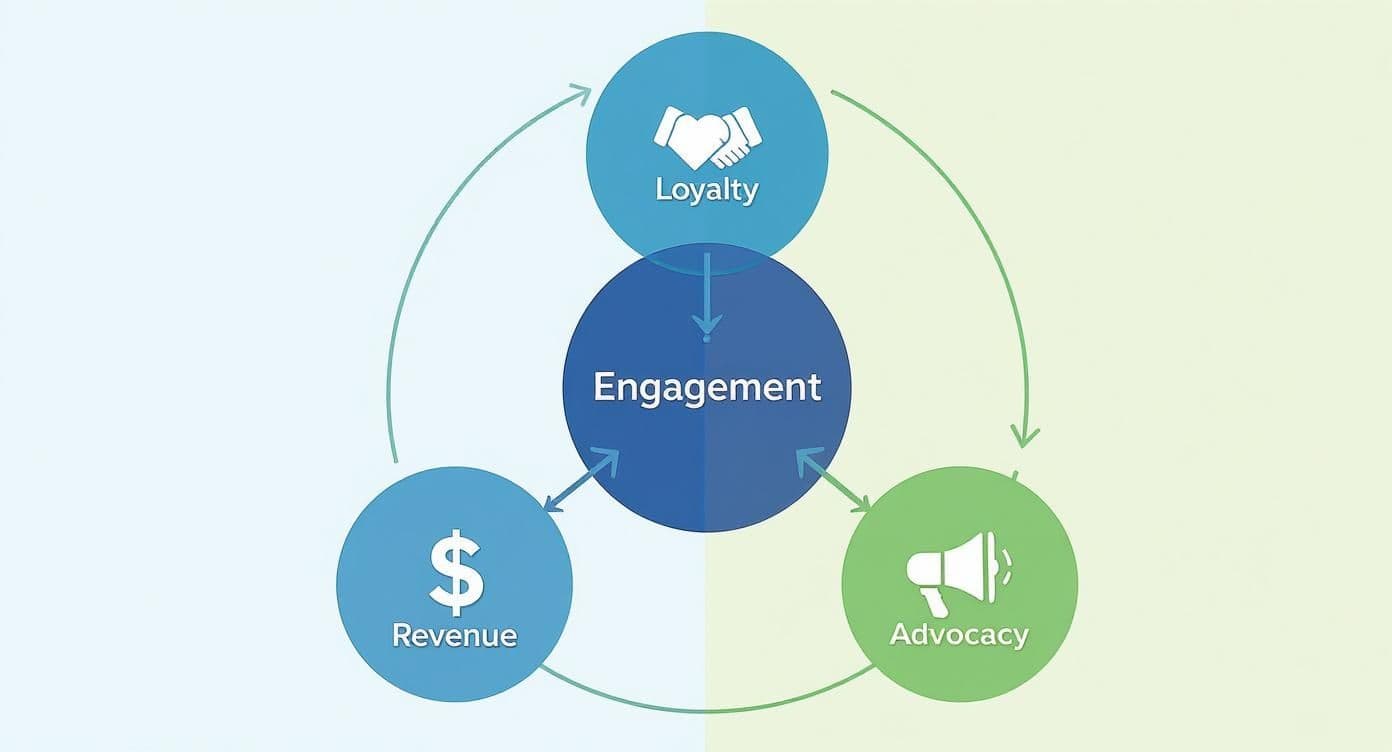
Great customer engagement isn’t just nice to have; it powers your bottom line. Engaged customers become advocates: they leave positive reviews, recommend you to friends, and create authentic social proof. That advocacy lowers acquisition costs and builds trust for new prospects.
The Financial Impact of Engagement
Ignoring engagement is expensive. Poor customer service costs U.S. companies an estimated $75 billion every year1. Investing in engagement reduces churn and increases Customer Lifetime Value (CLV). Engaged customers are likelier to return, upgrade, and stay longer—driving revenue over the lifetime of the relationship.
From Clicks to Conversions and Beyond
Engagement also helps SEO. When visitors stay on your site, explore multiple pages, and interact with content, search engines interpret that behavior as a sign of value. Interactive tools can lengthen session duration and boost perceived relevance.
For example, a financial advisor could embed the Mortgage Calculator to help visitors map scenarios. A marketing agency could include a results-oriented estimator like the Facebook Ads Cost Estimator to let prospects model ad spend. These tools provide immediate value and increase time on site.
- An e‑commerce store could add a simple discount or savings calculator to show shoppers instant savings.
- A SaaS company might embed a self-serve ROI worksheet to help prospects estimate value.
Tools like these transform passive browsing into an active, engaging session that helps with lead qualification and SEO.
How to Measure Engagement Without Getting Lost in Data
Measuring engagement can feel overwhelming. Focus on metrics that signal real customer relationships rather than vanity numbers.
Think beyond raw page views and toward behavioral and sentiment metrics that reflect true connection. Measurement should map to the customer journey—from first visit to repeat interactions—and guide action.
Key Customer Engagement Metrics and What They Mean
| Metric | What It Measures | Why It Matters |
|---|---|---|
| Session Duration | Average time on site per visit | Longer sessions suggest valuable content |
| Pages Per Session | Number of pages viewed per visit | Higher values indicate exploration and interest |
| Click-Through Rate (CTR) | Percentage who click a specific link | Shows how compelling your calls to action are |
| Net Promoter Score (NPS) | Likelihood to recommend (0–10) | Predicts advocacy and growth |
| Customer Satisfaction (CSAT) | Short-term satisfaction with a specific interaction | Helps pinpoint and fix friction quickly |
| Social Media Mentions | Frequency of brand mentions on social platforms | Measures awareness and conversation |
Putting the Metrics into Context
- On your website: Track session duration, pages per session, and bounce rate. A long session with multiple page views is a strong sign of engagement.
- In email: Focus on CTR and conversion rates, not just opens. High CTR shows your message drove action.
- On social media: Measure likes, comments, shares, and mentions—the actions that show real interaction.
Gauging How Your Customers Truly Feel
Behavioral data shows what customers do; sentiment data reveals how they feel. Tools like NPS and CSAT provide those qualitative signals. NPS quickly ranks customers into Promoters, Passives, and Detractors, while CSAT helps you fix immediate pain points.
Actionable Strategies to Build Real Engagement
Creating engagement is about being helpful, personal, and consistent. You don’t need a massive budget—small, repeatable acts of value add up.
Personalize the Experience
Personalization shows customers you see them as individuals. Real personalization uses data to anticipate needs and deliver relevant content, smart recommendations, and timely offers. Many consumers expect personalized interactions from brands2.
Practical steps:
- Segment your audience by behavior and purchase history.
- Recommend relevant products based on past purchases.
- Tailor content to reflect topics a user repeatedly reads.
For scaling outreach, consider email tools and segmentation platforms that let you automate targeted messages. See our personalization guide for implementation tips.
Provide Immediate Value with Interactive Tools
Interactive tools give visitors instant, personalized answers, creating an “aha” moment that builds trust and extends time on site. The fastest way to earn attention is to solve a small problem for free.
For example, a marketing agency can embed the Facebook Ads Cost Estimator so prospects can model spend and results. A SaaS company could add the Business Valuation Estimator to illustrate ROI scenarios for clients.
Build a Thriving Community
People want to connect with others. Create spaces where customers can talk to each other and to you:
- A dedicated online forum.
- An exclusive social group for passionate customers.
- Regular webinars or live Q&A sessions.
A community creates belonging and turns customers into advocates invested in everyone’s success.
How AI Is Reshaping Customer Engagement

AI today goes far beyond early chatbots. It can predict customer needs, analyze sentiment, and offer proactive support. By analyzing large datasets, AI finds patterns that let brands create timely, hyper-relevant offers and content.
Predictive Personalization in Action
AI watches behaviors—what people click, how long they linger—and compares those journeys to thousands of others to predict what a visitor will want next. That’s predictive personalization: recommendations that feel insightful rather than generic.
From Automation to Proactive Support
AI can detect when users struggle with a feature and trigger helpful interventions—pop-ups, tutorial emails, or a human follow-up—turning support into a loyalty-building activity. By some estimates, AI will support most customer interactions by 2025 and has already helped early adopters raise satisfaction scores significantly3.
Common Engagement Pitfalls and How to Avoid Them
Even well-intentioned teams can get engagement wrong. Here are common traps and how to avoid them.
Over-Automating the Experience
Automation is powerful, but it can’t replace human connection. Overdone automation makes customers feel like numbers. Use automation to empower human teams—not replace them.
Focusing on the Wrong Signals
Don’t chase vanity metrics. A spike in page views means little if people bounce quickly. Focus on repeat visits, time spent engaging with content, and direct feedback instead.
Ignoring the Voice of Your Customer
Ignoring feedback costs loyalty. Many customers will walk away after a few bad experiences, and repeating their issue to multiple people drives frustration4. The most successful companies build strategy around customer input and treat feedback as a roadmap for improvement.
Got Questions About Customer Engagement? We’ve Got Answers.
What’s the Real Difference Between Customer Engagement and Customer Service?
Customer service is reactive—fixing problems when they arise. Customer engagement is proactive—building a relationship before, during, and after transactions so customers feel like partners in your brand.
How Exactly Does Engagement Impact My Bottom Line?
Engaged customers stick around longer and spend more, raising Customer Lifetime Value (CLV). They also become advocates who lower acquisition costs through referrals and positive reviews.
What’s a Good First Step to Boost Engagement?
Give visitors instant, tangible value on your site. Interactive tools and simple calculators let prospects self-qualify and experience value in seconds. Try adding a calculator or estimator to key pages.
Ready to turn your website into a powerful engagement engine? Platforms that let you embed interactive tools quickly can help. Try the Business Valuation Estimator or the Mortgage Calculator to see how instant value changes visitor behavior.
Quick Q&A — Common User Questions
Q: How do I know if engagement efforts are working?
A: Track a mix of behavioral (session duration, repeat visits, CTR), sentiment (NPS, CSAT), and business (CLV, churn) metrics—together they show whether relationships are strengthening.
Q: Can small businesses afford to focus on engagement?
A: Yes. Small businesses can outperform larger competitors on personal connection—personal replies, thank-you notes, and helpful content cost little but build trust.
Q: What should I automate vs. personalize?
A: Automate routine tasks and data-driven triggers; personalize communications and human follow-up where empathy and context matter.
Top Q&A — Rapid Answers to Common Pain Points
How do I start if I have limited time and budget?
Start with one high-impact, low-cost action: add a simple interactive tool (a savings or ROI calculator), segment your email list, and send targeted messages to your best customers.
Which metric should I prioritize first?
Prioritize repeat visits and session duration—if customers keep coming back and spending time, your engagement is working.
How do I keep personalization from feeling creepy?
Be transparent about data use, focus on useful recommendations, and let customers opt out or control preferences.
1.
NewVoiceMedia, “Poor customer service costs US businesses $75bn per year,” https://www.newvoicemedia.com/blog/2017/08/poor-customer-service-costs-us-businesses-75bn-per-year/
2.
Salesforce, “State of the Connected Customer,” research on customer expectations for personalized experiences, https://www.salesforce.com/research/
3.
Helpshift, “Gartner Predicts 95% of Customer Interactions Will Be Supported by AI by 2025,” summary of industry projections and AI impact on satisfaction, https://www.helpshift.com/blog/gartner-predicts-95-of-customer-interactions-will-be-supported-by-ai-by-2025/
4.
Webex Blog, “Twenty-five customer experience statistics for 2025 — and why they matter,” data on customer churn and experience metrics, https://blog.webex.com/customer-experience/twenty-five-customer-experience-statistics-for-2025-and-why-they-matter/
Ready to Build Your Own Tools for Free?
Join hundreds of businesses already using custom estimation tools to increase profits and win more clients
✨ No coding required • 🚀 Ready in minutes • 💸 Free to create