Explore what is content marketing strategy and how to build a powerful plan that attracts customers, generates leads, and drives growth.
January 26, 2026 (9mo ago)
What Is a Content Marketing Strategy and How Does It Work Today?
Explore what is content marketing strategy and how to build a powerful plan that attracts customers, generates leads, and drives growth.
← Back to blog
So, what exactly is a content marketing strategy?
Think of it as your master plan for using content to pull in the right people, keep them hooked, and ultimately turn them into dedicated customers. I’m not just talking about churning out articles or videos; it’s about creating the right content, for the right audience, at the right moment to hit your business goals.
The Blueprint for Attracting Your Ideal Customer
Imagine your strategy is the architectural plan for a sturdy bridge. On one side are your potential customers, searching online for answers to their problems. On the other side is your business, holding the perfect solution.
Every piece of content you create—each blog post, video, or interactive tool—is a plank in that bridge, placed to guide them straight to you.
Without a plan, you're just throwing content into the void and hoping something sticks. That wastes time and money. A well-crafted strategy ensures every piece of content has a clear purpose and pushes you closer to a bigger goal, like generating high-quality leads or boosting sales.

Strategy vs. Tactic: What Is the Difference?
It’s common to mix up strategy (the “why”) with tactics (the “how”). They're related, but not the same thing.
The strategy is your big-picture vision—the destination on your map. Tactics are the individual turns and specific roads you take to get there.
Strategy vs Tactic What Is the Difference?
| Aspect | Content Marketing Strategy (The “Why”) | Content Marketing Tactic (The “How”) |
|---|---|---|
| Focus | Defines the long-term vision, business goals, and target audience. | A single, specific action or piece of content. |
| Scope | Broad and overarching, guiding all content decisions. | Narrow and specific, focused on a single execution. |
| Example | “Become the go-to resource for small business owners seeking financial clarity.” | “Create a Business Valuation Estimator to capture qualified leads.” |
| Timeline | Ongoing and adaptable, often planned annually or quarterly. | Short-term and project-based, like a single campaign. |
Putting a clear strategy in place isn't just a “nice-to-have”; it has real financial upside. The global content marketing market has grown dramatically in recent years, and industry estimates show major expansion over the past decade1. Ultimately, a strong strategy is the engine that drives sustainable growth. It shares a lot of DNA with growth-focused planning, where methodical planning and smart execution lead to scalable results.
The 5 Pillars of a Winning Content Strategy
A powerful content marketing strategy isn’t built on random acts of content creation. It's a system supported by five essential pillars. When these are in sync, your efforts become focused, effective, and actually drive business results.
Think of it like building a house. You need a solid foundation and a clear plan, otherwise the whole thing falls apart.
1. Define Your Audience
Before you write a single word, know exactly who you're talking to. This goes deeper than demographics. Who are these people, really? What keeps them up at night, and what problems are they trying to solve?
Creating detailed buyer personas is the first, non-negotiable step. For a B2B SaaS company, a persona might be “Operations Olivia,” an overworked manager struggling with inefficient workflows. When you understand her pain points, you can create content that speaks directly to her world.
2. Set SMART Goals
Your content needs a job to do. Vague goals like “get more traffic” are almost useless. Instead, use SMART goals—Specific, Measurable, Achievable, Relevant, and Time-bound.
A better goal would be: “Increase qualified leads from organic search by 15% in the next quarter by creating content that targets bottom-of-funnel keywords.” This gives you a clear target and a concrete way to measure success.
A strategy without measurement is just wishful thinking. By setting clear, data-driven goals, you transform content from a creative exercise into a predictable growth engine.
3. Plan Your Content
With your audience and goals defined, figure out what you'll actually create. This pillar connects your audience's problems to your business's solutions. A solid content plan involves brainstorming topics, choosing formats (blogs, videos, interactive tools), and organizing everything into a content calendar so nothing slips through the cracks.
For example, “Operations Olivia” is probably trying to justify new software purchases to her boss. A brilliant piece of content for her would be an article titled “How to Accurately Estimate Your SaaS Development Costs.” That post could include an interactive estimator as a call to action that helps her build a business case and present numbers to stakeholders.
See how that works? A simple connection turns a blog post into a tangible value exchange and a powerful lead-generation tool.
4. Choose Distribution Channels
Creating great content is only half the battle. If no one sees it, it doesn't exist. Your distribution plan outlines where you'll share your content to reach your target audience. Be where your audience already is.
- Owned channels: your blog, email newsletter, and company social profiles.
- Earned channels: mentions on other sites, guest posts, and PR.
- Paid channels: social ads, search ads, and sponsored content.
Choosing the right mix ensures your content gets maximum visibility.
5. Measure Performance
Track performance to understand what’s working and what isn't. This pillar feeds back into the first, creating continuous improvement. Key metrics include organic traffic, conversion rates, and engagement.
For instance, if a logistics company embeds a Logistics Shipping Cost Predictor on its services page, they can track how many users engage with it and how many interactions become qualified leads. That data proves the ROI of the content and helps refine strategic decisions.
How to Build Your Strategy Step by Step
Building a content marketing strategy isn't abstract; it’s a practical, step-by-step process. It ensures every blog post, video, or tool you create has a specific job to do—and isn't just adding to the noise.
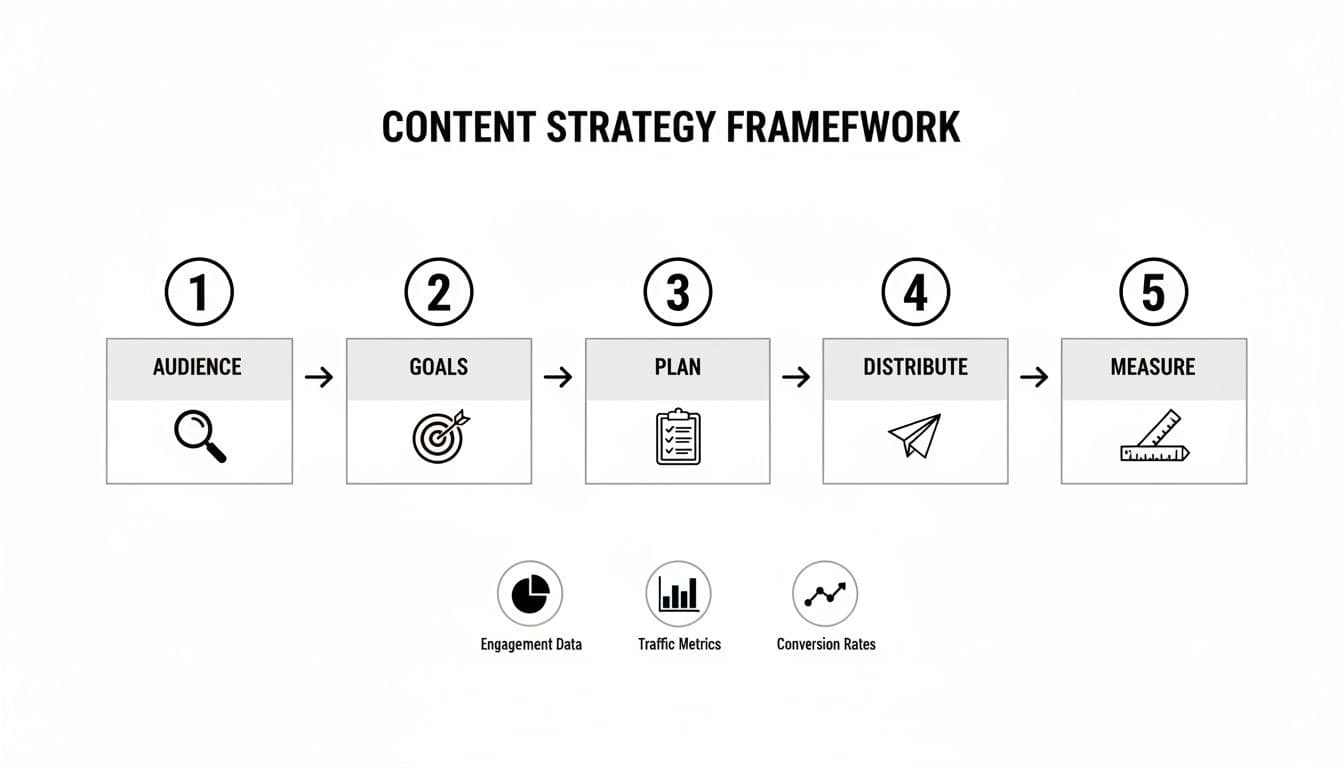
Each step builds on the last, creating a repeatable cycle of planning, creating, and improving.
Step 1: Define Your Mission and Business Goals
First: why are you creating content? Your content mission statement needs to answer three things: who you're helping, what you’re giving them, and how it makes their lives better. This is your north star.
Tie that mission to real business goals. Are you trying to boost qualified leads by 20% this quarter? Increase customer retention? Get specific. That clarity will guide every decision you make.
Step 2: Conduct Audience and Competitor Research
You can't create content that hits home if you don't know who you're talking to. Go beyond demographics and dig into their biggest frustrations. What questions keep them up at night?
At the same time, scope out the competition. Look at their best-performing content. What topics are they owning? Where are the gaps? This isn't about copying; it's about finding an angle they missed and serving the audience better.
Step 3: Perform a Content Audit
You're probably not starting from scratch. A content audit is taking inventory of everything you’ve already published—blog posts, case studies, videos—and seeing how it's performing.
- What should you keep? Find your greatest hits. Update or expand them.
- What should you ditch? Remove outdated or irrelevant content.
- What’s missing? Based on your research, what content gaps can you fill?
Step 4: Create a Content Calendar
With your research and audit done, get organized. A content calendar is your roadmap, laying out what you'll publish, where, and when. It turns good ideas into a consistent plan.
Lean on proven content marketing best practices to make sure your plan is built to last.
Step 5: Embed Value with Interactive Tools
Want to stand out? Give people something they can use right now. Passive content is fine, but interactive tools offer immediate, tangible value that sets you apart.
A financial planner, for instance, could embed a free retirement savings calculator on their blog. This transforms a static page into a problem-solving machine. It offers instant value by helping visitors see their financial future, turning casual readers into qualified leads and showcasing the planner's expertise.
Using Interactive Content to Power Your SEO
The web is overflowing with blog posts. To grab a top spot on Google, you need to do more than share good information—you have to create an experience. Interactive content, like calculators and quizzes, is your secret weapon.
Embedding these tools on your site can boost how long people stick around. When users plug in numbers and get personalized results, they're engaged. Google picks up on these signals, which can improve your rankings.

Why Interactive Tools Are SEO Gold
Static content informs, but interactive content involves. When a visitor uses a tool on your site, they move from passive reader to active participant. That shift has a big effect on SEO.
- Longer dwell time: People naturally spend more time on a page when they're interacting with a tool.
- Lower bounce rates: Engaged visitors are less likely to leave immediately.
- More backlinks: Useful calculators and estimators are link magnets.
Imagine a logistics page with a Logistics Shipping Cost Predictor. It solves a real problem for a potential customer and makes that page an indispensable resource.
The Real-World Impact
Content marketing is more cost-effective than many traditional channels, and it generates strong lead volumes for long-term growth2. With AI-driven search on the rise, proving Experience, Expertise, Authoritativeness, and Trustworthiness (EEAT) is essential3.
Tools like an embedded Business Valuation Estimator deliver immediate value. They drive engagement and build authority by solving real problems for visitors.
If you want a ready-made interactive example, consider the Digital Business Valuation Tool as a model for how a calculator can turn traffic into leads.
Measuring What Matters for Real Growth
Creating great content feels good, but how do you prove it's moving the needle? A content strategy without solid measurement is expensive guesswork. Look beyond vanity metrics and focus on KPIs tied directly to business goals.
Think of it like building a dashboard for your content engine. You need gauges for every part of the machine to see what's working, what's sputtering, and where to adjust.
From Clicks to Customers: A KPI Framework
Group your KPIs into four stages to trace the path from a person’s first search to a sale.
- Search impact: organic traffic, keyword rankings, backlinks.
- Audience engagement: time on page, social shares, comments.
- Lead generation: conversion rate, cost per lead, form submissions.
- Revenue impact: customer acquisition cost and return on investment.
Organize metrics to clearly communicate their purpose.
Essential Content Marketing KPIs and What They Tell You
| KPI Category | Key Metrics | What It Measures |
|---|---|---|
| Search Impact & Visibility | Organic Traffic, Keyword Rankings, Backlinks | Your content's ability to attract relevant audiences from search engines. |
| Audience Engagement | Time on Page, Bounce Rate, Social Shares, Comments | How well your content resonates with and holds attention. |
| Lead Generation | Conversion Rate, Cost Per Lead (CPL), Form Submissions | Your content's effectiveness at turning visitors into qualified leads. |
| Revenue & ROI | Customer Acquisition Cost (CAC), Return on Investment (ROI), Pipeline Value | The financial impact of your content on sales and growth. |
Tracking these KPIs gives a 360-degree view of your strategy's health.
Proving Value with Interactive Tools
Interactive content makes tracking ROI simple. When you embed a tool, you create a measurable link between content and business outcomes.
For example, a marketing team might embed a YouTube Channel Value Estimator in a blog post about video strategy. The tool offers immediate value, captures contact information, and shows how much business came from that one resource.
Your Content Marketing Strategy Questions, Answered
How Long Does It Really Take to See Results?
Expect 6 to 12 months of consistent effort before you see reliable organic growth and a steady flow of leads. You’re building an asset—brand authority and audience trust—and that takes time.
Content Strategy vs. Content Marketing: What's the Difference?
Content strategy is the high-level blueprint—the “why.” Content marketing is the execution—the “how.” Strategy sets the direction; marketing puts that plan into action.
I Have a Tiny Budget. How Can I Compete?
You don’t need a huge budget. Focus on one niche and solve a single, painful problem better than anyone else. Create one pillar piece of content and repurpose it across channels. A single, valuable interactive tool can generate more leads than many mediocre posts.
Quick Q&A
Q: What is a content marketing strategy in one sentence?
A: A content marketing strategy is a plan that defines who you’re helping, what you’ll create for them, and how that content will drive measurable business outcomes.
Q: Which metrics matter most?
A: Focus on metrics that tie to business goals—organic traffic and rankings for visibility, engagement metrics for resonance, conversion rates for lead quality, and CAC/ROI for revenue impact.
Q: What’s the fastest way to increase engagement?
A: Add interactive tools or calculators that give users personalized results—these increase dwell time, lower bounce rates, and attract backlinks.
1.
Statista, “Content marketing market size and growth,” https://www.statista.com/
2.
Demand Metric, “Content marketing costs and lead generation” infographic, https://www.demandmetric.com/
3.
Google Search Central, guidance on Experience, Expertise, Authoritativeness, and Trustworthiness (EEAT), https://developers.google.com/search/docs/essentials/eeat
Ready to Build Your Own Tools for Free?
Join hundreds of businesses already using custom estimation tools to increase profits and win more clients
✨ No coding required • 🚀 Ready in minutes • 💸 Free to create