Estimating software costs gets easier when you break work into phases, features, and decisions. This guide explains the main cost drivers, realistic budgets by project complexity, pricing models, and task-level tips so you can budget your app or platform with more confidence and fewer surprises.
July 24, 2025 (11mo ago) — last updated November 1, 2025 (7mo ago)
Software Development Costs 2025: App Budget Guide
Practical 2025 guide to estimating software development costs with realistic budgets by complexity, pricing models, and task-level tips for apps and platforms.
← Back to blog
Software Development Costs 2025: App Budget Guide

Estimating software development costs often feels impossible until you break the work into phases, features, and decisions. This guide explains the main cost drivers, realistic budget ranges for common project sizes, pricing models, and practical estimation tips so you can plan with more confidence and fewer surprises. Throughout, I note where task-level estimates and a proper discovery phase reduce risk and cost overruns1.
TL;DR: Quick cost ranges
- Simple public-facing apps: $60,000–$90,000
- Medium complexity apps: $90,000–$250,000
- Complex and enterprise solutions: $250,000+ (large transformations often start at $500,000+)
Development is usually the largest line item, and you should budget for ongoing maintenance and hosting. Use these ranges to set expectations, then refine with task-level estimates and a discovery phase. Maintenance commonly runs 15–20% of initial development per year2.
How scale and complexity influence cost
Think complexity, not just feature count. Typical 2025 ballpark ranges:
- Simple projects: $60,000–$90,000, basic features and UI
- Medium complexity: $90,000–$250,000, custom logic and integrations
- Complex solutions: $250,000+, advanced workflows, scale, and security
For enterprise work, security and scalability raise the floor:
- Small enterprise: $100,000–$250,000
- Mid-sized enterprise: $250,000–$500,000
- Large-scale transformations: $500,000+
One common mistake is treating software like a one-time purchase. Plan for maintenance, security updates, and feature evolution, because software is a living asset. Organizations that invest in discovery and incremental delivery tend to deliver more predictable budgets and faster time to value1.
Six lifecycle phases and why each matters
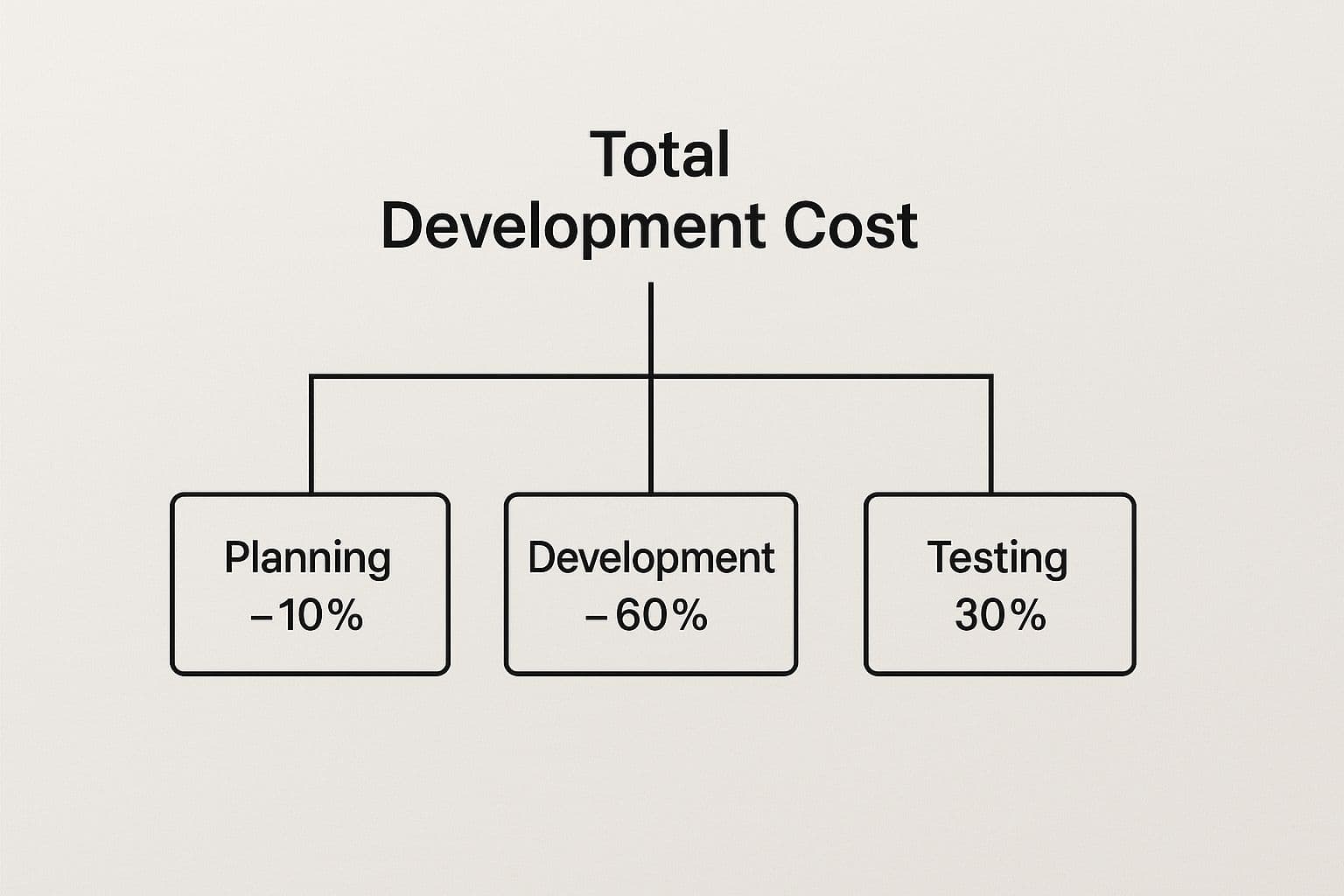
A helpful analogy is building a custom home: you wouldn’t start construction without a blueprint, and you shouldn’t start development without discovery. Clear lifecycle stages and budget allocation reduce surprises.
1) Discovery and planning
This is the foundation: market research, user definition, product goals, and feature prioritization. Deliverables include a roadmap, feature specs, and a prioritized backlog. Skimp here and you’ll pay later in scope creep and rework.
Why it matters: good discovery prevents wasted developer time and lowers total cost.
2) UI and UX design
Design shapes how users perceive and use your product. Wireframes, mockups, and prototypes reduce ambiguity and can shorten development time. Investing in UX improves retention and lowers support costs.
3) Development and coding
Development is the most resource-intensive stage. Developers implement features, APIs, and integrations. Often development is 60–70% of the total budget3. A seemingly simple feature can vary widely in cost depending on security, integrations, and data synchronization needs.
4) Testing and quality assurance
QA catches bugs and performance issues before users see them. Include functional, usability, performance, and security testing. Thorough QA reduces expensive fixes and reputational risk after launch.
5) Deployment
Deployment prepares and launches your product: provisioning infrastructure, CI/CD pipelines, monitoring, and release management.
6) Maintenance and operations
Ongoing costs include hosting, monitoring, security patches, performance tuning, and future feature work. Budget a recurring maintenance line, often 15–20% annually of initial development, and include a contingency buffer2.
Primary cost drivers
These multipliers can change a quote from modest to major.
Project scope and feature complexity
More screens and user journeys mean more hours. Complexity — AI, real-time sync, or advanced integrations — drives cost more than raw size. Examples:
- Third-party integrations (payments, maps, SMS) add development and testing time
- Custom UI and animations require front-end specialists
- AI/ML or AR requires specialist skills and data work
Real-world example: adding a real-time ML recommendation engine to an e-commerce project can add $100,000–$150,000, depending on data and model complexity.
Platform choice: web, mobile, or both
Native iOS and Android means two codebases, which increases cost. Cross-platform frameworks such as React Native or Flutter typically reduce up-front cost by roughly 30–40%, though trade-offs exist for performance and platform-specific features. Choose an approach that aligns with your product goals and long-term roadmap4.
Team location and hourly rates
Onshore, nearshore, and offshore options affect budget. 2025 rates vary widely:
- Enterprise onshore firms: $200–$400+/hr
- Nearshore/offshore skilled teams: $27–$82/hr
Balance cost savings with communication, time-zone overlap, and project-management needs5.
Pricing models, pros and cons
Three common models:
- Fixed price: predictable total cost for a locked scope. Good for small, well-defined projects, but rigid for changing requirements
- Time and Materials (T&M): pay for hours and resources. Flexible and iterative, but less predictable
- Dedicated team: flat monthly cost for a team focused on your product. Good for long-term products that need continuity
Ask: is scope frozen, how much budget uncertainty can you tolerate, and how long will the project run?
Better estimates, better control
Modern estimation breaks projects into small, priced tasks. Instead of a single guess, you get line-item clarity. That helps prioritize features by ROI and negotiate with data.
Example: login feature cost breakdown
- Basic email/password plus 2FA: about $1,200
- Social sign-on with profile sync: about $3,500
A clear delta, about $2,300 here, helps decide what to include in an MVP versus a later release.
Negotiating with data
Request task-level estimates from vendors so you can discuss specific items rather than a single lump sum. That reduces padding and helps reallocate budget to higher-value activities like marketing or analytics.
Track estimates in your workflow
Export estimates as CSV or JSON and import them into tools like Jira or Excel to track planned versus actual spending by sprint. Set alerts for variance and integrate cost data into sprint planning.
Tools and validated estimators
Use cost calculators that model granular breakdowns. Try these verified tools:
- Digital Business Valuation Tool
- Architectural Design Fee Estimator
- Event Planning Budget Allocator
- Email List Value Estimator
- Healthcare Procedure Cost Calculator
Link key internal resources from high-traffic pages to improve discoverability: /resources/estimation-templates, /case-studies/software-budgeting, and /methodology/estimation.
Practical tips to reduce cost without harming quality
- Start with an MVP focused on core value
- Hire thoughtfully: nearshore or offshore can save money but adds communication overhead, so balance accordingly
- Be ruthless with priorities and defer nice-to-haves
- Leverage open-source where appropriate
- Use data-driven estimates to decide what to build now versus later
Keep a contingency buffer of 15–20% for post-launch and unexpected expenses.
FAQ
How can I reduce development costs without sacrificing quality?
Launch an MVP, prioritize ruthlessly, consider nearshore talent, and rely on open-source tools. Use granular estimates to spot big savings.
What are the hidden costs?
Hosting, third-party API subscriptions (Stripe, SendGrid, Google Maps), software licenses, and ongoing maintenance. Add a 15–20% contingency to your budget2.
Why is custom software expensive?
You’re buying skilled labor across roles — architects, designers, developers, QA, and project managers — to create a tailored business asset.
How long does development take?
- Simple MVP: 2–4 months
- Moderately complex: 4–9 months
- Large enterprise: 12+ months
Agile approaches get an MVP to market faster by delivering value in incremental sprints.
Quick Q&A — three concise answers
Q: What’s the single best way to avoid budget surprises?
A: Invest in discovery and task-level estimates so you can prioritize by ROI and reduce rework.
Q: Should I build native or cross-platform first?
A: Start with the smallest set of platforms that prove your value. Cross-platform often lowers upfront cost, but choose based on user needs and performance targets4.
Q: How much contingency should I plan?
A: Budget 15–20% for maintenance and unexpected issues after launch2.
Bottom-line Q&A (concise)
Q: How do I set a realistic initial budget?
A: Use the TL;DR ranges above, add 15–20% contingency, and run a short discovery to convert guesses into task-level estimates.
Q: Where should I cut to save money fastest?
A: Defer complex integrations and advanced UI animations to later releases; prioritize features that prove user value.
Q: How do I compare vendor proposals fairly?
A: Ask for task-level pricing, the same scope definition, and team profiles. Compare hours, rates, and deliverables rather than just totals.
Three concise Q&A sections
Q&A: Budget setup
Q: What’s the fastest way to get a defensible budget?
A: Run a short discovery, prioritize features, and ask vendors for task-level estimates so you can compare apples to apples.
Q: How large should the contingency be?
A: Plan 15–20% of the initial development budget for post-launch and unknowns.
Q&A: Vendor selection
Q: How do I choose between onshore and offshore teams?
A: Use onshore for close collaboration and high-risk projects; nearshore or offshore can reduce cost but requires stronger communication processes.
Q: What pricing model works best for growing products?
A: A dedicated team or T&M model supports continuous delivery and changing priorities.
Q&A: Post-launch planning
Q: What ongoing costs should I expect?
A: Hosting, monitoring, security updates, third-party subscriptions, and feature improvements. Expect maintenance to be 15–20% annually2.
Q: How do I limit scope creep after launch?
A: Prioritize using measurable KPIs and reserve budget for the highest-impact items.
Author and published date: (unchanged)
1.
Standish Group, CHAOS Report, Standish Group International, accessed 2025, https://www.standishgroup.org.
2.
Gartner, Application maintenance industry guidance, accessed 2025, https://www.gartner.com.
3.
Project Management Institute, research on project-costing and distribution of effort, accessed 2025, https://www.pmi.org.
4.
Flutter documentation and cross-platform guidance, accessed 2025, https://flutter.dev.
5.
Market rate surveys for global software development (2024–2025); example resource: Accelerance, Global Software Development Rates, accessed 2025, https://www.accelerance.com.
Ready to Build Your Own Tools for Free?
Join hundreds of businesses already using custom estimation tools to increase profits and win more clients
✨ No coding required • 🚀 Ready in minutes • 💸 Free to create