Learn how to increase sales conversion rate with proven tactics, clear steps, and examples you can apply today to boost revenue and reduce friction.
December 1, 2025 (6mo ago) — last updated February 11, 2026 (4mo ago)
Increase Sales Conversion Rate: Quick Guide
Practical tactics and tools to find funnel friction, build trust, and run tests that raise conversion rates and revenue.
← Back to blog
Increase Sales Conversion Rate: Quick Guide
Summary: Learn how to increase sales conversion rate with proven tactics, simple steps, and actionable examples you can apply today to boost your bottom line.
Introduction: Learn how to increase sales conversion rate with proven tactics, clear steps, and examples you can apply today to boost revenue and reduce friction.
If you want to boost your sales conversion rate, the core task is simple: find friction in your sales process and remove it. That means identifying exactly where potential customers get stuck, lose interest, or get confused, and then making targeted changes that smooth their path to purchase.
Find Your Conversion Blockers Before You Fix Them
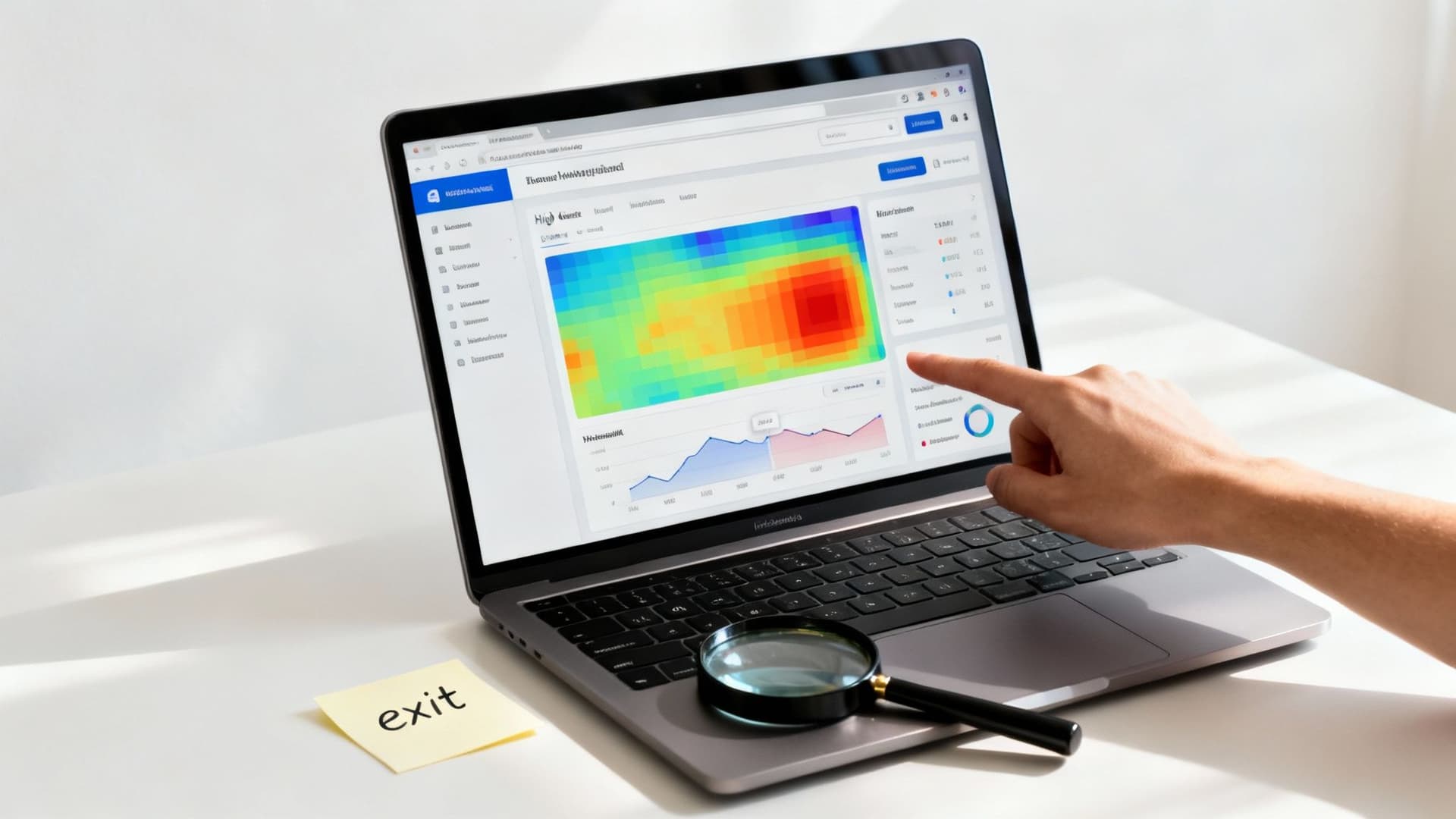
Before you change a button color or tweak a headline, put on your detective hat. Guessing wastes time and money. Start by pinpointing where your site is bleeding potential customers. That’s the difference between knowing “that” people leave and understanding “why” they leave.
Start with High-Level Data
Use your analytics platform (for example, Google Analytics) to find the obvious red flags that point to problems. Focus on the pages and funnel steps where the biggest leaks happen.
- High exit rates on key pages: If a pricing or product page gets lots of traffic but a large share of visitors leave, you’ve found a conversion blocker.
- Big funnel drop-offs: Look for cliffs in your funnel—like between “Add to cart” and “Checkout start.” That points to a specific problem at that transition.
- Low time on page: If visitors spend only a few seconds on pages that should take minutes, your message or value proposition is unclear.
If you need benchmarks, use industry resources to compare your performance and prioritize fixes. Google Ads benchmarks can help set expectations for paid campaigns.1
“Data tells you what, but observation tells you why. An exit rate shows a page is failing, but a session recording shows the user rage-clicking a broken button.”
Dig Deeper with Visual User Behavior Tools
Once analytics point to where the problem is, use qualitative tools—heatmaps, scroll maps, and session recordings—to learn why people behave the way they do.
- Heatmaps show where people click—and where they don’t. You might discover users click on non-clickable elements.
- Scroll maps reveal how far down people actually read. If crucial trust signals live below the fold, move them up.
- Session recordings show rage clicks, confusion, and repetitive behavior that indicate usability issues.
Combine the “what” from quantitative data with the “why” from qualitative insights to craft evidence-based fixes.
Build Trust and Clarity with Interactive Tools
Confusion kills sales. If visitors can’t quickly see your pricing, ROI, or how you solve their problem, they’ll leave. Interactive tools give instant, personalized answers and turn passive browsing into active engagement.
Empower Visitors with Immediate Value
In many B2B journeys, prospects click “Book a demo” just to get a simple quote. Interactive tools flip that. Let visitors plug in their numbers and see results on the spot.
For example, a marketing agency could embed an estimator that shows long-term customer value. When prospects see the numbers for themselves, the agency’s fee starts to look like an investment, not an expense. These tools also qualify leads—someone who uses a calculator and then contacts you is likely higher intent.
Practical tool links:
Turn Vague Promises into Tangible Projections
Features are abstract until a prospect sees how they affect the bottom line. ROI and projection tools make benefits concrete.
- SaaS: Show how a small investment can pay for itself via productivity gains.
- Logistics: Offer instant shipping estimates so prospects don’t need a phone call for basic pricing.
- Financial advisory: Let visitors model retirement savings to create urgency.
Interactive tools shorten sales cycles, pre-qualify leads, increase time on page, and boost trust.
Craft Landing Pages That Actually Convert
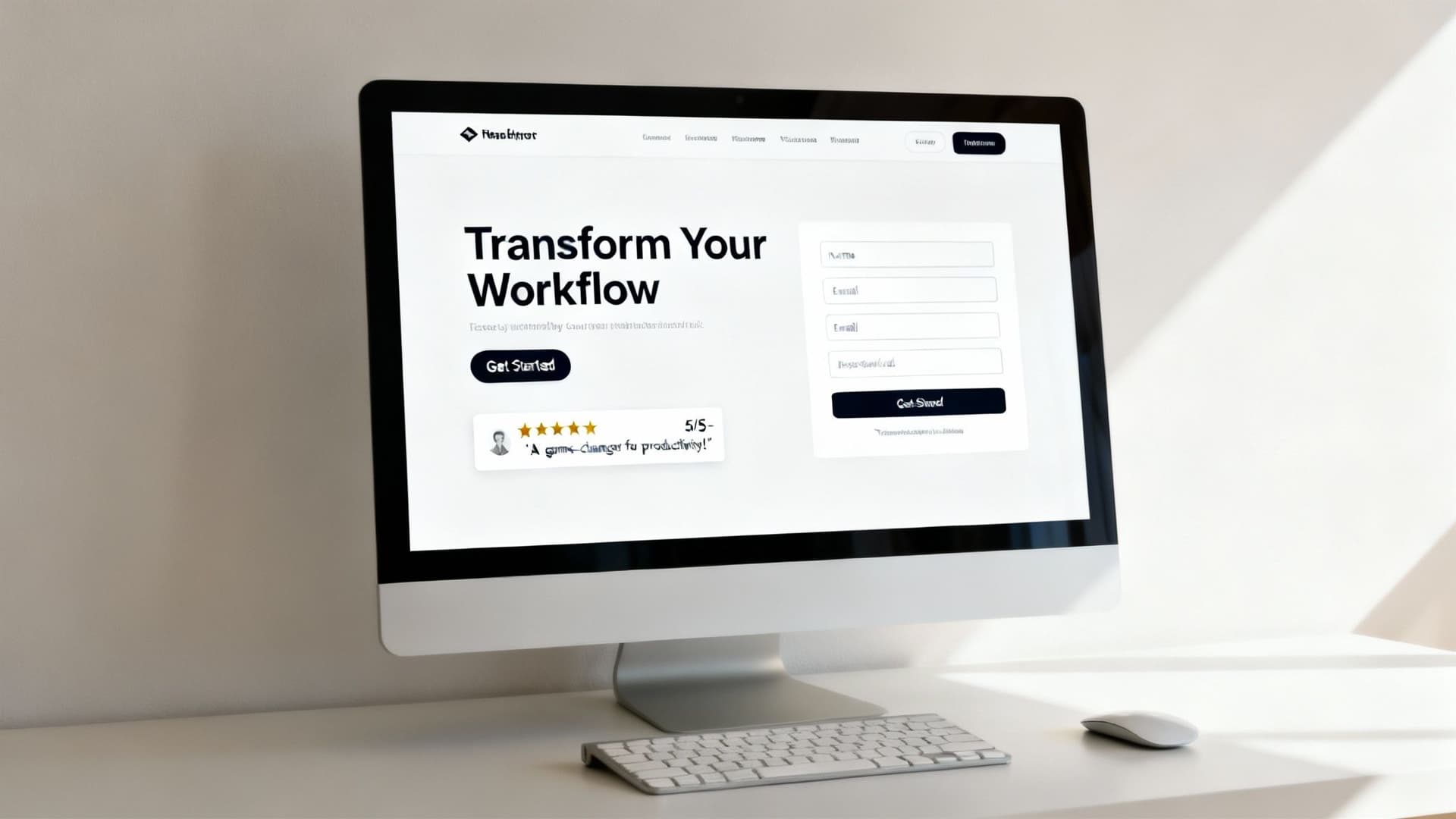
Your landing page is your digital handshake and pitch. No matter how much you spend on ads, a weak or confusing page will lose visitors instantly.
Nail Your Value Proposition Instantly
Answer the visitor’s first question in seconds: “Am I in the right place?” Use clear, benefit-focused headlines that match the ad or source that brought them there. This message match builds trust immediately.
Design a Call-to-Action That Feels Natural
The CTA should feel like the obvious next step. Small changes can have big impacts.
- Use action-oriented language like “Get Your Free Quote” or “Download My Guide.”
- Make the CTA stand out visually with contrasting color.
- Remove friction—ask only for what you absolutely need in forms.
A strong CTA guides rather than pressures.
Build Credibility with Social Proof
New visitors are skeptical. Social proof reduces anxiety and builds trust.
- Use real customer quotes with names and photos.
- Highlight case-study metrics next to CTAs.
- Show logos of clients, awards, or certifications near payment forms.
A tuned landing page pairs a motivated click with a clear, trust-building experience. Google Ads benchmarks can help set expectations for paid campaigns.1
Simplify Your Checkout and Sales Handoff
You’ve generated interest—that’s huge. But the checkout or sales handoff is where many deals fall apart. Smooth the finish line to stop losing customers at the last moment.
Stop Losing Customers at the Finish Line
In e-commerce, cart abandonment is a major issue—many stores lose roughly 70% of carts to abandonment on average4. Fight it by removing common barriers:
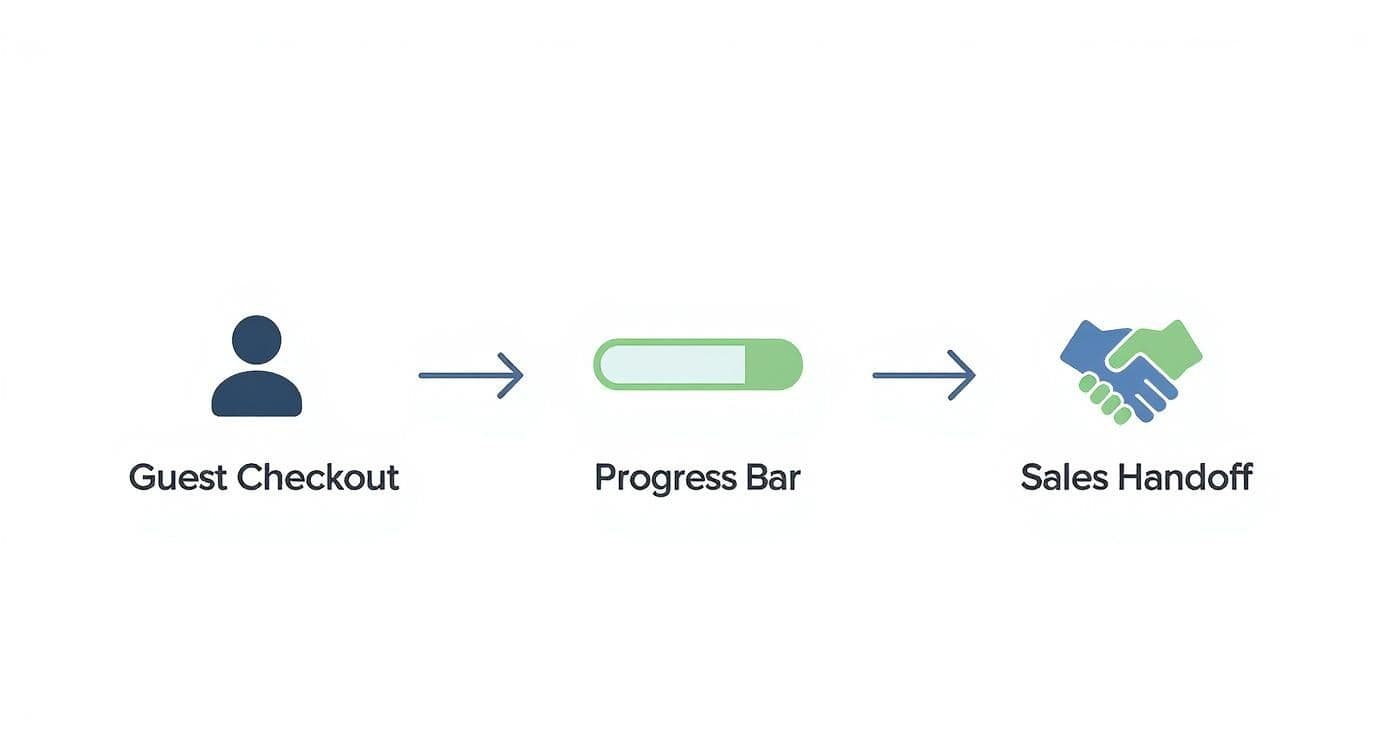
- Offer guest checkout so buyers aren’t forced to create accounts.
- Be upfront about all costs—show the all-in price early.
- Use a progress bar to reduce anxiety and show how close they are to completion.
Globally, average e-commerce conversion rates tend to sit between about 2.5% and 3%—so even small friction reductions can have large effects on revenue.2
The Critical B2B Sales Handoff
For B2B, the problem is the disconnected transition from marketing interest to sales outreach. A powerful handoff uses the prospect’s on-site actions to start a highly relevant conversation.
If a prospect uses an estimator and projects a specific ROI, your sales outreach can reference that projection directly. That makes the follow-up feel informed and helpful rather than cold and generic. Use tools to capture context and pass it along to sales.
Build a System for Continuous Improvement
Improving conversion rate isn’t a one-off project. It’s an ongoing system of learning, testing, and iterating. The backbone is disciplined experimentation—A/B testing that begins with a clear hypothesis.
“A strong hypothesis isn’t a wild guess; it’s an educated prediction based on the data. For example: ‘Changing our CTA from “Submit” to “Get Your Free Audit” will boost form submissions by 20% because it signals immediate value.’”
Prioritizing Tests for Maximum Impact
You could test hundreds of small things—your time and traffic are finite. Prioritize big-impact changes first:
- Headlines and value propositions
- Primary CTAs: wording, color, placement
- Hero images and videos
- Form length and complexity
Know where your best customers come from—paid, organic, or referral—and design tests for those segments.
Creating a Powerful Feedback Loop
Every experiment teaches you something. Use results to refine messaging and next tests. For example, if an embedded estimator increases engagement, test the follow-up CTA: “Book a Demo” versus “Download Your Custom Report.” The winner tells you whether your audience prefers a direct conversation or content to review.
This ongoing feedback loop turns one-off wins into a scalable, repeatable growth engine.
Your Top Conversion Rate Questions, Answered
We’ve covered analytics, interactive tools, landing pages, checkout, and continuous testing. Here are clear answers to the common questions that come up when implementing these strategies.
What’s a Good Sales Conversion Rate?
There’s no single magic number. Benchmarks vary by industry, traffic source, price point, and business model. Focus on improving your own historical performance and comparing against direct competitors.
How Long Should I Run an A/B Test?
Run tests until you reach statistical significance—typically a 95% confidence level—rather than stopping early based on a small sample. Use a sample-size calculator before you start so you know how long you’ll need.3
What Change Moves the Needle Most?
While it depends on context, headline and value-proposition changes often have the biggest impact. After that, your main CTA and form complexity are usually the highest-leverage areas.
Quick Q&A: Common User Questions
Q: Where should I start if my funnel has low conversions? A: Start with analytics to find the biggest leaks, then use session recordings and heatmaps to find the cause.
Q: Do interactive tools really help conversion? A: Yes. Tools that show personalized ROI or cost estimates increase engagement, qualify leads, and speed decision-making.
Q: Which page elements should I A/B test first? A: Test headlines/value props, CTAs, and form fields first—these often deliver the largest gains.
At MicroEstimates, we build tools that take the guesswork out of the buying process. Try tools like the Business Valuation Estimator or the Logistics Shipping Cost Predictor to see how embedded calculators can boost trust and pre-qualify leads.
Concise Q&A — Top 3 Action Questions
How do I find the single biggest conversion blocker? Use analytics to identify the page or funnel step with the largest drop-off, then confirm the cause with session recordings and heatmaps.
What’s the quickest test to run with limited traffic? Focus on headlines or your primary CTA; they often move the needle with relatively small sample sizes.
How do I reduce checkout abandonment fast? Show clear all-in pricing, offer guest checkout, and display a progress bar to reduce friction and anxiety.
1.
WordStream, “Google Ads Benchmarks.” [https://www.wordstream.com/blog/google-ads-benchmarks]
2.
Red Stag, “Average Conversion Rate for Ecommerce.” [https://redstagfulfillment.com/average-conversion-rate-for-ecommerce/]
3.
Optimizely, “Statistical Significance: What It Is and How to Calculate It.” [https://www.optimizely.com/optimization-glossary/statistical-significance/]
4.
Baymard Institute, “Average Cart Abandonment Rate.” [https://baymard.com/lists/cart-abandonment-rate]
Ready to Build Your Own Tools for Free?
Join hundreds of businesses already using custom estimation tools to increase profits and win more clients
✨ No coding required • 🚀 Ready in minutes • 💸 Free to create