इस व्यावहारिक गाइड के साथ जानें कि SERP फीचर्स को कैसे ट्रैक करें। डेटा का विश्लेषण करना सीखें, सही टूल चुनें, और SERP-फीचर जीत को वास्तविक व्यावसायिक विकास में बदलें।
January 6, 2026 (9mo ago) — last updated March 11, 2026 (7mo ago)
SERP फीचर ट्रैकिंग से SEO प्रभुत्व
SERP फीचर्स को ट्रैक करके विजिबिलिटी और रेवन्यू बढ़ाएँ—डेटा, टूल और इंटरैक्टिव कंटेंट से तेज परिणाम पाएं।
← Back to blog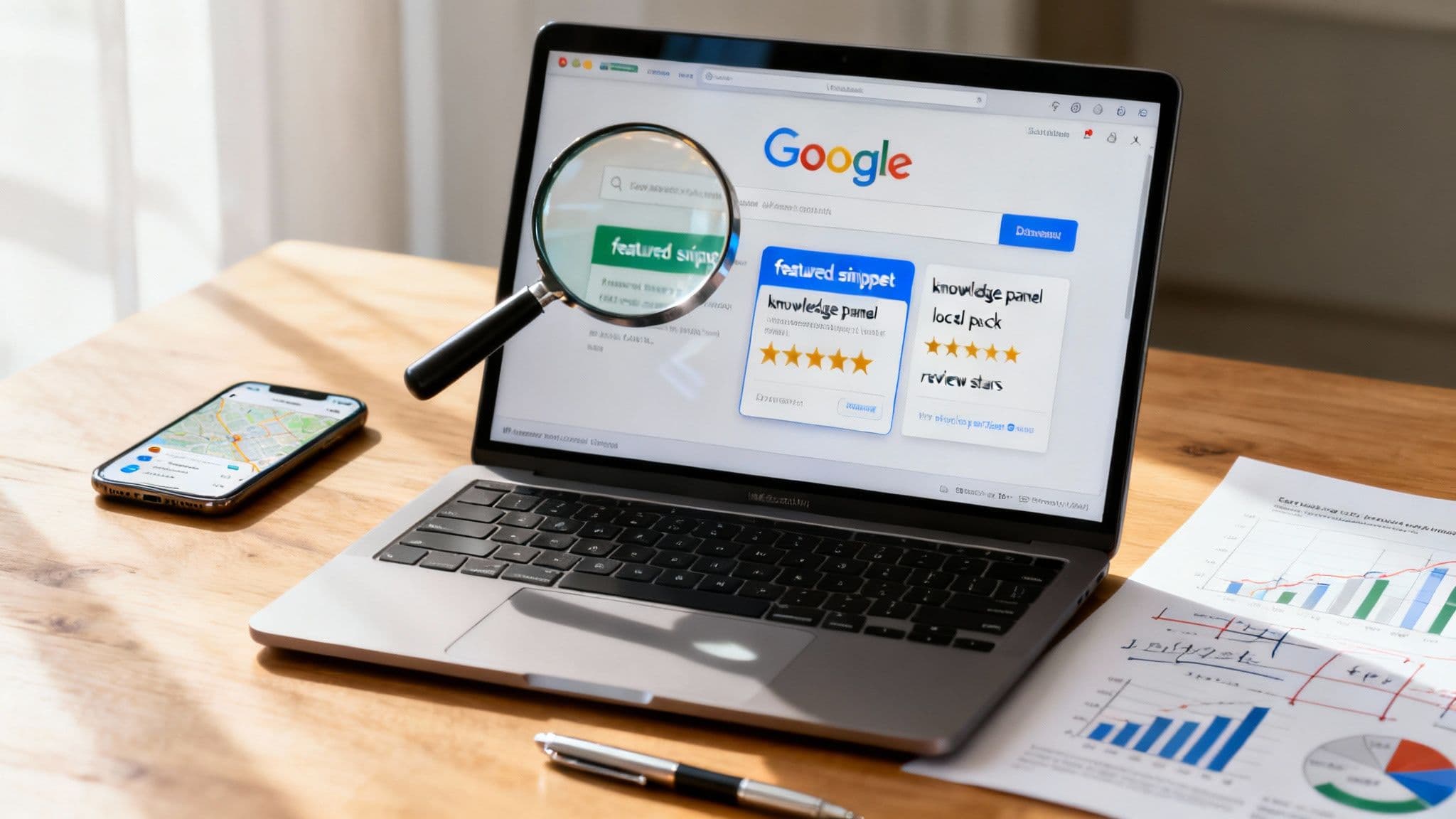
How to Track SERP Features for SEO Dominance
Master how to track SERP features with this practical guide. Learn to analyze data, choose the right tools, and turn SERP insights into measurable business growth.
Introduction
If you’re only tracking keyword rankings, you’re looking at a map of a city that no longer exists. Google’s results pages are packed with Featured Snippets, Local Packs, Video Carousels, Knowledge Panels, and more. This guide explains how to prioritize keywords, build a reliable tracking system, choose the right tools, and turn SERP-feature wins into measurable business results.
If you want faster wins, embed a relevant interactive tool such as the Business Valuation Estimator to boost engagement and signal value to search engines.
If you’re only tracking keyword positions, you’re using an outdated approach. The old “ten blue links” model no longer reflects actual visibility. Today’s SERPs are dynamic, and ignoring that means missing clicks and revenue.
Why Tracking SERP Features Is Non-Negotiable
Classic rank tracking is no longer enough. A #3 ranking can be invisible on a SERP crowded with a featured snippet, a video carousel, and a People Also Ask box. SERP features steal clicks and attention from traditional organic listings; if you’re not tracking them, you’re flying blind.
When a competitor takes the featured snippet for a high-value commercial keyword, they move to “position zero” and often capture the first click and the user’s trust. That has direct revenue implications for your business.
The Real Cost of Ignoring SERP Features
Failing to track SERP features is like navigating rush-hour traffic with an old map. You might know the street names, but you miss the new overpasses and one-way streets that determine the real route. These features change click-through rates and user behavior.
Featured snippets alone capture about 8–12% of clicks on average1. For businesses in markets where Google has over 90% search dominance, missing this means leaving significant traffic on the table2.
Key SERP Features and Their Business Impact
| SERP Feature | What It Is | Potential Impact on Your Business |
|---|---|---|
| Featured Snippets | A direct answer shown at the top of results. | Positions you as the authority (“position zero”) and can raise CTR significantly. |
| Local Pack | A map with local business listings. | Essential for local businesses; being listed drives high-intent visits and calls. |
| Knowledge Panel | A branded information box on the side. | Boosts brand credibility and dominates brand-related results. |
| People Also Ask (PAA) | Expandable questions related to the query. | Opportunity to answer related queries and earn multiple snippet placements. |
| Video Carousels | A horizontal row of video results, often from YouTube. | Captures attention for visual queries and channels users to video content. |
| Image Packs | A block of image results within organic listings. | Important for visual industries; can push text results down and reduce CTR by up to ~30% in some cases3. |
Each feature is either a big opportunity or a threat, depending on whether you or a competitor owns it.
Using On-Page Engagement to Win Features
One of the most effective ways to claim SERP features is by improving on-page engagement — the signals Google favors. Interactive content creates “sticky” pages that users engage with, which often correlates with improved SERP-feature visibility.
Embedding a practical tool can increase time on page and interaction. Use relevant tools that match user intent. Examples:
- Embed the Business Valuation Estimator to turn a finance post into a conversion engine.
- Add the Logistics Shipping Cost Predictor on logistics pages to reduce bounce rates and provide immediate value.
- Offer the Instagram Account Value Estimator for marketing content to boost engagement.
When users spend minutes interacting with a page, it signals value. That makes the page a stronger candidate for featured snippets and other rich results.
Building Your SERP Feature Tracking System
Setting up a scalable tracking system is about process as much as tools. Think of tracking as an early-warning mechanism for market shifts.
Start with the Right Keywords
Be ruthless with prioritization. Track keywords that map to business goals — prioritize high-conversion terms over high-volume vanity phrases.
Segment keywords into buckets:
- High-Value Commercial Keywords: Terms tied directly to revenue. Losing features here hits the bottom line.
- Top-of-Funnel Informational Keywords: Queries that build authority and awareness.
- Brand-Related Keywords: Company and product names; you should own these features.
Dial in Your Tracking Parameters
Track by device and location. A featured snippet that appears on desktop in New York may not show on mobile in Los Angeles.
Decide between an all-in-one platform and a custom API approach. Tools like Semrush and Ahrefs provide location and device tracking. For historical data and precision, use specialized SERP APIs. A hybrid approach often works best: a suite for broad monitoring and an API for mission-critical keywords.
Create a Reliable Data Pipeline
Automate data collection. Manual checks are useful for spot checks but don’t scale and are prone to personalization bias.
Your system should provide near-real-time visibility and alert you when you win or lose a key feature so you can correlate the event with traffic changes.
For high-competition niches, track pages with interactive tools (for example, a page with the Logistics Shipping Cost Predictor) to measure how utility assets affect SEO ROI.
Choosing the Right Tools for the Job
The market is crowded. Choose tools based on team needs and technical comfort.
- All-in-One Platforms: Semrush and Ahrefs offer user-friendly dashboards and quick setup for tracking feature ownership.
- Specialized APIs: Data providers deliver raw SERP data and historical snapshots for deep analysis.
Use a platform like Semrush for daily monitoring and an API for precise historical work. The ability to rewind SERPs helps you understand why a competitor overtook a feature.
The No-Code Advantage
No-code tools let you shift from tracking to influencing SERPs faster. Build useful interactive assets instead of another generic article. Examples include the Business Valuation Estimator, the YouTube Channel Value Estimator, or the Logistics Shipping Cost Predictor.
Well-designed tools deliver utility, boost engagement, and create content more likely to appear in SERP features.
Analyzing Competitor Strategies with SERP Data
Competitors leave clues in the SERPs. Don’t just track who ranks — track what ranks and why.
When a competitor wins a featured snippet or a PAA box, deconstruct their page:
- Featured Snippets: Are they using a concise paragraph, numbered list, or table that matches the query?
- Video Carousels: Is the video title, description, and thumbnail optimized for the query?
- Image Packs: Are image filenames, alt text, and surrounding content optimized?
Historical SERP snapshots help you pinpoint the exact change that moved the needle.
Turning the Tables with Superior Utility
Competitors often win features because their content is “good enough.” Make your content undeniably better. Embedding an interactive tool can turn a static article into a page that wins repeated SERP features.
A logistics site can outdo static competitors by adding the Logistics Shipping Cost Predictor. A marketing agency can add the Instagram Account Value Estimator to provide shareable utility.
Track how these pages perform in SERP features to measure direct impact on visibility and leads.
Turning Insights into Action and Profit
Data matters only when you act. Turn SERP tracking into a playbook that ties changes to revenue.
Building Your Action Dashboard
Create a dashboard that answers the right questions at a glance:
- Feature Ownership: What percentage of target SERP features do we own versus competitors?
- Volatility Alerts: Which valuable keywords had SERP feature changes in the last 24 hours?
- Performance Impact: How did traffic and conversions change after we won or lost a feature?
Automated alerts for losing a money-making snippet or a new competitor in the local pack create a rapid-response capability.
Prioritizing Tasks Based on Revenue Impact
Not all features are equal. Assign a potential revenue value to target keywords so you can prioritize responses. Losing a featured snippet for a bottom-of-funnel keyword is higher priority than a top-of-funnel branding win.
Treat significant SERP features as revenue-generating assets and respond immediately with a data-driven plan when you lose one.
Practical Game Plan for Common Scenarios
| Scenario | Immediate Action Steps | Long-Term Strategy |
|---|---|---|
| You lose a featured snippet | Analyze the competitor’s page, match their snippet format (list, table, paragraph), update your content, and resubmit the URL in Google Search Console. | Improve page utility and engagement, for example by embedding the Business Valuation Estimator. |
| Competitor wins a People Also Ask box | Identify the exact question, add a matching H2/H3 and a concise answer on your page. | Build a comprehensive FAQ addressing related PAA questions to dominate the SERP. |
| New business enters the Local Pack | Check their Google Business Profile and reviews. Improve your profile and solicit reviews. | Create location-specific landing pages with local schema and hyper-local content. |
Weaving SERP Insights into Your Broader Strategy
SERP queries are direct signals of customer intent. Recurring searches for a specific calculation or decision are a clear signal to build a tool that solves the problem.
Interactive tools turn search demand into measurable product-led growth. For scaling teams, programmatic SEO can transform SERP tracking from defensive work into a revenue engine.
Common Questions About Tracking SERP Features
How often should I check SERP feature data?
For high-value keywords, check daily. SERPs for those terms can change quickly. For less-critical informational keywords, weekly tracking is usually sufficient.
What is the most important SERP feature to track?
It depends on your business and search intent. Featured Snippets and PAA matter for “how-to” content; Local Pack is critical for local businesses; Shopping and review snippets matter for e-commerce.
Can I track SERP features without expensive tools?
Manual checking is possible but doesn’t scale. Investing in an automated tool usually pays for itself by providing geo-specific, historical data you can trust.
At MicroEstimates, we offer no-code tools you can embed to boost engagement and win SERP features, such as the Business Valuation Estimator and the Logistics Shipping Cost Predictor.
Quick Q&A — Practical Answers
Q: What’s the first step to tracking SERP features?
A: Prioritize a small list of revenue-critical keywords and set up device- and location-specific tracking for those terms.
Q: How do I measure the impact of winning a feature?
A: Link SERP events to analytics: track traffic, engagement, and conversions for the affected URL and add an analytics annotation on the date of the change.
Q: What’s a fast win to improve SERP visibility?
A: Add a high-utility interactive asset to the page (for example, the Business Valuation Estimator) to increase engagement and improve chances of winning rich results.
Three Concise Q&A Sections
Q: Which SERP features affect click-through most?
A: Featured Snippets, Local Pack, and image or video carousels often shift CTR the most for transactional and visual queries.
Q: How do I prioritize which features to chase?
A: Score keywords by estimated revenue impact and volatility. Focus on bottom-of-funnel terms where feature ownership drives conversions.
Q: What’s the fastest way to test if an on-page change helps?
A: Update the target page, add a concise SERP-friendly answer or interactive tool, monitor feature ownership and traffic for the next 1–2 weeks, and compare performance to the prior baseline.
1.
Sistrix, “Featured Snippet Study: How Often Do Featured Snippets Get Clicks?” https://sistrix.com/blog/featured-snippet-study/
2.
StatCounter, “Search Engine Market Share — United States” https://gs.statcounter.com/search-engine-market-share/all/united-states/
3.
Semrush, “Zero-Click Searches and Rich Results: How They Impact Organic Traffic” https://www.semrush.com/blog/zero-click-searches/
क्या आप अपना खुद का उपकरण मुफ्त में बनाने के लिए तैयार हैं?
सैकड़ों व्यापारों से जुड़ें जो पहले से ही मुनाफा बढ़ाने और अधिक ग्राहक जीतने के लिए कस्टम अनुमान उपकरणों का उपयोग कर रहे हैं
✨ कोडिंग की आवश्यकता नहीं • 🚀 मिनटों में तैयार • 💸 बनाना मुफ्त