Tired of missed targets? Misaligned sales and marketing wastes budget, slows deals, and frustrates buyers. This practical, step-by-step guide shows how to unify teams with an SLA, shared metrics, and a single source of truth to drive measurable revenue gains.
November 7, 2025 (4mo ago) — last updated January 17, 2026 (2mo ago)
Align Sales and Marketing to Grow Revenue
Stop revenue leaks: align sales and marketing with SLAs, shared metrics, and synced tech to improve lead quality and close more deals.
← Back to blog
How to Align Sales and Marketing for Growth
Summary: Stop revenue leaks by aligning sales and marketing with an SLA, shared metrics, and synced tech. Improve lead quality and close more deals.
Introduction: Tired of missed targets? Misaligned sales and marketing wastes budget, slows deals, and frustrates buyers. This practical, step-by-step guide shows how to unify teams with a simple SLA, shared metrics, and a single source of truth to drive measurable revenue gains.
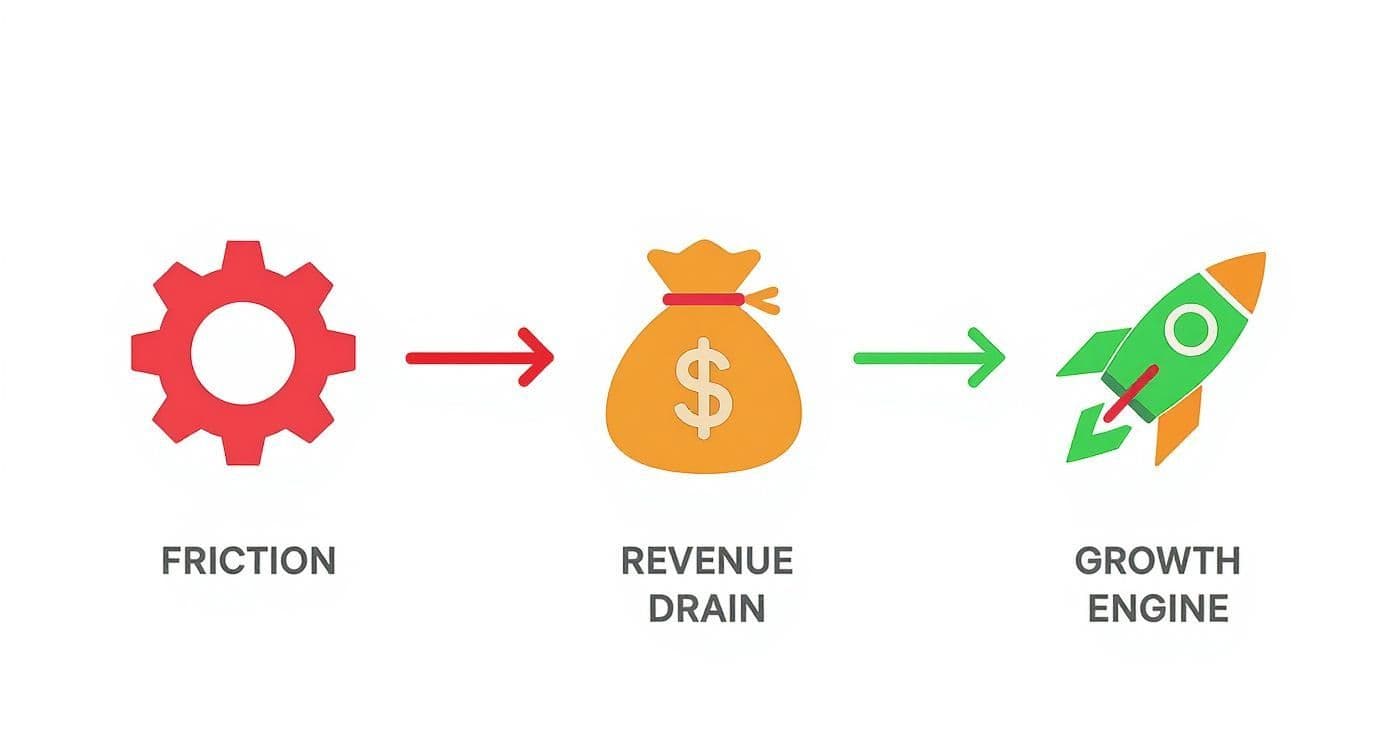
When sales and marketing aren’t on the same page, it’s more than an internal headache—it’s a direct drain on your bottom line.
Marketing spends to generate leads that sales calls “junk.” Sales chases quotas and blames a weak pipeline. That cycle wastes money, time, and opportunity and creates an inconsistent buyer experience.
Imagine a buyer attracted by a campaign that highlights a specific feature, then hearing a different story from a sales rep. That mismatch kills trust and slows deals.
The True Cost of a Disconnected Team
The financial fallout from misalignment shows up in revenue and profit numbers. Companies with strong sales and marketing alignment see markedly better revenue and profit outcomes1. At scale, poor coordination creates significant market inefficiencies and lost opportunity every year2.
The Financial Impact of Misalignment
Where does the lost revenue come from?
- Wasted marketing spend: Without sales input, marketing can attract the wrong audience. Every dollar spent on leads unlikely to convert is wasted ad spend.
- Inefficient sales cycles: Reps spend time on unqualified leads instead of focusing on ready buyers, which lengthens cycles and raises acquisition cost.
- Leaked revenue: Warm leads can go cold during a clunky handoff or because follow-up is slow or inconsistent.
Shifting From Blame to Growth
This isn’t about pointing fingers. Root causes are usually siloed data, conflicting priorities, and no shared metrics. Start by showing the upside: model what a small conversion improvement means for revenue with a valuation or estimator tool. For example, use a simple estimator to demonstrate the impact of a 1–2% conversion lift. Try a Business Valuation Estimator to quantify potential gains.
When both teams focus on the same north star—like customer lifetime value or overall profitability—the case for alignment becomes persuasive. Use a shared valuation or estimator tool to put numbers behind the opportunity.
Building Your Foundation on Shared Goals
Real alignment starts with a clear, shared definition of success and a practical pact for how teams will work together day to day.
That pact is a Service Level Agreement (SLA): a formal promise where marketing commits to delivering a specific number and quality of leads, and sales commits to a specific follow-up process.
Defining Your Terms
Most “your leads are junk” versus “you’re not calling them” fights begin because nobody defined a “good” lead together.
Agree on common definitions before implementing an SLA:
- Marketing Qualified Lead (MQL): A lead marketing has vetted and believes is more likely to become a customer. Define the actions and attributes that qualify a lead in collaboration with sales.
- Sales Qualified Lead (SQL): An MQL that sales reviews and accepts as ready for direct outreach. Define the acceptance criteria together.
Key takeaway: an SLA is a mutual promise. For example, Marketing might commit to delivering “50 MQLs per month” that meet agreed criteria, and Sales commits to contacting 100% of those MQLs within 24 hours.
Focusing on Profitability, Not Just Volume
Shift the conversation from lead volume to customer value. Who cares if marketing generated 500 leads if none can afford your product? Start with a precise Ideal Customer Profile (ICP) and measure leads by their potential value.
Bring money into the discussion. Use valuation tools to estimate CLV or customer impact and rally the teams around high-value targets. For practical modeling, try the Business Valuation Estimator. Targeting higher-CLV customers forces marketing to aim higher and gives sales a clearer reason to prioritize those leads.
Creating a Single Source of Truth with Technology
Shared goals are a start, but technology is the glue that makes alignment stick. Without a unified tech stack, you get “your data” versus “my data” fights.
A single source of truth is a reliable view of the customer journey accessible to everyone. It’s about getting tools you already have—your CRM and marketing automation—to talk to each other.
Syncing Your Core Platforms
Integrate your CRM with your marketing automation platform bidirectionally so data flows freely.
- Sales gets the full story. Reps see every marketing touch—emails, downloads, webinar attendance—so outreach is informed and relevant.
- Marketing gets a reality check. Teams can trace revenue back to campaigns and channels and stop celebrating MQLs that go nowhere.
This integration creates a feedback loop that helps both teams improve with every lead.
Building Shared Dashboards
Once data flows, build dashboards that visualize SLA metrics. The goal is a single hub where both teams track progress against shared goals in real time.
A dashboard should show the entire funnel, from first touchpoint to closed-won. Start with a few high-impact metrics on a shared dashboard: Customer Acquisition Cost, MQL-to-SQL conversion, and pipeline velocity. Use those numbers to focus both teams on improving the same KPIs.
Consider linking to a simple SLA template or internal playbook for consistency, for example: [/resources/sla-template].
Turning Sales Insights Into Content That Converts
If shared goals and tech are the skeleton of alignment, content is the muscle. When sales and marketing collaborate on content, assets become conversion tools rather than guesses.
Sales reps are a goldmine of insight. They hear objections, know the most persuasive success stories, and can point to the language that moves prospects.
Systematizing the Flow of Intel
You need a consistent system for capturing what sales hears. A shared document, a dedicated Slack channel, or a lightweight CRM field can collect:
- Top objections — price, implementation time, or feature gaps.
- Constant questions — recurring issues prospects raise.
- “Aha!” moments — phrases or demos that make prospects lean in.
Marketing then turns those inputs into targeted assets: blog posts, one-pagers, case studies, or calculators. Recurring ROI questions become an interactive ROI tool buyers can use independently. Embed a Business Valuation Estimator to help prospects see the financial upside.
Mapping Content to the Buyer’s Journey
With sales intel, marketing can build an asset library aligned to each stage of the funnel so sales always has the right piece for the right conversation.
| Sales Insight | Marketing Action | Resulting Asset | Funnel Stage |
|---|---|---|---|
| “Your pricing is confusing.” | Clarify pricing and build a transparent breakdown. | Pricing page or downloadable guide. | Consideration |
| “How are you different from Competitor X?” | Build a side-by-side comparison. | Competitor comparison landing page. | Consideration |
| “We can’t implement this.” | Show a successful onboarding story. | Case study or “First 30 Days” video. | Decision |
| “I need to prove ROI to my boss.” | Build an interactive tool to quantify value. | An embedded valuation/estimator on the site. | Decision |
| “We struggle with X problem.” | Produce an in-depth guide. | Expert-level blog post or ebook. | Awareness |
Use experiments and A/B testing to validate messaging that sales says works. When marketing proves a headline or asset increases demo requests, that winning message becomes a sales play.
Establishing Rhythms for Communication and Feedback
Alignment is ongoing. After an SLA and dashboards, build communication rhythms that keep teams in sync without adding busywork.
The Weekly “Smarketing” Huddle
Run a 30-minute, data-driven huddle with a fixed agenda:
- SLA metrics review: Progress against MQL/SQL goals.
- Lead quality deep dive: Real-time feedback and reasons for disqualification.
- Win/loss analysis: Celebrate one win and dissect one loss.
- What’s next: New campaigns and target accounts.
Keep it focused on decisions and actions.
Closing the Feedback Loop
Make it easy for sales to capture why a lead was disqualified inside the CRM. A mandatory dropdown with reasons like “Not decision-maker,” “Wrong timing,” or “No budget” turns vague complaints into data marketing can act on.
That structured feedback transforms sentiment into changes. If many leads are disqualified for budget reasons, marketing can adjust targeting or create content that helps buyers build a financial case. Embedding an interactive estimator on your site gives prospects a self-serve way to see business impact and helps sales have more productive conversations. Try a Business Valuation Estimator.
Despite the clear benefits, progress in alignment remains slow: many leaders report being only partially aligned while fully aligned teams see stronger win rates and deal outcomes1.
By analyzing disqualification reasons, marketing can tweak campaigns immediately. This closed loop turns complaints into actionable data and builds trust between teams.
Got Questions? We’ve Got Answers
Getting sales and marketing to work together sounds great in theory, but the reality can be messy. Here are common questions and tactical answers.
Q&A
Q: Our teams are on different planets. Where do we begin?
A: Start small. Get sales and marketing together to agree on MQL and SQL definitions. Build a simple dashboard with three metrics—total MQLs, MQL→SQL conversion rate, and average sales cycle for marketing-sourced leads—and hold a weekly 30-minute review. Quick wins build trust.
Q: How do we prove alignment is worth the effort?
A: Track lead-to-customer conversion rate, sales cycle length, and customer acquisition cost before and after alignment work. Use estimator tools to show ROI in black and white. If an initiative costs $5,000 and creates $50,000 in profit, the math is persuasive. Try the Business Valuation Estimator.
Q: Sales always says marketing’s leads are junk. How do we stop that?
A: Define a good lead with top-performing reps and close the feedback loop. Require a disqualification reason in the CRM and review that data weekly. When reps see their feedback change targeting, trust grows and the blame game ends.
Frequently Asked Questions
Q: What is the simplest SLA to start with?
A: A basic SLA sets monthly MQL targets, an MQL acceptance window (for example, 24–48 hours), and a defined follow-up cadence. Keep it measurable and revisit after 30–60 days.
Q: Which three KPIs matter most at the start?
A: Total marketing-sourced MQLs, MQL→SQL conversion rate, and average sales cycle for marketing-sourced leads.
Q: How often should the teams review lead disqualifications?
A: Weekly at first, then shift to biweekly once trends are stable. Use the CRM dropdown reasons to turn feedback into action.
Ready to build interactive tools that unify your teams? Create embedded calculators and estimators to qualify prospects and arm sales with data-driven assets. Try a Business Valuation Estimator.
1.
MarketingProfs, “The State of Sales and Marketing Alignment in 2019,” https://www.marketingprofs.com/charts/2019/40888/the-state-of-sales-and-marketing-alignment-in-2019
2.
BrainstormClub, summary of alignment statistics and economic impact, https://brainstormclub.com/brainstorming/sales-marketing-alignment-statistics/
3.
MarketingProfs and related alignment studies showing revenue and profit growth benefits for aligned B2B organizations, https://www.marketingprofs.com/charts/2019/40888/the-state-of-sales-and-marketing-alignment-in-2019
4.
Buyer research on self-education prior to contacting sales, summarized in industry reports and buyer-journey studies: https://www.forrester.com and https://www.siriusdecisions.com
¿Listo para construir tus propias herramientas gratis?
Únete a cientos de empresas que ya usan herramientas de estimación personalizadas para aumentar ganancias y conseguir más clientes
✨ No se requiere programación • 🚀 Listo en minutos • 💸 Gratis para crear