When you hear “on-page SEO,” think of everything you can directly control on your website to help search engines and visitors understand and value your pages. This guide lays out the key elements, practical steps, and simple examples you can apply right away.
November 5, 2025 (11mo ago) — last updated March 28, 2026 (7mo ago)
On-Page SEO: What It Is and How It Works
Clear, actionable guide to on-page SEO: what you control, essential elements, and steps to improve rankings and user experience.
← Back to blog
On-Page SEO: What It Is and How It Works
Confused about what on-page SEO controls? This guide explains the on-page elements you can change to rank higher, with clear examples and practical tips.
Introduction
When you hear “on-page SEO,” think of everything you can directly control on your website to help search engines and visitors understand and value your pages. It’s the words you choose, the page titles, headlines, URLs, and how the page is organized so Google and people instantly know what your content is about.
What is On-Page SEO, Really?
Imagine your website is a new bookstore. You wouldn’t toss books into random piles. You’d put a clear sign outside (that’s your page title), labels above each aisle (your headers), and snappy blurbs on the back of each book (your content). On-page SEO is organizing your digital storefront so both search engines and visitors can find what they want.
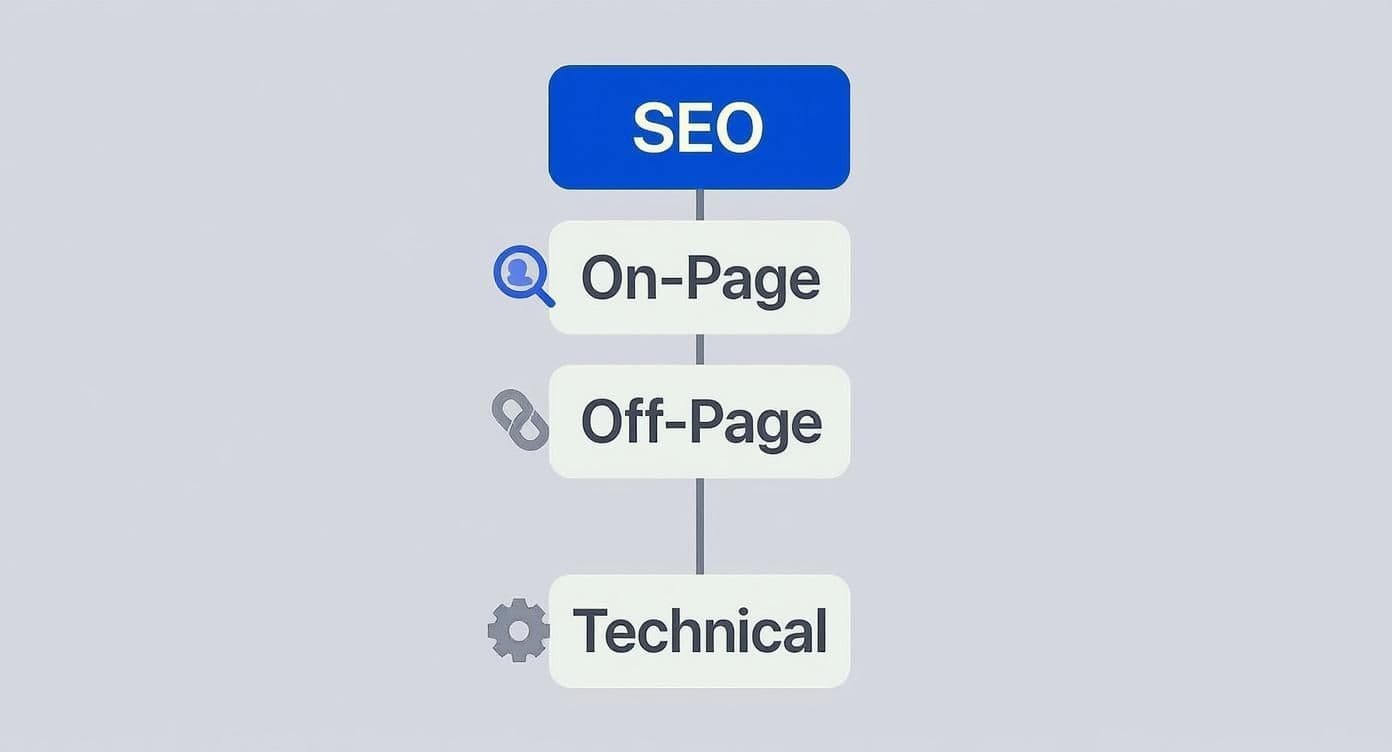
On-page SEO is fully in your control, which makes it different from:
- Off-Page SEO: Things you do away from your site, like earning backlinks.
- Technical SEO: The behind-the-scenes setup that keeps your site fast, secure, and crawlable.
“On-page SEO is the art and science of making your content and site structure speak Google’s language so your message is heard clearly.”
On-Page SEO vs Off-Page SEO at a Glance
| Factor | On-Page SEO (Your Website) | Off-Page SEO (Other Websites) |
|---|---|---|
| Primary Focus | Optimize individual pages for relevance and user experience. | Build authority, credibility, and reputation online. |
| Key Activities | Keyword research, content, title tags, internal linking. | Link building, social promotion, brand mentions. |
| Control Level | 100% direct control. | Indirect control—you influence outcomes. |
| Example | Writing a detailed guide about indoor gardening. | Getting a popular blog to link to your guide. |
A solid SEO strategy needs both. You can’t build a strong reputation for a poorly built website.
The Main Goal of On-Page Optimization
The goal is simple: create a great experience where search engines immediately grasp your content’s relevance and visitors find exactly what they searched for. Many sites miss basic opportunities — about 25% of top-ranking pages don’t have a meta description, which is a missed chance to earn clicks from search results.1
The Essential Building Blocks of On-Page SEO
On-page SEO is like a recipe: miss an ingredient and the result won’t be right. These elements are the direct signals you send to search engines to explain what your page is about.
The Most Important On-Page Signals
- Title Tags: The headline people see in search results. Make it descriptive and keyword-focused, for example, “A Beginner’s Guide to Indoor Gardening.”
- Meta Descriptions: The short snippet under the title in search results. It’s a concise sales pitch that can improve click-through rates even if it’s not a direct ranking factor.1
- Header Tags (H1, H2, H3): Use headers to structure content for readers and crawlers. H1 is the main page title; H2s and H3s break the page into readable sections.
- URL Structure: Keep URLs clean and descriptive, such as
yourwebsite.com/on-page-seo-guide.
These elements help you compete for a share of billions of daily searches and the organic traffic they bring: organic search drives a majority of trackable web traffic worldwide.23
Plan Before You Write
Before you write, analyze top-ranking pages for your target keyword. Check their depth, structure, and common subtopics to set a realistic benchmark. This prevents writing short posts for topics where first-page results are comprehensive long-form content.
A quick competitive check saves time and helps you match the depth Google rewards.
Why Quality Content Is Your Greatest Asset
You can nail technical details and keywords, but if the content is weak, it won’t convert or keep readers. On-page SEO is about creating the best answer to a user’s query. Google’s goal is to satisfy users, so your aim should be the same.
It’s not about keyword stuffing. It’s about understanding users’ problems and answering them fully.
The E-E-A-T Framework
Google evaluates quality with E‑E‑A‑T: Experience, Expertise, Authoritativeness, and Trustworthiness.
- Experience: Have you actually done what you describe?
- Expertise: Are your claims accurate and well researched?
- Authoritativeness: Are you a recognized voice in the field?
- Trustworthiness: Do you cite sources, use HTTPS, and make contact info easy to find?
For businesses, E‑E‑A‑T can mean publishing case studies or adding interactive tools that prove expertise. For example, a construction company could embed a cost tool like the Construction Material Cost Predictor to demonstrate authority and help potential clients evaluate projects.
It’s About More Than Just Keywords
Search engines understand context, not just exact matches. If you write about “baking bread,” include related concepts like yeast, flour, kneading, and proofing. Use the “People also ask” and “Related searches” sections in Google to find related terms.
Structure matters: short paragraphs, clear subheadings, and bullet points help readers scan and stay engaged. Use relevant images to break up text and add visual interest.
Adding interactive tools increases engagement and time on page. Examples of useful tools include the Business Valuation Estimator and the Home Renovation Budget Estimator. These give visitors instant value and can improve dwell time.
Improving User Experience for Better Rankings
On-page SEO and user experience are closely tied. If people land on your page and quickly leave, that signals poor relevance. Optimize for people first: make navigation clear, content scannable, and the page useful.
Mobile-First Is Now the Default
Google uses mobile-first indexing, so the mobile version of your site is what it evaluates for ranking. By 2025, mobile devices are projected to account for nearly 59% of global internet traffic, and Google handles the vast majority of mobile searches — so a strong mobile experience is essential.45
Core Web Vitals: Simple UX Metrics
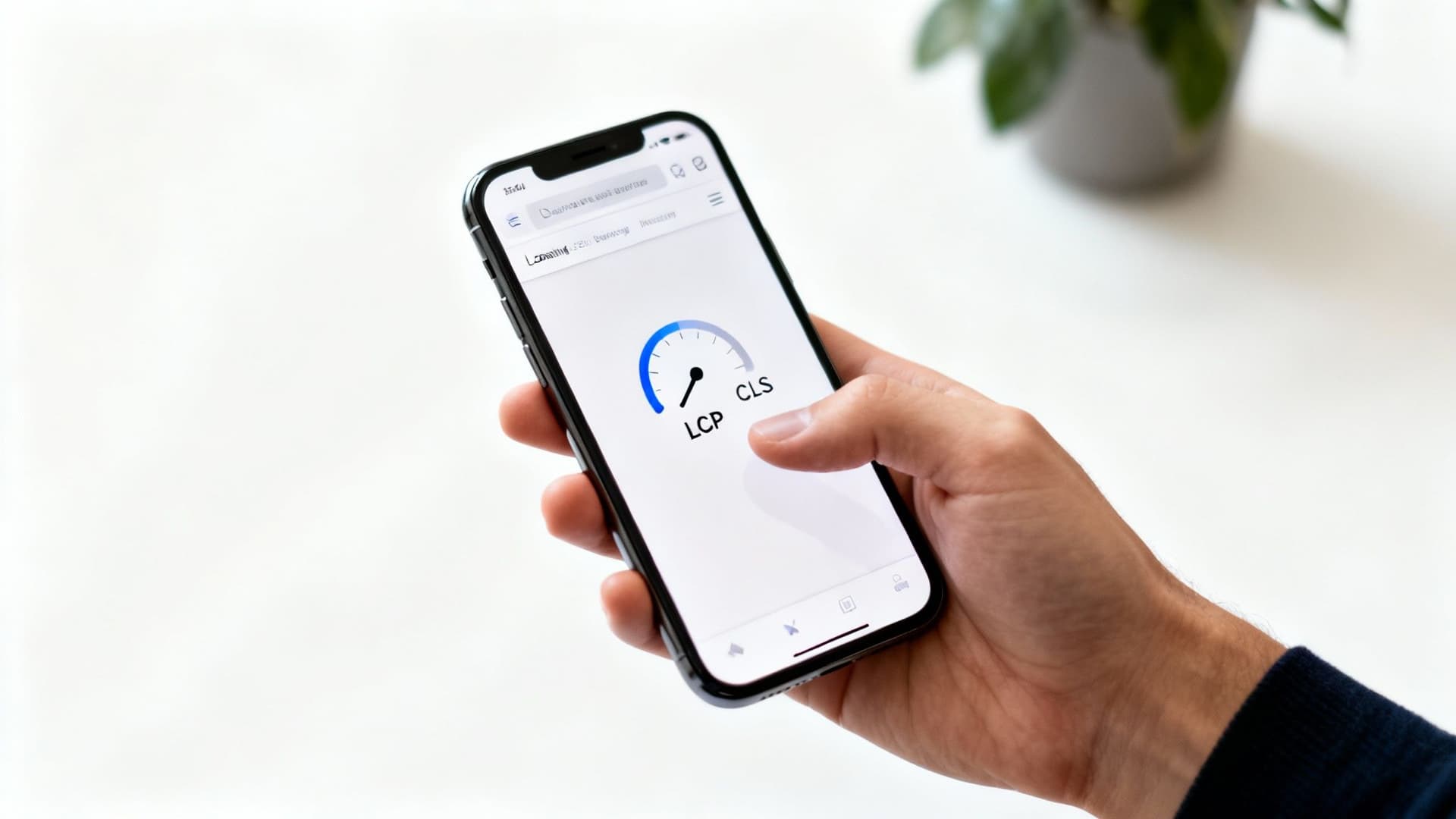
Google’s Core Web Vitals measure user experience in three practical ways: Largest Contentful Paint (LCP) for speed, Interaction to Next Paint (INP) for responsiveness, and Cumulative Layout Shift (CLS) for visual stability.6
A slow or unstable site frustrates users and costs conversions. Improving these scores usually means compressing images, choosing a reliable host, and simplifying page design.8
Advanced Tactics to Outperform Your Competition
Once you’ve covered the basics, advanced tactics give a competitive edge.
Create a Web of Authority with Internal Linking
Strategic internal linking helps crawlers find related content and passes ranking power between pages. Link thoughtfully from high-value pages to deeper resources to guide both users and search engines.
Use Schema Markup to Win the Click
Schema (structured data) tells search engines extra details about your content — like ratings, event dates, or FAQs — helping you earn rich results that boost click-through rates.
Fine-Tune Your Image Optimization
Use descriptive file names (for example, advanced-on-page-seo-tips.jpg) and alt text that explains the image. Check competitor visuals to see what performs well, then adapt colors and styles that fit your brand.
Mastering these methods helps you rank and stand out in search.
Common On-Page SEO Questions Answered
How Long Does It Take to See Results?
It depends. Small changes may be noticed in days, but meaningful ranking improvements usually take about 3 to 6 months, depending on competition and site authority.7
What Is More Important: Content or Technical Elements?
Both matter. Start with user-first content, then ensure your technical setup lets search engines find and evaluate that content.
Can I Do On-Page SEO Myself?
Yes. Fundamentals like writing good titles, organizing content with headers, and optimizing images are approachable. Use tools to check keyword use and performance, and make steady improvements over time.
At MicroEstimates, we help businesses create custom embeddable tools to boost SEO and generate leads. You can build a professional calculator or estimator quickly and add interactive value to your site.
Quick Q&A (Concise User Questions and Answers)
Q: What exactly does on-page SEO control?
A: On-page SEO covers everything on a page you can change — title tags, meta descriptions, headers, content, URLs, images, and internal links.
Q: What should I fix first on my pages?
A: Start with titles, meta descriptions, H1/H2 structure, mobile usability, and making sure content answers user intent fully.
Q: How do I measure on-page improvements?
A: Track rankings, organic traffic, click-through rates, and user metrics like bounce rate and time on page. Also monitor Core Web Vitals for UX improvements.6
1.
Ahrefs, “Meta Descriptions: Do They Help Rankings and Clicks?” https://ahrefs.com/blog/meta-description/
2.
Internet Live Stats, “Google Search Statistics” https://www.internetlivestats.com/google-search-statistics/
3.
BrightEdge, “Organic Search Is a Top Driver of Traffic” https://www.brightedge.com/resources
4.
Statista, “Share of website traffic from mobile devices” https://www.statista.com/statistics/277125/share-of-website-traffic-coming-from-mobile-devices/
5.
StatCounter, “Search engine market share — mobile” https://gs.statcounter.com/search_engine_market_share/mobile/search
6.
Google Web Dev, “Core Web Vitals” https://web.dev/vitals/
7.
Search Engine Journal, “How Long Does SEO Take?” https://www.searchenginejournal.com/how-long-does-seo-take/
8.
Google Developers, “Why Performance Matters” https://developers.google.com/web/fundamentals/performance/why-performance-matters
Ready to Build Your Own Tools for Free?
Join hundreds of businesses already using custom estimation tools to increase profits and win more clients
✨ No coding required • 🚀 Ready in minutes • 💸 Free to create