Think of website engagement tools as the difference between a window shopper and a buyer. The right interactive features—live chat, calculators, quizzes, review widgets—turn passive visitors into active participants, increasing trust, conversions, and search visibility.
January 25, 2026 (9mo ago) — last updated June 26, 2026 (4mo ago)
Website Engagement Tools to Boost Conversions
Discover engagement tools—chats, calculators, quizzes, review widgets—that increase dwell time, improve SEO, and convert visitors into customers.
← Back to blog
Website Engagement Tools to Boost Conversions
Summary: Discover the engagement tools—chats, calculators, quizzes, and review widgets—that increase dwell time, improve SEO, and convert visitors to customers.
Introduction
Think of website engagement tools as the difference between a window shopper and a buyer. The right interactive features—live chat, calculators, quizzes, review widgets—turn passive visitors into active participants, increasing trust, conversions, and search visibility.
What Are Website Engagement Tools?
Imagine your website as a store. If people glance in the window and walk away, you’re missing opportunities. Engagement tools act like greeters, demos, or product experts that keep visitors interested and moving toward a purchase.
These features capture attention and encourage meaningful interaction. The longer someone stays and the more they interact, the more likely they are to trust your brand and take a high-value action.
Why Engagement Matters for SEO and Business Growth
Engagement isn’t just a feel-good metric. When visitors use your content, they send strong signals to search engines that your page is valuable and relevant1. Interactive tools also attract backlinks, which remain one of the most influential ranking factors for organic search results1.
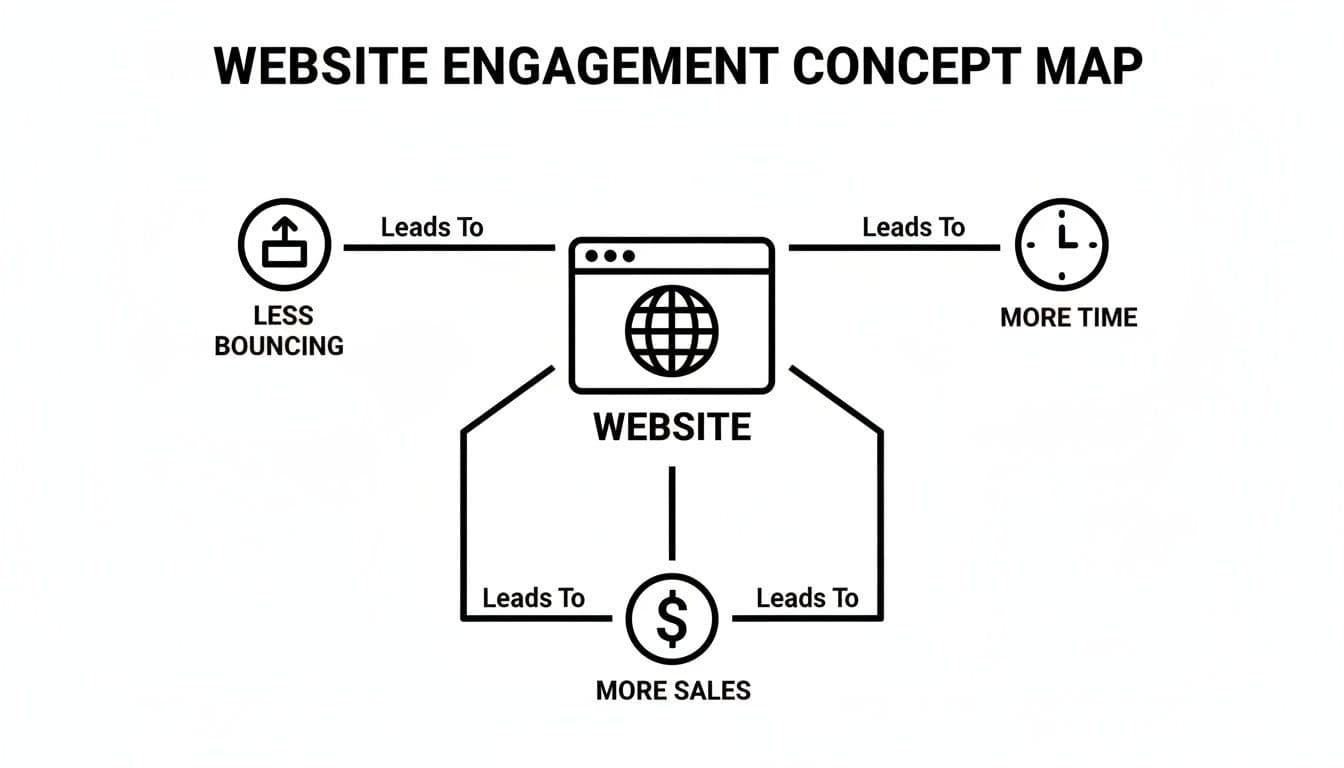
By turning passive browsing into an active, problem-solving experience, you reduce bounce rates, increase dwell time, and create memorable brand impressions that drive conversions.
Direct Business Impact
An engaged visitor is far more valuable than a passive one. Typical outcomes of adding interactive tools include:
- Reduced bounce rate: Tools that solve a user’s immediate problem keep them on the page.
- Increased dwell time: Calculators and estimators can keep users engaged for minutes, signaling authority to search engines.
- Higher conversion rates: Instant answers build trust and guide visitors to next steps.
- Better lead quality: Tools that address specific problems pre-qualify high-intent users.
These outcomes translate directly into more qualified leads and higher revenue.
Core Types of Website Engagement Tools
You don’t need every possible tool—just the right ones for your goals. Here are four categories that consistently drive results.
Communication Tools
These are your digital receptionists. They open immediate, two-way conversations and capture leads before they leave.
- Live chat: Connects visitors to a real person for complex questions.
- Chatbots: Provide 24/7 answers for common questions.
- Click-to-call buttons: Make it easy for mobile users to call with one tap.
Feedback Tools
Ask visitors what they think. Feedback tools turn audience insight into product and site improvements.
- Surveys: Deep dives into customer satisfaction.
- Polls: Quick, one-question snapshots of visitor opinion.
- Feedback forms: Simple ways for users to report bugs or suggest features.
Social Proof Tools
People trust peer experiences. Social proof reduces hesitation and improves conversion rates.
- Testimonial sliders: Showcase client praise.
- Review widgets: Pull star ratings from trusted platforms.
- Case study pop-ups: Highlight quick success stories.
Interactive Content Tools
These are the highest-value engagement assets: calculators, estimators, quizzes, and configurators. They turn passive readers into active participants and create memorable value.
For example, a financial advisor offering a Mortgage Calculator gives visitors an immediate, personalized answer that builds trust. A marketing firm can use a Social Media Management Cost Estimator to qualify leads before the first sales conversation, or an advisor can offer a Business Valuation Estimator for instant credibility.
How Interactive Content Drives SEO and Sales
Interactive content flips a user’s role from reader to participant. Instead of passively consuming text, users input data and receive personalized results—an experience that signals quality to search engines and encourages sharing and backlinks1.
A useful, unique tool is also strong link bait: industry blogs and news outlets are more likely to link to a helpful calculator than a generic article, which helps your domain authority and search rankings1.
Turning Engagement Into Qualified Leads
Interactive tools naturally attract users with real intent. Examples:
- Real estate: a Mortgage Calculator captures serious homebuyers who are comparing financing options.
- Agencies: a Social Media Management Cost Estimator demonstrates expertise and pre-qualifies clients.
- Finance: a Business Valuation Estimator provides instant value and positions advisors as trusted experts.
The No-Code Advantage
Building custom tools used to require costly development. No-code platforms let businesses create and embed professional calculators without heavy developer time, reducing cost and time to market. This makes advanced engagement assets accessible to small and mid-size companies.
The website builder and tools market is growing fast, reflecting rising investment in interactive web experiences2.
Choosing the Right Tools for Your Business
Start with your objective. Are you after more qualified leads, better support, or clearer product understanding? Match your goal to a tool—for lead-gen, choose a calculator; for support, choose live chat.
Key Criteria for Evaluation
Use this checklist when comparing tools:
- Ease of use: Can your team launch it quickly?
- Customization: Does it match your brand and UX?
- Integration: Will it connect with your CRM or email platform?
- Pricing and scalability: Will it grow with your business?
Build vs. Buy
Building a custom tool gives full control but usually costs more and takes longer. Off-the-shelf or no-code platforms provide speed and lower upfront cost while delivering most business benefits.
For many service businesses, an off-the-shelf estimator delivers strong ROI compared with a custom build.
Market demand for analytics and engagement tools is rising, and the web analytics market is expanding as businesses rely more on data to prove results3.
Measuring the ROI of Your Engagement Tools
Launching a tool is only the first step. Prove value by connecting tool interactions to revenue.
Define KPIs
Choose KPIs tied to business outcomes—not vanity metrics. Examples:
- Live chat: support tickets resolved or qualified leads generated.
- Quiz: completion rate and lead conversion from results.
- Calculator: total submissions and downstream closed deals tracked in your CRM.
Track With Analytics
Use analytics to monitor sitewide impact—session duration, pages per session, and bounce rate. If time-on-page increases and bounce rate drops after launch, that’s evidence your tool is working. Don’t forget to keep page speed in mind—slow tools can hurt both user experience and SEO, so use tools that load asynchronously and test with PageSpeed Insights4.
Built-In Analytics
Tools with built-in dashboards simplify measurement. You can see starts, completions, and leads without complex setup, then connect those leads to your CRM for closed-loop ROI reporting.
Your First Steps to a More Engaging Website
You don’t need to overhaul your site. Follow a simple, five-step plan for a quick win:
- Pinpoint one engagement gap—where visitors drop off.
- Set a measurable goal (for example, 10 qualified leads in 30 days).
- Build a pilot tool using a no-code service or an off-the-shelf estimator.
- Place it on a high-traffic, relevant page.
- Track results for 30 days to validate impact.
A single embedded tool—such as a Mortgage Calculator on a real estate page—can start qualifying leads immediately.

Frequently Asked Questions
What do engagement tools cost?
Costs vary widely. Simple widgets can be free or low-cost; robust live chat or enterprise tools can be $50–$500+ per month. No-code platforms offer a middle ground with subscription pricing and far lower upfront development costs.
Will these tools slow down my site?
Poorly built tools can harm page speed. Choose tools that load asynchronously and test performance with PageSpeed Insights4.
What’s the best engagement tool for B2B?
For B2B services, interactive calculators and estimators usually outperform other tools because they provide immediate, actionable value and qualify high-intent leads.
Key Q&A — Quick Answers
Q: Which engagement tool gives the fastest ROI?
A: Calculators and estimators—because they provide immediate value, capture intent, and pre-qualify leads for sales.
Q: How do I prove a tool created revenue?
A: Tag tool-generated leads with UTM parameters or hidden CRM fields, then track conversions through your CRM for closed-loop reporting.
Q: How do I avoid technical headaches?
A: Start with a no-code or lightweight tool that offers built-in analytics and easy CRM integrations.
Three Quick Q&A Summaries
Q: What should I build first?
A: Pick one high-traffic page and add a single interactive tool that answers a specific user need.
Q: How will I measure success?
A: Track submissions, conversion rate, and downstream revenue in your CRM.
Q: When should I scale?
A: If the pilot meets your KPI within 30–60 days, expand placement and variations.
1.
Backlinko, “We Analyzed 11.8 Million Google Search Results,” https://backlinko.com/search-engine-ranking
2.
Future Market Insights, “Website Builder Tool Market,” https://www.futuremarketinsights.com/reports/website-builder-tool-market
3.
Grand View Research, “Web Analytics Market Size,” https://www.grandviewresearch.com/industry-analysis/web-analytics-market
4.
Google Developers, “PageSpeed Insights,” https://developers.google.com/speed/pagespeed/insights/
Ready to Build Your Own Tools for Free?
Join hundreds of businesses already using custom estimation tools to increase profits and win more clients
✨ No coding required • 🚀 Ready in minutes • 💸 Free to create