Transform your website's performance with a practical site content audit. Learn how to diagnose weak content, improve SEO, and drive meaningful growth.
February 9, 2026 (8mo ago)
A Practical Guide to Your Next Site Content Audit
Transform your website's performance with a practical site content audit. Learn how to diagnose weak content, improve SEO, and drive meaningful growth.
← Back to blog
A Practical Guide to Your Next Site Content Audit
Transform your website's performance with a practical site content audit. Learn how to diagnose weak content, improve SEO, and drive meaningful growth.
A site content audit isn't just about spring cleaning your website—it's a full strategic review of everything you've published. Roll up your sleeves to figure out what content is actually working, what’s just taking up space, and what you can remove or repurpose. It’s less about deleting old posts and more about strategically overhauling your content library to improve the user experience and, just as importantly, your search rankings.
Why a Content Audit Is Your Most Powerful Growth Lever
Let’s be honest: most of the pages on the web get little to no organic search traffic. A big percentage of published pages are essentially invisible to search engines and users1. A site content audit is how you fight back. It’s a systematic review of every page—from blog posts to service pages—to find what’s working, what’s failing, and what’s actively holding you back. Think of it as a health check-up for your website that helps you prepare for algorithm changes and long-term growth.
Uncovering Hidden Opportunities
Performing a content audit is like finding money in your website’s couch cushions. You might discover a page that attracts traffic but has poor engagement. Instead of letting it sit idle, you can turn it into a lead-generating asset.
For example, imagine a blog post about small business finance that gets search traffic but short session durations. Embed a relevant interactive tool—such as the Business Valuation Estimator—to give visitors immediate value. They get a quick estimate of their business’s worth; you get higher engagement and a qualified lead. A forgotten page becomes a valuable part of your funnel without having to create wholly new content.
When you analyze content with data, you can:
- Identify winners: find pages already driving traffic and conversions so you can double down.
- Spot underperformers: detect pages that need updates, merging, or pruning to improve overall site quality.
- Discover content gaps: see topics competitors rank for that you haven’t covered and build a roadmap for new content.
An audit forces you to align every piece of content with a clear goal—the heart of any strong content strategy. You’ll see which posts could use an embedded tool like the YouTube Channel Value Estimator or the Social Media Management Cost Estimator to add value and capture leads.
Laying the Groundwork for a Killer Content Audit
Before opening a spreadsheet, decide what you want the audit to achieve. If you skip this step, you’re just making a long list of URLs. Are you trying to increase organic traffic, generate more qualified leads, or clear out irrelevant pages? Your objective sets the tone for every decision that follows.
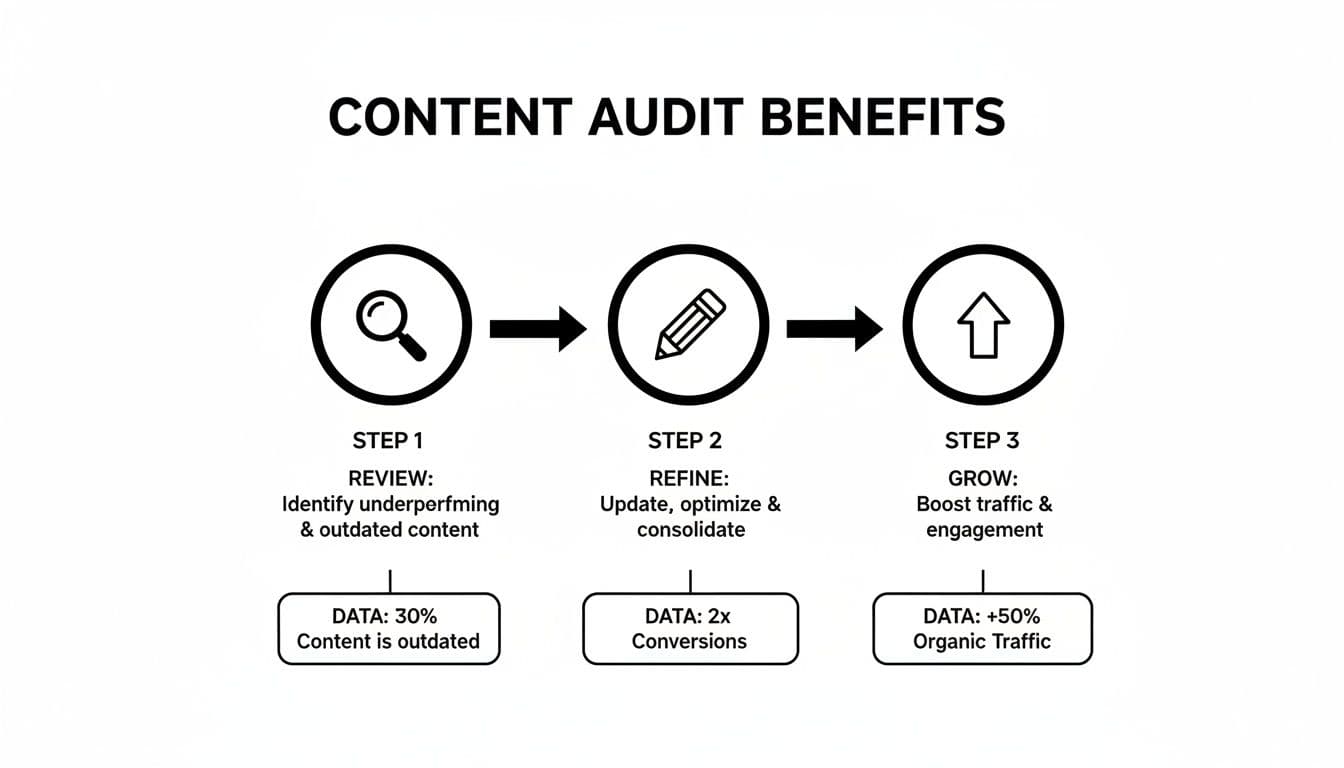
If your target is a 20% traffic increase, you’ll focus on keyword rankings and backlinks. If the goal is lead generation, prioritize conversion rates and engagement on high-value pages. The process is simple: review what you have, refine it using data, and then monitor results.
Taking Stock: Building Your Content Inventory
Once you know your “why,” build a content inventory—the master list of every URL on your site. This is the bedrock of your audit. A crawling tool like Screaming Frog or a site-audit tool in Semrush can export every URL your site exposes. That first export will include blog posts, service pages, PDFs, and more. It can feel like a data tidal wave, but you need the complete picture.
A useful inventory is more than a list of links. Include columns for data you’ll add later, such as:
- Page title and meta description
- Word count
- Publication or last updated date
- Author
Your inventory shows you what you really have and prevents overlooked pages or embarrassing duds.
Arming Yourself with the Right Data and Tools
With an inventory in hand, layer in performance data to connect high-level goals with actual behavior. Pull from a few key sources:
- Google Analytics: page views, bounce rate, time on page.
- Google Search Console: impressions, clicks, and keyword performance.
- An SEO tool (Ahrefs, Moz, SEMrush): backlinks and authority metrics.
If lead generation is your goal, spot pages with solid traffic but no call-to-action—low-hanging fruit. Also consider site architecture for SEO so users and crawlers can find your best content more easily.
How to Gather and Interpret Your Content Data
This is the real work. Your URL list is a map—now add the terrain. Layer in organic traffic, keyword rankings, bounce rate, time on page, and conversions to tell the true story of each piece of content. The goal is to move from “I think this page is good” to “I know this page drives results.”

What Data Should You Actually Collect?
To avoid drowning in analytics, focus on a core set of metrics for every URL:
- Organic traffic: visitors from search engines over a set period.
- Keyword rankings: position for target search terms.
- Bounce rate: percentage that leaves after one page.
- Time on page: average active time spent.
- Conversions: form fills, downloads, signups, or purchases.
- Inbound links: quantity and quality of backlinks.
The most powerful insights come from combinations of metrics. High traffic with a 95% bounce rate and zero conversions is not a winner—it’s a red flag.
Moving From Raw Data to Real Insights
Populate your spreadsheet, then interpret with context. A high bounce rate on a long-form article is usually negative; on a contact page, it may be normal. For an underperforming blog post, think bigger than small edits: embed an interactive tool such as the Business Valuation Estimator to boost engagement and capture leads.
A Simple System for Scoring Your Content
Make the data manageable with a scoring system (1–5) across key categories:
- Traffic score: how organic traffic compares to your site average.
- Engagement score: time on page and bounce rate.
- Conversion score: how well it converts visitors.
- SEO value score: backlinks and keyword value.
This scoring helps prioritize actions. High-traffic, low-conversion pages are prime candidates for content upgrades; pages with strong backlinks but outdated content are easy wins for refreshes.
The Four Action Buckets for Your Content
Sort every URL into one of four choices:
- Keep: pages that perform well—monitor and maintain them.
- Improve: pages with potential that need updates, expansion, or new calls-to-action.
- Consolidate: merge multiple pages that compete for the same keywords into one authoritative resource.
- Prune: remove thin, irrelevant, or zero-value pages to improve overall site quality.
Regular audits fight the trend of low-performing pages and deliver strong ROI by focusing resources on content that matters1.
A Real-World Example of “Improve”
An old post that ranks but has poor engagement deserves a major upgrade. Add interactive tools or fresh examples. Embedding a tool like the Business Valuation Estimator can turn passive readers into engaged users and qualified leads. Strategic repurposing and clear calls-to-action can change a page’s trajectory from mediocre to high-performing.
Creating Your Content Action Plan
An audit without action is just a spreadsheet. Build a prioritized roadmap that balances quick wins with major projects. Assign ownership, set deadlines, and measure results.

Prioritizing for Maximum Impact
Prioritize items by potential impact and required effort:
- Quick wins (high impact, low effort): update meta descriptions, fix internal links, add CTAs on pages with decent traffic.
- Major projects (high impact, high effort): merge several thin posts into a comprehensive guide or rewrite key service pages.
- Fill-in tasks (low impact, low effort): minor formatting or image updates.
- Re-evaluate later (low impact, high effort): defer large overhauls that won’t move the needle.
Building Truly Actionable Tasks
Use specific tasks, not vague reminders. Instead of “update blog post,” use: “Update ‘The Ultimate Guide to Instagram Ads’ with 2024 statistics and embed the YouTube Channel Value Estimator to improve relevance and generate leads.”
When you remove or consolidate content, set up proper 301 redirects to preserve link equity and user experience3.
Measuring the ROI of Your Content Audit
A site content audit takes time and resources. Measure impact by annotating key change dates in Google Analytics so you can see before-and-after performance. Track the KPIs that matter:
- Organic traffic growth
- Keyword ranking improvements
- Higher engagement (time on page)
- More conversions
If an optimized page that previously had low conversions begins to capture qualified leads after embedding a tool like the Mortgage Calculator or the Business Valuation Estimator, you’ve created a repeatable playbook for success.
Tracking ROI isn’t just a victory lap; it’s how you learn what works so you can do more of it.
Common Questions That Pop Up During a Content Audit
How Often Should I Actually Be Doing This?
It depends on your site’s size and publishing cadence. For many sites, a deep annual audit plus quarterly mini-audits on critical pages and recent content is a practical rhythm that keeps issues from accumulating2.
What’s the Best Way to Handle Seasonal Content?
For recurring seasonal pages, update the existing page each year to retain earned authority. For one-off promotions, set a permanent redirect from the old URL to a relevant evergreen page so link equity isn’t wasted.
My Page Gets Tons of Traffic but Zero Conversions. What Gives?
High traffic with low conversions is an opportunity. Match content to user intent and give visitors a clear next step. Add stronger CTAs or an embedded tool—like the Business Valuation Estimator or the YouTube Channel Value Estimator—to turn visitors into leads.
At MicroEstimates, we help you turn content into lead-generating assets. Create custom, embeddable tools in minutes to boost engagement and capture qualified leads. Get started for free and build your first tool today.
Quick Q&A
What is a site content audit?
A site content audit is a systematic review of every page on your site to assess performance, identify gaps, and decide whether to keep, improve, consolidate, or prune each URL.
How do I prioritize content updates?
Prioritize by potential impact and effort: start with high-impact, low-effort quick wins, then schedule major projects that will move the needle.
What metrics matter most?
Focus on organic traffic, keyword rankings, engagement (time on page and bounce rate), conversions, and inbound links.
1.
Ahrefs, “Most pages get no traffic from Google,” https://ahrefs.com/blog/most-pages-get-no-traffic/
2.
Content Marketing Institute, “How to conduct a content audit,” https://contentmarketinginstitute.com/
3.
Google Search Central, “301 redirects,” https://developers.google.com/search/docs/advanced/crawling/301-redirects
Ready to Build Your Own Tools for Free?
Join hundreds of businesses already using custom estimation tools to increase profits and win more clients
✨ No coding required • 🚀 Ready in minutes • 💸 Free to create