Discover proven strategies for SEO for dentists. Learn how to master local search, create patient-centric content, and use tech to book more appointments.
January 18, 2026 (9mo ago)
A Guide to SEO for Dentists That Actually Drives New Patients
Discover proven strategies for SEO for dentists. Learn how to master local search, create patient-centric content, and use tech to book more appointments.
← Back to blog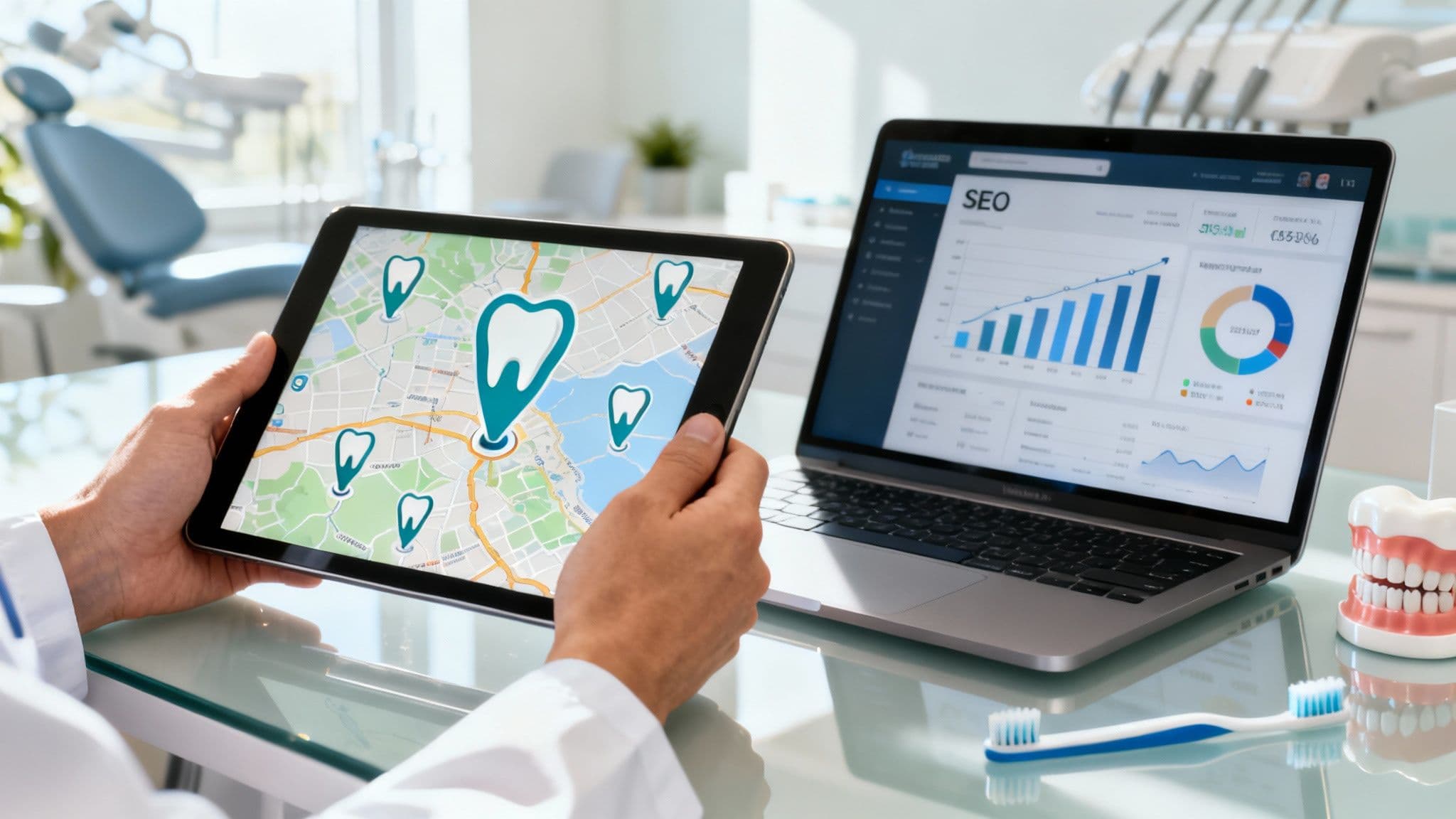
A Guide to SEO for Dentists That Actually Drives New Patients
Summary: Discover proven strategies for SEO for dentists. Learn how to master local search, create patient-centric content, and use tech to book more appointments.
Introduction: Discover proven strategies for SEO for dentists. Learn how to master local search, create patient-centric content, and use tech to book more appointments.
SEO for dentists is really about one thing: making your practice the first one potential patients see when they’re searching online for dental care. It’s the process of fine-tuning your entire digital presence so that when someone in your town searches for a dentist, your name pops up first, turning that search directly into a booked appointment.
Why SEO Is Your Practice’s Most Valuable Patient Magnet
Let’s be direct. The days of filling your appointment book with word-of-mouth referrals or a Yellow Pages ad are over. The modern patient’s journey to your chair almost always starts online, usually with a few taps on a smartphone. They’re looking for everything from “emergency dentist near me” to “cost of Invisalign in [Your City].” SEO is what puts your practice front and center at that exact moment.
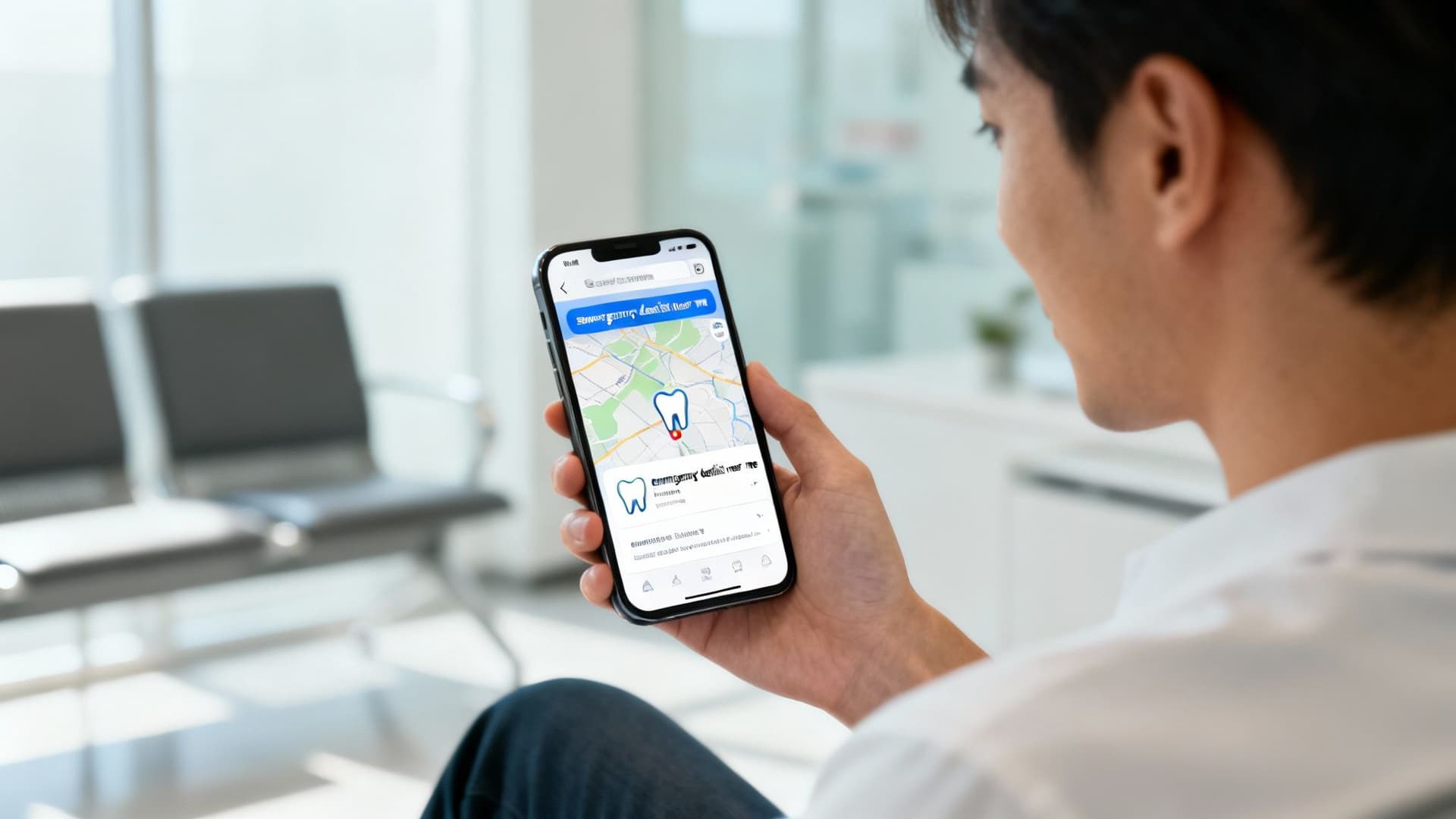
Search volume for local terms like “dentist near me” can be very large, which makes local visibility critical for patient acquisition1. That alone shows why you can’t afford to ignore SEO. In fact, a large share of people looking for a new dentist start with an online search2, and many will contact a practice after finding them online3. It’s a powerful, predictable pipeline for new patients.
Connecting with High-Intent Patients
Good dental SEO isn't just about getting seen by everyone; it’s about attracting the right patients. We’re talking about the people actively searching for the high-value services you excel at. Your strategy needs to go beyond generic keywords and target real patient intent. You want to show up for specific, valuable searches like:
- “Dental implants payment plans”
- “Best cosmetic dentist for veneers”
- “Same-day crown appointment”
When your practice ranks for terms like these, you’re connecting with people who are past the “just browsing” stage. They’re ready to make a decision. This is where your website’s content and interactive tools can become your most effective sales team.
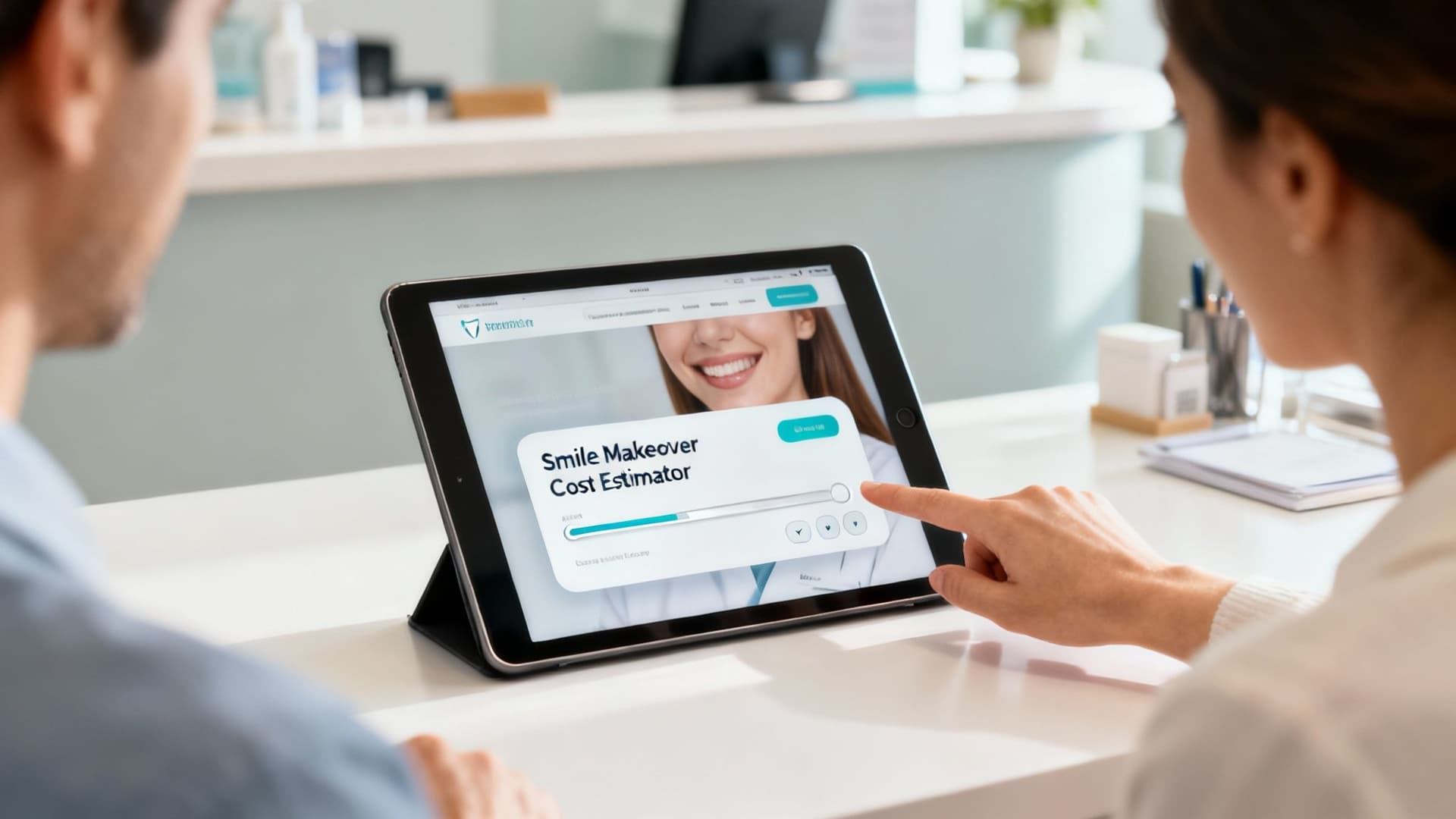
For instance, embedding a cost estimator on a service page can be a game-changer. Imagine a potential patient landing on your page for crowns, seeing a tool that gives them an instant price range, and submitting their contact info right then and there. A clear, interactive estimator provides immediate value and captures a lead at peak interest. Consider adding a calculator such as the Healthcare Procedure Cost Calculator to give visitors a fast, personalized estimate.
Building Trust Before the First Visit
Showing up on the first page of Google does more than just drive traffic. It builds immediate credibility. A high ranking is essentially a stamp of approval from Google, signaling to searchers that your practice is a trusted, authoritative choice in your community.
“Think of your digital presence as your new storefront. SEO makes sure that storefront is on the busiest, most visible street on the internet, open 24/7, and welcoming to every potential patient who passes by.”
This foundation of trust is everything. When paired with great reviews and a professional, easy-to-use website, SEO creates a powerful first impression long before a patient ever steps foot in your office. They’re not just looking for any provider; they’re looking for a partner in their health. By investing in your online presence, you’re simply making it easier for people who need your care to find you.
To get a broader perspective on how SEO benefits small businesses, see the resources from established local-marketing research and platforms4.
Building a Website That Google and Patients Will Love
Your website is your digital front door. If a potential patient lands on your site and it’s slow, clunky on their phone, or confusing, they’re gone. They’ll hit the back button and head straight to your competitor. Getting the technical and on-page SEO right isn’t just a “nice-to-have”—it’s the foundation of your entire digital marketing strategy.
Put yourself in a patient’s shoes for a moment. They’re probably searching on their phone, maybe in a bit of a panic over a toothache. They need info, and they need it now. Research shows mobile users are impatient: slow load times increase abandonment and reduce conversions, so speed matters for both users and search engines5.
Speed Is a Non-Negotiable
Site speed isn’t just about keeping impatient visitors happy; it’s a strong signal to Google. A slow site signals poor user experience and can hurt your local rankings.
You can get a quick pulse check on your site’s performance with free tools like Google’s PageSpeed Insights. It gives a clear score for mobile and desktop and highlights specific issues—bulky images, render-blocking scripts, or unoptimized resources—that you can fix to improve load times and rankings.
Structuring Your Site Around High-Value Services
A well-organized website makes it straightforward for both Google and patients to understand what you do. One common mistake is lumping all services onto a single generic page. Instead, create dedicated, in-depth pages for your most important treatments.
This targeted approach is the cornerstone of effective SEO for dentists. Each service page becomes a focused asset targeting specific keywords.
Examples:
- Dental Implants Page: Make this the go-to resource for implants—benefits, step-by-step process, candidacy, and costs. Consider embedding the Healthcare Procedure Cost Calculator to provide immediate pricing context and capture leads.
- Invisalign Page: Use before-and-after photos, patient testimonials, and clear financing or payment plan details.
- Veneers Page: Explain what veneers fix, the treatment timeline, and recovery expectations.
This structure helps you show up for high-intent searches like “dental implants in [Your City]” or “Invisalign cost,” attracting patients who are much further along in their decision process.
“Think of a disorganized website like a reception area with no one at the front desk. Patients arrive, get confused, and leave. A clear, service-focused site structure guides them directly to the information they need, making them feel confident and ready to book.”
Optimizing for a Mobile-First World
Most local searches happen on a smartphone. If your website is hard to use on mobile, you’re essentially invisible to many potential patients. Real mobile optimization means thinking about the user’s experience:
- Buttons need to be large and easy to tap.
- Navigation menus should be simple and intuitive.
- Phone numbers must be click-to-call.
- Text must be readable without pinching or zooming.
A polished mobile experience is critical. You can also embed mobile-friendly estimators such as the Dental Crown Cost Estimator so visitors get instant answers on the go.
For core user-experience best practices, prioritize clear CTAs, streamlined navigation, and prominent contact options (click-to-call, online booking, and contact forms).
Dominating The Local Map And Winning The “Near Me” Search
For a dental practice, the real SEO battle isn’t national—it’s won or lost in your neighborhood.
When a patient wakes up with a throbbing toothache at 2 a.m., they’re not searching for “best dentist in the country.” They’re typing “emergency dentist near me.” In that moment, your local SEO determines whether they find you or your competitor.
The heart of local SEO is your Google Business Profile (GBP). It’s the info box that appears in Google Maps and search results, and for many people it’s the first impression they’ll have of your practice.
Local SEO is everything for a dentist. Many potential patients use search engines to find a provider, and a significant portion of those searches lead to same-day appointments, so a complete GBP and strong local presence matter greatly6.
Your Google Business Profile Is Your Digital Front Desk
One costly mistake is treating the GBP as an afterthought. It’s not “set it and forget it.” It’s a living profile that needs regular attention to show Google your practice is active and trustworthy.
Fill out every field: the most accurate primary category, relevant secondary categories (for example, “Cosmetic Dentist” or “Pediatric Dentist”), up-to-date hours, quality photos, and a complete services list with descriptions and price ranges where appropriate.
Use these GBP features regularly:
- Google Posts: Announce specials, new team members, or health tips.
- Q&A Section: Seed common questions and answer them clearly.
- Services: List all services with concise, helpful descriptions.
A well-managed profile drives more calls, direction requests, and booked appointments.
Optimized vs. Unoptimized Google Business Profile
| Feature | Unoptimized Profile (The Competition) | Fully Optimized Profile (Your Practice) |
|---|---|---|
| Completeness | Basic info only (name, address, phone). | All sections filled: services, hours, photos, Q&A. |
| Photos | Maybe a single, outdated exterior shot. | High-quality photos of the team, office, and technology. |
| Reviews | A few old reviews, some unanswered. | A steady stream of new reviews, with prompt replies. |
| Posts & Updates | No recent activity or posts. | Regular posts about promotions, events, and health tips. |
| Patient Perception | Looks unprofessional or possibly closed. | Appears active, trustworthy, and welcoming. |
| Visibility | Ranks lower in the Map Pack for key searches. | Ranks higher, attracting more local clicks and calls. |
The Power Of Patient Reviews
Reviews are social proof that fuels local SEO. For Google and prospective patients, they’re a major trust signal. A steady flow of recent, positive reviews shows you provide excellent care.
Don’t wait for reviews to happen by chance. Use a simple follow-up email or text the day after a visit with a direct link to your GBP review page. Make it easy for satisfied patients to leave feedback.
All of this local SEO work rests on a fast, mobile-friendly website with clear structure. Without it, other efforts won’t be as effective. For a practical local SEO checklist, add an optimized GBP, consistent citations, a review-generation process, and service pages that convert.
Creating Content That Answers Patient Questions and Builds Trust
Solid local SEO gets potential patients to your website. But it’s the content on that site that convinces them you’re the right dentist and prompts them to book.
Too many dental blogs publish generic posts that don’t attract high-value patients. Your content strategy should transform your website from a brochure into a resource that answers the real, often urgent, questions patients type into Google. That’s the heart of effective SEO for dentists.
Find Out What Patients Are Really Asking
Stop guessing. Find out what your potential patients want to learn. The best source of content ideas is your front desk. Your team hears real questions every day, such as:
- “Are dental implants really worth the cost?”
- “How long does the Invisalign process take?”
- “What’s the real difference between porcelain veneers and bonding?”
- “Do you offer payment plans for cosmetic procedures?”
These are high-intent queries. Someone asking about financing for implants isn’t just window shopping—they’re close to deciding. Your website should be the best place online for those answers. Use long-tail keyword research to capture these queries.
Build Service Pages That Actually Convert
Service pages for implants, veneers, and orthodontics should be comprehensive resources. Walk patients through benefits, the procedure, recovery, and costs. Price is often the biggest barrier, and addressing it up front builds trust.
Each service page should act like a mini-consultation. Consider adding interactive elements—calculators, downloadable guides, or step-by-step visuals—to increase engagement and conversions.
Turn Your Pages into Interactive Experiences
Imagine a patient lands on your dental implants page. Instead of “contact us for a quote,” they find an embedded estimator. A tool such as the Healthcare Procedure Cost Calculator answers their biggest concern about investment immediately and can capture an email to send the estimate.
Benefits of an embedded estimator:
- Answers the primary question: immediate cost transparency.
- Captures warm leads: request an email to send the estimate.
- Boosts SEO: interactive content increases dwell time, a positive signal to search engines.
You can apply the same approach on cosmetic pages with combined-estimate tools and on orthodontics pages to show monthly payment options. Interactive tools save staff time and position your practice as transparent and patient-focused.
Turning Website Visitors Into Booked Appointments with Interactive Tools
Getting a potential patient to your website is a huge win, but it’s only half the battle. You need to close the gap between their question and your solution. For many patients, the biggest hesitation is cost. Answering that instantly converts interest into action.
Empowering Patients with Instant Answers
When a visitor uses an estimator on your veneers page, they get a personalized, confidential quote in seconds. That interaction pre-qualifies the lead and reduces friction in the booking process.
Interactive tools typically:
- Pre-qualify leads: users who proceed after seeing an estimate are serious.
- Save staff time: fewer repetitive pricing calls.
- Build immediate trust: transparency about cost is a major differentiator.
The SEO Benefits of Interactive Content
Beyond lead quality, interactive tools boost engagement metrics that search engines value. Longer dwell time and lower bounce rates tell Google your page satisfies the user’s query, which supports higher rankings over time. Consider adding interactive calculators and clear CTAs to convert visitors into booked patients.
The marketing landscape is evolving toward more dynamic, AI-assisted experiences. Embedding useful tools positions your practice as modern and patient-centered.
Putting Interactive Tools into Practice
You don’t need a development team to add useful tools. Use no-code or embeddable calculators to get started quickly.
Examples to implement now:
- Emergency Dental Visit Estimator: place this on your homepage or emergency services page to convert urgent searches.
- Dental Implant Estimator: embed on your implants page to capture high-value leads via the Healthcare Procedure Cost Calculator.
- Invisalign Cost Estimator: show monthly-payment scenarios and financing options to make treatment feel achievable.
By integrating these tools, you’re optimizing for both search engines and patients: instant answers, higher engagement, and more booked appointments.
Answering Your Top Questions About Dental SEO
Even with a solid plan, you’ll have questions as you put these pieces together. Here are clear answers to common concerns.
How Long Until I See Real Results From SEO?
SEO is a marathon, not a sprint. You may see small wins—like improved GBP impressions—within weeks, but meaningful increases in organic traffic and booked appointments usually take four to six months of consistent work. In highly competitive urban markets, it can take closer to a year to reach top results. The work you do now compounds over time.
Can I Do My Own SEO, or Do I Need to Hire Someone?
You can handle many tasks in-house—GBP updates, review generation, and writing helpful blog posts. Technical tasks like site-speed optimization, schema markup, and backlink acquisition often benefit from a specialist’s support. A hybrid approach—internal team for daily tasks, external expert for technical and strategic work—often works best.
Where Should I Start: Local SEO or Content?
Start with local SEO. If potential patients nearby can’t find you in the Map Pack, the best content won’t help. Get your GBP right, build consistent local citations, and generate reviews. Once the local foundation is solid, layer on a content strategy to capture higher-value, consideration-stage searches.
Quick Q&A: Common Patient-Focused Questions
Q: How do I find a dental practice that offers payment plans? A: Look for service pages that mention financing and payment plans, check the practice’s GBP Q&A, and use contact forms or click-to-call to confirm specifics.
Q: What should I expect to see on a trustworthy dental website? A: Clear service pages, staff bios, before-and-after photos, transparent pricing or an estimator, easy booking options, and recent patient reviews.
Q: How can I check if my practice ranks locally? A: Search from a mobile device using private/incognito mode for “dentist near me” and your city. Check your GBP position, Map Pack presence, and local citations.
Ready to make your website the hardest-working member of your team? Add transparent pricing tools and patient-focused content to boost trust, engagement, and bookings.
1.
SEMrush, keyword research and search volume tools indicate high monthly search volume for local queries such as “dentist near me.” See https://www.semrush.com.
2.
BrightLocal, Local Consumer Review Survey: consumers commonly begin local service searches online; see https://www.brightlocal.com/research/local-consumer-review-survey/.
3.
Statista and industry reports show a high share of patients contact providers after finding them online; see https://www.statista.com for related healthcare search behavior reports.
4.
Google PageSpeed Insights and web performance studies explain how site speed affects user behavior and search rankings; see https://pagespeed.web.dev/.
5.
DoubleClick and Google research on mobile user behavior: slow mobile pages increase abandonment and hurt conversions; see https://pagespeed.web.dev/.
6.
Local search behavior and Map Pack research from industry sources highlight the importance of GBP and local citations; see BrightLocal and Google’s local-search resources at https://www.brightlocal.com and https://support.google.com/business.
Ready to Build Your Own Tools for Free?
Join hundreds of businesses already using custom estimation tools to increase profits and win more clients
✨ No coding required • 🚀 Ready in minutes • 💸 Free to create