When people search “near me” for a quick lunch or an emergency plumber, being invisible online is a real business risk. If your business doesn’t appear in local search results or on maps, you’re not just missing clicks — you’re losing foot traffic and revenue to nearby competitors. Most mobile local searches lead to a store visit within a day, so local visibility matters. This checklist pares away jargon and gives clear, actionable steps across GBP, citations, schema, reviews, and local content.
December 7, 2025 (10mo ago) — last updated May 18, 2026 (5mo ago)
10-Point Local SEO Checklist for 2025
Boost local search rankings with 10 actionable steps for Google Business Profile, citations, reviews, schema, and local content.
← Back to blog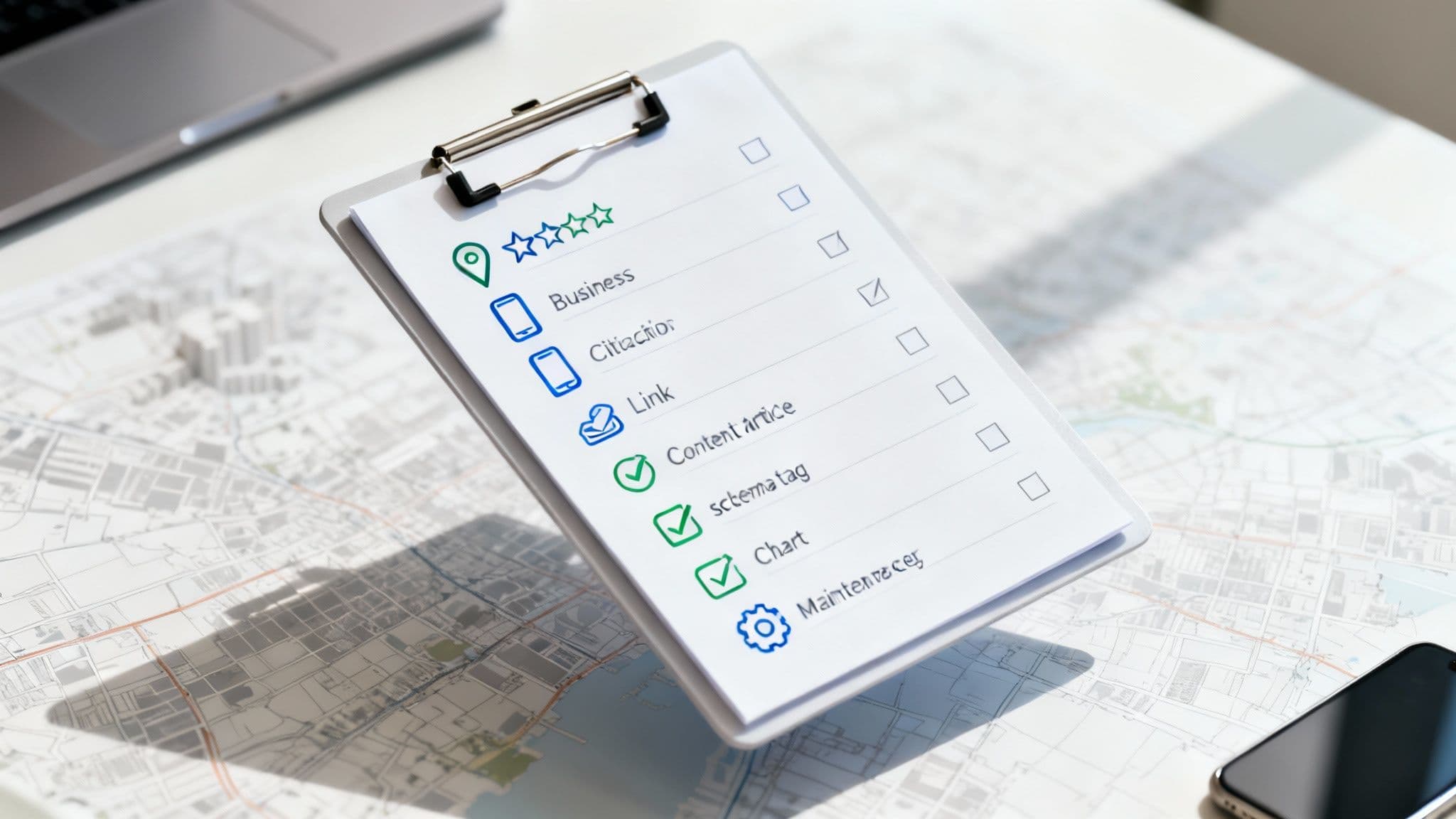
10-Point Local SEO Checklist for 2025
Summary: Boost local search rankings with 10 actionable steps for Google Business Profile, citations, reviews, schema, and local content.
Introduction
When people search “near me” for a quick lunch or an emergency plumber, being invisible online is a real business risk. If your business doesn’t appear in local search results or on maps, you’re not just missing clicks — you’re losing foot traffic and revenue to nearby competitors. Most mobile local searches lead to a store visit within a day1, so local visibility matters.
This practical checklist pares away jargon and gives a clear, step-by-step plan to win your local market. It covers essential elements like your Google Business Profile, local citations, on-page local keywords, schema markup, and community-based link building. Use the recommended tools and pages to convert searchers into qualified leads, for example the Email List Value Estimator to estimate the value of leads you capture from local visitors.
We’ll walk through the ten pillars of local SEO with concise, actionable steps. Let’s dive in and turn your local presence into a competitive advantage.
1. Create and Optimize Google Business Profile
Your Google Business Profile (GBP) is the cornerstone of local SEO. It appears in the Map Pack and on Google Maps, and a complete, accurate GBP listing makes you visible, trustworthy, and easy to contact.
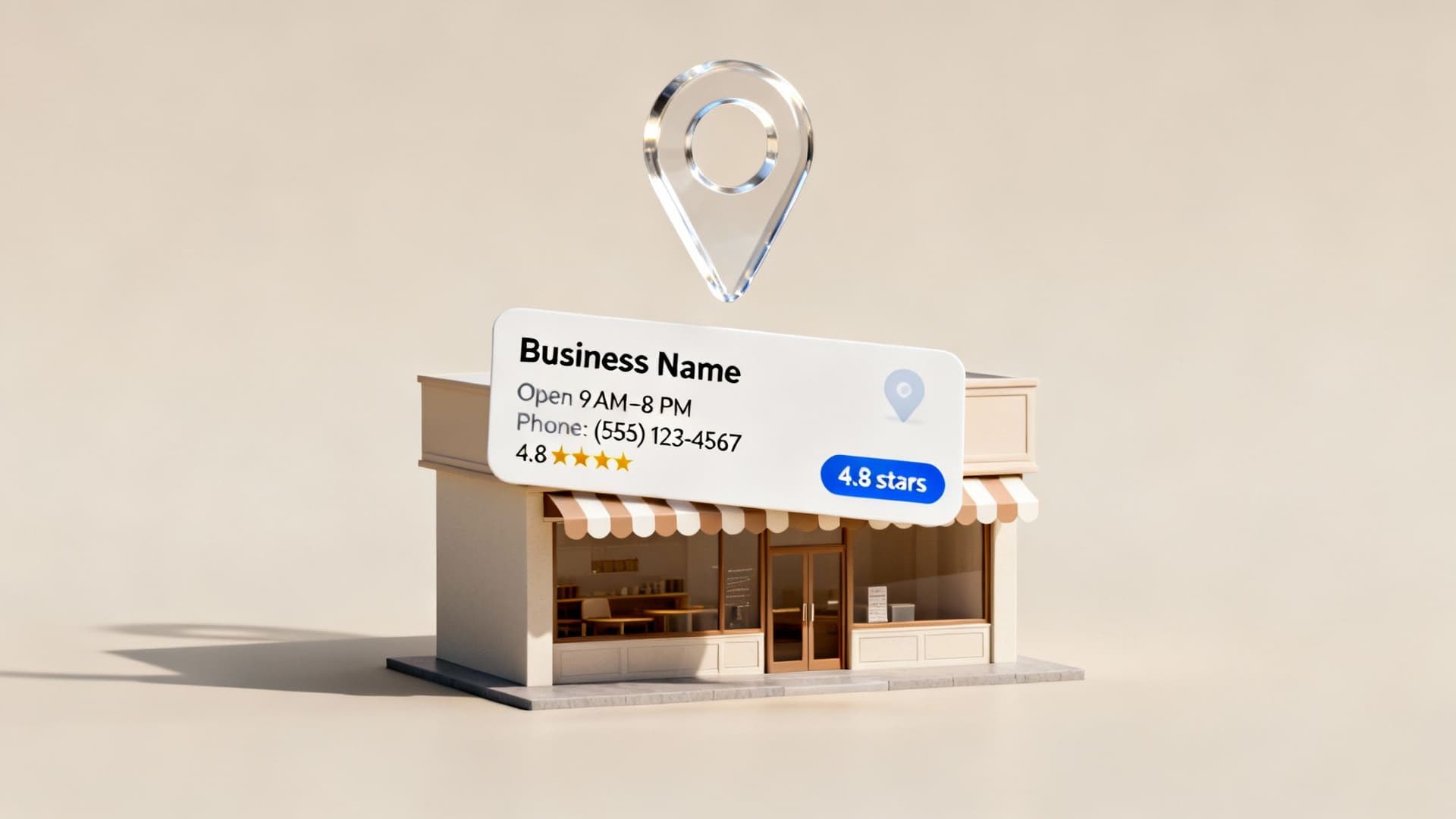
Just picture a dental clinic letting patients book from search results, or a pizzeria using mouth-watering photos to attract hungry people browsing Maps.
Actionable Optimization Steps
- Complete every field: Name, address, phone, website, hours, service areas, and a keyword-rich business description.
- Select precise categories: Use a primary category that matches your core service and add relevant secondary categories.
- Upload high-quality media: Aim for 10+ high-res photos and a short video tour if possible.
- Use GBP Posts: Share offers, events, and updates once or twice a week.
- Manage Q&A: Answer customer questions quickly and proactively post common Q&As.
- Enable messaging: Let customers contact you directly from your profile.
2. Build and Manage Local Citations
Citations — mentions of your Name, Address, and Phone number (NAP) — act as digital proof of your business’s existence and location. Accurate, consistent citations on authoritative directories tell search engines your business is real and where it operates.
Actionable Optimization Steps
- Ensure NAP consistency: Use the exact same formatting everywhere.
- Prioritize foundational directories: Start with Google, Yelp, Apple Maps, Facebook, and Bing Places.
- Target industry-specific sites: A dentist should be on Healthgrades; a contractor should be on Thumbtack or Houzz.
- Audit and clean up: Find duplicates or incorrect listings and fix them.
- Monitor and maintain: Recheck key citations regularly, especially after any changes.
- Use citation tools: Services like BrightLocal or Moz Local can automate listings and cleanup.
3. Optimize On-Page Content for Local Keywords
Your website is where searchers learn what you offer. Using local keywords (city, neighborhood, “near me”) in page titles, headings, and body copy tells search engines where you operate and what you do.
Actionable Optimization Steps
- Conduct local keyword research: Find phrases your customers use, like “[City] air conditioning repair” or “best pizza in [Neighborhood].”
- Optimize core elements: Put main local keywords in titles, meta descriptions (155–160 characters), and H1s.
- Create dedicated location pages: Build unique pages for each area you serve.
- Use local modifiers naturally: Add city names, neighborhoods, and landmarks where relevant.
- Avoid keyword stuffing: Prioritize clear, helpful content over repeated keywords.
- Use long-tail local phrases: Target specific searches like “emergency commercial HVAC repair in downtown Austin.”
To prioritize pages that drive valuable leads, try the Email List Value Estimator.
4. Implement Local Schema Markup
Schema markup tells search engines exactly what your pages describe, such as business name, address, hours, and services. Local schema can help you earn rich snippets that increase click-through rates.
Actionable Optimization Steps
- Choose the most specific schema type (e.g., Restaurant, Dentist, AutoRepair).
- Include full business details: consistent NAP, website, hours, and geo-coordinates.
- Add review and aggregate rating schema for star display.
- Use JSON-LD format and place it in the or of your HTML.
- Generate and validate: Use Google’s Structured Data tools and the Rich Results Test.
- Update schema immediately whenever business details change.
5. Get High-Quality Local Backlinks and Citations
Local backlinks from community sites, news outlets, and niche directories build authority and help you rank in local searches. Links from your Chamber of Commerce, local news, or a popular neighborhood blog are especially valuable.
Actionable Optimization Steps
- Join local organizations: Chamber of Commerce and BBB listings often include links.
- Sponsor events: Charities and local festivals frequently link back to sponsors.
- Pitch local media: Build relationships with journalists and bloggers.
- Partner with complementary businesses: Co-promotions can produce natural links.
- Use reputable local directories: Yelp, Foursquare, and well-known local sites.
- Use outreach tools to scale and prioritize targets with data from the Email List Value Estimator.
6. Develop Location-Specific Landing Pages
If you serve multiple towns or neighborhoods, generic pages won’t cut it. Location pages help you rank for searches like “plumber in Brooklyn” by proving local relevance with unique, localized content.
Actionable Optimization Steps
- Create unique content: Each page should include at least 500 words tailored to the area.
- Include localized keywords and image alt text.
- Add local social proof: Testimonials and case studies from that area.
- Use location-specific imagery and embed a focused Google Map.
- Apply LocalBusiness schema for each location.
- Scale carefully: If you create many pages, follow a clear content and template plan.
For multi-location buildouts, consider adding interactive local assets like the Home Renovation Budget Estimator to engage visitors and capture leads.
7. Manage and Encourage Customer Reviews
Reviews are modern word-of-mouth. They influence rankings, trust, and click-throughs. A systematic review strategy is essential.

Actionable Optimization Steps
- Systematize requests: Ask satisfied customers for reviews via email, text, or QR codes on receipts.
- Respond to all reviews: Thank positive reviewers and professionally address negative feedback promptly.
- Make leaving reviews easy with direct links to your profiles.
- Monitor reviews across platforms using management tools.
- Showcase strong reviews on your website and marketing materials.
- Track ROI: Use the Business Valuation Estimator to help measure the long-term value of reputation improvements.
Consumer review surveys show reviews strongly influence local purchasing decisions3.
8. Optimize For Mobile and Local Search Intent
Most local searches happen on mobile when people need something quickly — directions, hours, or a phone number. A fast, easy mobile experience turns searchers into customers.
Actionable Optimization Steps
- Improve page speed: Use PageSpeed Insights and focus on Core Web Vitals.
- Ensure responsive design: Test on multiple screen sizes.
- Make contact effortless: Prominent click-to-call and one-tap directions.
- Simplify navigation: A clear mobile menu helps visitors find key info fast.
- Optimize for voice search: Use conversational Q&A content for voice queries.
- Audit regularly on real devices to catch usability issues.
Interactive calculators like the Square Footage Cost Estimator can increase engagement with mobile visitors.
9. Create and Optimize Google Posts and Local Content Updates
Google Posts let you publish short updates directly to your GBP. They’re useful for limited-time offers, events, and news, and they appear in search and Maps results.
Actionable Optimization Steps
- Post regularly: Aim for one to two Posts per week.
- Use strong visuals: High-res photos or short videos increase engagement.
- Keep copy short: Under 300 characters is ideal for mobile.
- Add a clear CTA: Use Google’s CTA buttons like “Book,” “Call now,” or “Learn more.”
- Link to relevant landing pages: Point users to booking pages or offers.
- Rotate Post types: Use offers, events, new products, and news to keep interest high.
10. Build Local Authority Through Community Engagement and Partnerships
Real-world prominence helps search performance. Sponsorships, partnerships, and local involvement create authentic mentions and links that search engines value.
Actionable Optimization Steps
- Join and participate in local groups: Attend events and speak when possible.
- Sponsor events or teams: Ensure sponsorships include a website link.
- Form strategic partnerships: Cross-promote with non-competing local businesses.
- Host or speak at local events: Become known as a local expert.
- Highlight involvement online: Create a Community page showcasing sponsorships and partnerships.
- Engage local media: Send press releases and build relationships with journalists.
10-Point Local SEO Checklist Comparison
| Item | Complexity | Resources | Expected impact | Ideal use cases |
|---|---|---|---|---|
| Create and Optimize Google Business Profile | Low | Low | Very high | All local businesses |
| Build and Manage Local Citations | Moderate | Moderate | Moderate–High | Directory-driven referral businesses |
| Optimize On-Page Content for Local Keywords | Moderate | Moderate | High | Multi-service or multi-location sites |
| Implement Local Schema Markup | Low–Moderate | Low | Moderate | Businesses seeking rich snippets |
| Get High-Quality Local Backlinks | High | High | High | Competitive local markets |
| Develop Location Pages | Moderate–High | Moderate–High | High | Multi-location or service-area businesses |
| Manage Customer Reviews | Low–Moderate | Low–Moderate | Very high | Reputation-sensitive industries |
| Optimize For Mobile | Moderate | Moderate–High | High | Businesses with high mobile intent |
| Create Google Posts | Low | Low | Low–Moderate | Time-sensitive promotions |
| Build Local Authority | High | High | High (long-term) | Established businesses seeking leadership |
Putting It All Together: Your Next Steps for Local Dominance
This checklist is designed to make you a local landmark. The real power comes from combining these tactics: a complete GBP backed by consistent citations, local schema, strong reviews, and community links creates a durable advantage.
Prioritized Plan
- Phase 1 — Foundation (Now): Perfect your Google Business Profile and fix NAP across major citations.
- Phase 2 — Build Trust (Weeks 1–4): Collect reviews, implement schema, and optimize key pages.
- Phase 3 — Amplify (Ongoing): Develop location pages, create local content, and pursue high-quality local links.
The Business Case
Local SEO is more than rankings — it’s a predictable engine for real customers. When someone searches “plumber near me” or “best Italian restaurant in [City],” you want to be the obvious choice. Interactive tools help convert that traffic: a contractor can use the Home Renovation Budget Estimator to engage visitors and capture qualified leads, turning interest into booked jobs.
Follow this checklist consistently. Over time, your efforts will compound into more foot traffic, calls, and revenue.
Ready to improve conversion on your local site? Add an interactive estimator like the Home Renovation Budget Estimator to provide instant value and boost both SEO and lead generation.
Frequently Asked Questions
Q: What should I do first to improve local visibility?
A: Start with a complete Google Business Profile and fix any NAP inconsistencies across major directories. Those moves deliver the fastest, most reliable results.
Q: How important are customer reviews?
A: Very important. Reviews influence ranking, click-through rates, and trust. Implement a simple, repeatable process to request and respond to reviews.
Q: Do I need a location page for every neighborhood I serve?
A: If you serve multiple distinct areas, yes. Unique location pages that include localized content, testimonials, and a map help you rank for specific local searches.
Quick Q&A: Common local SEO questions
Q: How quickly will I see results from local SEO?
A: Foundational fixes like GBP and NAP cleanup can show improvement in weeks. Building authority and backlinks takes longer, often several months.
Q: Can I ask customers for reviews directly?
A: Yes. Use email, SMS, or QR codes on receipts to make leaving a review easy and legal. Always follow platform and local guidelines.
Q: Which local metric matters most?
A: Revenue-driving actions matter most: calls, direction requests, bookings, and in-store visits. Track those alongside impressions and rankings.
1.
Nearly three-quarters of people who search for something nearby on their smartphone go on to visit a related business within a day; mobile local intent drives rapid offline action. https://www.thinkwithgoogle.com/
2.
Local search is a major portion of overall search behavior — multiple industry reports show a large share of queries have local intent. https://www.searchenginejournal.com/local-seo-statistics/
3.
Consumer reviews strongly influence local purchasing decisions; BrightLocal’s Local Consumer Review Survey highlights how star ratings and review volume affect trust and conversions. https://www.brightlocal.com/research/local-consumer-review-survey/
Ready to Build Your Own Tools for Free?
Join hundreds of businesses already using custom estimation tools to increase profits and win more clients
✨ No coding required • 🚀 Ready in minutes • 💸 Free to create