If you want to improve your website’s SEO, focus on three clear stages: know your starting point, fix and optimize the site, and build authority. Start with a thorough audit to create a prioritized roadmap rather than guessing what to do next.1
December 28, 2025 (9mo ago) — last updated October 17, 2026 (6d ago)
Improve Website SEO: Boost Traffic Faster
Practical guide to improve website SEO: audits, content strategy, technical fixes, and link-building tactics to increase organic traffic.
← Back to blog
How to Improve Website SEO and Unlock More Traffic
Discover how to improve website SEO with our practical guide. We cover content strategy, technical fixes, and link building to boost your rankings.
Introduction
If you want to improve your website’s SEO, focus on three clear stages: know your starting point, fix and optimize the site, and build authority. Start with a thorough audit to create a prioritized roadmap rather than guessing what to do next.1
Your Starting Point: A No-Nonsense SEO Audit
Before you can improve your SEO, you need a clear, honest view of your site’s current performance. Think of an SEO audit like a doctor’s check-up: diagnose the problem before prescribing treatment.
A good audit isn’t about drowning in data. It’s about finding the low-hanging fruit—quick wins that move the needle without a massive effort. This step produces a prioritized action plan, not overwhelming spreadsheets. You’re hunting for critical issues that hold you back, and you don’t need a massive budget to find them.
The Three Pillars of a Solid Audit
Break a site audit into three core areas to stay organized and make sure nothing important is missed.
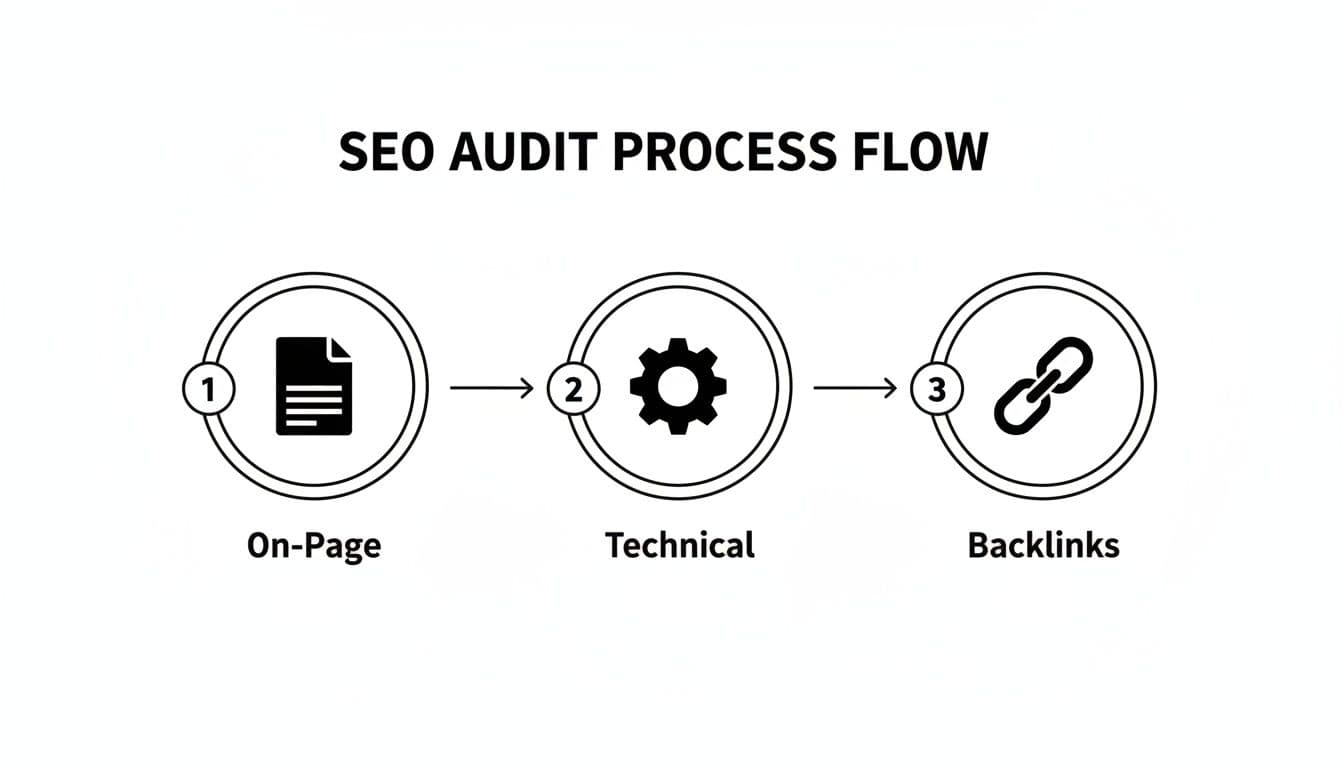
Your on-page content, technical health, and backlink profile are connected, but each needs focused attention. Getting all three right creates the foundation for better rankings.
For example, an e-commerce site might find product descriptions are too thin (an on-page issue) while slow page speeds are killing conversions (a technical issue). Those are the kinds of actionable insights a good audit delivers.
Prioritizing Fixes for Maximum Impact
When your audit produces a list of issues, decide what to fix first by weighing potential SEO impact against required effort. Fixing a typo in a meta description is low effort with modest impact. Overhauling site architecture is higher effort and higher impact.
| Audit Area | What to Check For | Primary Goal |
|---|---|---|
| On-Page SEO | Content quality, keyword usage, meta tags, internal links | Make content relevant, valuable, and easy for search engines to understand. |
| Technical SEO | Site speed, mobile-friendliness, crawl errors, site structure | Ensure the site is fast, accessible, and crawlable. |
| Backlink Profile | Number of referring domains, link quality, anchor text | Build authority and trust with links from reputable, relevant sites. |
Look for the 20% of issues that cause 80% of the problems. Fix high-impact, low-effort items first to build momentum.
Examples of quick wins: standardize your business name, address, and phone number across listings, or add an interactive tool to a key page to boost engagement and time on page. For a thorough audit checklist, see a specialist resource linked in the footnotes.1
Crafting Content That Ranks and Engages
With your audit complete and a plan in hand, focus on content. The old habit of churning out short posts just to publish is over. Today, content must be the definitive answer to the audience’s question.
Create pieces that genuinely satisfy users. Think comprehensive guides rather than quick overviews. When someone lands on your page and finds everything they need, they stay. That dwell time signals value to search engines.
Go Deep, Not Just Long
Depth is about usefulness, not padding. Cover a topic so thoroughly readers don’t need to hit the back button. Deep articles—often 2,000–3,000+ words—tend to attract more organic traffic and backlinks than shorter posts.2
Don’t write more for the sake of length; add more value. Ask: what follow-up questions will readers have? What examples, templates, or tools can I include? Make your content the go-to resource.
If you want to embed useful tools, consider adding an interactive element such as the Mortgage Calculator or the Business Valuation Estimator on relevant pages. These features give readers immediate utility and keep them on the page longer.
Structure for Scanners
No matter how insightful your writing, a wall of text will push readers away. Structure is as important as content.
- Use descriptive subheadings (H2, H3) so readers can scan for what they need.
- Keep paragraphs short—two to three sentences each—to create readable white space.
- Use bullet points and numbered lists to present steps, tips, or features clearly.
- Add visuals—screenshots, charts, or simple infographics—to illustrate points and break up text.
This helps humans and search engine crawlers understand your content faster.
Turn Passive Readers Into Active Participants
Embedding interactive tools transforms an article into a hands-on experience. For example, a marketing post about influencer partnerships could include the Instagram Account Value Estimator or the YouTube Channel Value Estimator. A real estate article could feature the Real Estate Flip Profit Estimator.
These tools provide immediate value and make your page link-worthy. They also create stronger engagement signals that help SEO.
Nailing Technical SEO for a Flawless User Experience
“Technical SEO” can sound intimidating, but it’s about making your site easy for search engines to find, crawl, and understand, and giving visitors a fast, smooth, secure experience.
Think of technical SEO as your site’s foundation. Beautiful content and strong backlinks won’t help if the site is slow, insecure, or unindexable.

Make Page Speed and Core Web Vitals a Priority
Nothing turns visitors away faster than a slow page. Google’s Core Web Vitals measure real user experience during page load and are an important ranking factor.3
Key metrics:
- Largest Contentful Paint (LCP): how quickly the main content appears.
- First Input Delay (FID): how fast the page responds to the first user interaction.
- Cumulative Layout Shift (CLS): whether the page shifts unexpectedly while loading.
Faster pages convert better. Data show pages that load in about 1 second have significantly higher conversion rates than those taking 5 seconds, so every second matters.4
Choose On-Page Tools That Don’t Hurt Performance
Interactive tools can boost engagement but also harm performance if poorly implemented. Use lightweight, asynchronously loaded tools where possible; they add functionality without blocking critical content from rendering.
Examples of compact, asynchronously loadable tools include the Mortgage Calculator and the Logistics Shipping Cost Predictor.
Build a Clean, Crawlable Site Architecture
A logical site structure helps Google understand which pages are most important. A clear hierarchy makes navigation easier for users and lets link equity flow to your priority pages.
Don’t Overlook Security and Mobile-Friendliness
Two essentials: SSL (HTTPS) and mobile-first design. Google primarily uses the mobile version of a site for indexing, so your mobile experience must be top-notch. An SSL certificate signals security and builds user trust.
Build Real Authority with Link-Worthy Assets
After on-page and technical work, focus on authority. High-quality backlinks are votes of confidence from other sites, and they remain one of the strongest ranking signals.5
This isn’t about buying many low-quality links. Earn links by creating genuinely useful, reference-worthy assets.
Move Beyond Blog Posts to Create Link Magnets
Assets that attract links include:
- Original research and data that journalists and bloggers cite.
- Comprehensive guides and ebooks that serve as long-term references.
- Sharable infographics that condense complex ideas visually.
- Free interactive tools that solve real problems and get reused across the web.
Top-ranking pages often have substantially more backlinks than lower-ranked pages, which demonstrates the impact a strong link profile has on visibility.5
The Power of a Simple, Embedded Tool
Offering a free tool can flip outreach on its head. Instead of asking for links, you give a useful resource others naturally want to link to. For instance, embedding the Business Valuation Estimator can attract links from industry blogs, university programs, and news sites.
A tool like this also becomes an inbound lead engine—qualified users find value and convert at higher rates than generic leads.
Measuring What Matters and Iterating for Success
SEO is a cycle of action, measurement, and refinement. Focus on a few key metrics rather than everything at once.
Use Google Analytics 4 and Google Search Console as your primary sources of truth. Track these core metrics:
- Organic traffic: are more users finding you from search?
- Keyword rankings: are target keywords improving in position?
- Conversion rate (from organic): are search visitors taking valuable actions?
- Backlink growth: are you earning links from quality domains?
These metrics provide a clear picture of progress and where to focus next.
Analyze Interactive Tool Usage
Tool usage is a direct signal of what your audience values. Track how many visitors use a tool, which pages drive the most usage, and the conversion rate of tool users. For example, a logistics firm using the Logistics Shipping Cost Predictor can see which articles drive high-value interactions and which pages convert to quotes.
This insight tells you what to amplify and where to cut wasted spend.
Your Top SEO Questions, Answered
How Long Until I See Real SEO Results?
Expect early signs in about 3–6 months and stronger business-impact results in 6–12 months. Timelines vary by market competitiveness, your site’s starting point, and resources devoted to content and outreach.6
Should I Focus on Content or Technical SEO?
Both. Technical SEO is the foundation that lets your content be found and consumed; content is the reason people visit and link to your site. Neglecting either reduces the effectiveness of the other.
How Can a Small Business Outrank a Big Brand?
Be specific and useful. Target long-tail keywords and create niche resources—especially tools or calculators—that meet precise needs bigger brands overlook. A focused, high-value page can attract targeted traffic and links even in competitive fields.
Ready to turn your site into a lead-generating asset? Consider adding a useful calculator or estimator on a key page—examples above include the Mortgage Calculator, Business Valuation Estimator, Instagram Account Value Estimator, YouTube Channel Value Estimator, or the Logistics Shipping Cost Predictor.
Quick Q&A (Concise)
Q: What’s the first thing to do to improve SEO?
A: Run a focused audit to identify high-impact, low-effort fixes and create a prioritized roadmap.1
Q: What type of content performs best?
A: Deep, useful resources that fully answer user intent—often long-form guides or interactive tools that serve as definitive references.2
Q: Which technical factors matter most right away?
A: Page speed and Core Web Vitals, mobile-friendliness, and secure HTTPS will have the fastest impact on user experience and rankings.3
Ready to Build Your Own Tools for Free?
Join hundreds of businesses already using custom estimation tools to increase profits and win more clients
✨ No coding required • 🚀 Ready in minutes • 💸 Free to create