The Cost Performance Index (CPI = EV / AC) gives a fast, practical measure of how well your project turns spending into completed work. Use this short guide to calculate CPI, read the score, diagnose cost issues, and automate tracking so you can protect margins and make quicker budget decisions.
July 29, 2025 (1y ago) — last updated January 8, 2026 (9mo ago)
Cost Performance Index (CPI): Calculate & Use
Calculate CPI (EV/AC) to detect budget issues early, forecast cost outcomes, and take corrective action to protect project margins.
← Back to blog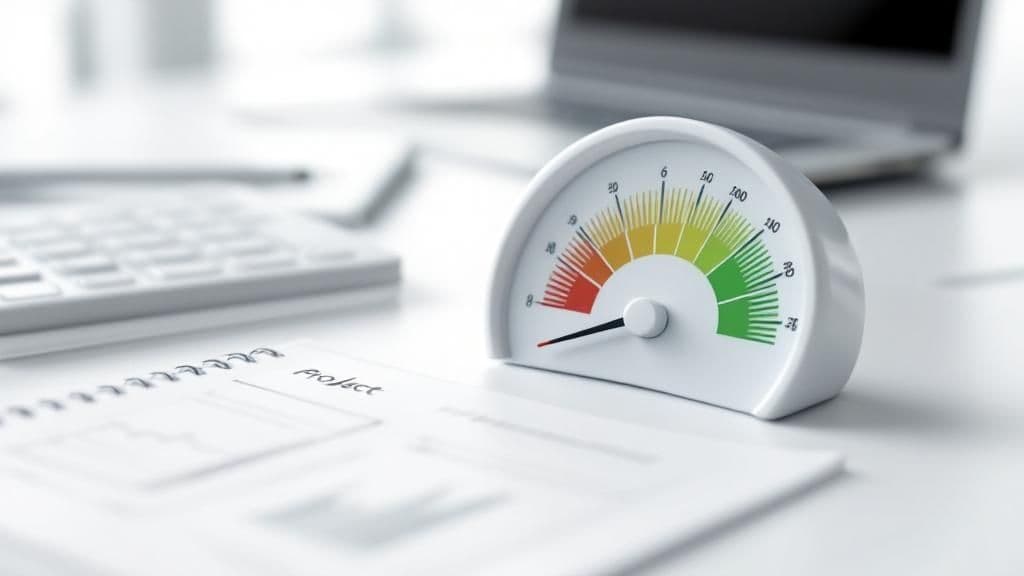
Cost Performance Index (CPI): Formula & Guide
Author: (same as original)
Published: (same as original)
Quick summary
The Cost Performance Index (CPI) shows how efficiently your project converts spending into completed work. Use the formula CPI = EV / AC to watch budget health, forecast outcomes, and act before problems grow.1
Introduction
The Cost Performance Index, calculated as Earned Value (EV) divided by Actual Cost (AC), gives a direct measure of cost efficiency. In minutes you can see whether each dollar spent delivers planned value, detect budget leaks early, and focus corrective action where it counts. This guide explains the CPI formula, how to read scores, real-world examples, and practical automation tips so you can protect margins and make faster budget decisions.
What is CPI and why it matters
CPI = Earned Value (EV) / Actual Cost (AC)
CPI gives a quick snapshot of cost efficiency:
- CPI > 1 — under budget (positive)
- CPI = 1 — on budget
- CPI < 1 — over budget (warning)
Think of CPI as your project’s financial pulse. A falling CPI early in a project gives you time to investigate root causes before issues compound. Projects with weak cost control often waste a measurable share of invested funds.1
CPI formula components
| Component | Abbreviation | Meaning |
|---|---|---|
| Earned Value | EV | Budgeted cost of completed work — what the completed work is worth in budget terms |
| Actual Cost | AC | Money actually spent to produce that work |
CPI = EV / AC
Example: EV = $30,000; AC = $40,000 → CPI = 0.75. That means you’ve received $0.75 of earned value for every $1 spent.
How to interpret your CPI score
- CPI > 1.0: You’re getting more value than you paid for. Document what’s working and repeat it.
- CPI = 1.0: You’re on budget. Keep controls tight and watch schedule metrics so surprises don’t appear.
- CPI < 1.0: You’re spending more than the value delivered. Diagnose root causes and act quickly.
Projects with CPI below about 0.9 at midpoint rarely recover to meet original budgets, so early action matters.1
Practical examples
Road-trip analogy
Budget: $500. Halfway, EV = $250, AC = $300 → CPI = 0.83. You’re overspending and need to reduce costs or adjust plans.
Software development
If a sprint shows CPI = 0.90, investigate causes such as scope creep, overtime, or inefficient handoffs. Reprioritize the backlog or adjust resourcing.
Construction
CPI = 1.15 indicates efficient cost performance. Identify the savings (bulk discounts, better suppliers, fewer change orders) and document them for future projects.
Step-by-step: Calculate CPI and act on it
- Confirm EV, the budgeted value of completed work.
- Confirm AC, the actual spend to date.
- Calculate CPI = EV / AC.
- If CPI < 1, diagnose likely causes: increased unit costs, scope changes, productivity losses, or reporting errors.
- Take corrective actions: negotiate suppliers, reduce scope, reallocate resources, or improve estimate accuracy.
- Recalculate regularly and track the CPI trend over time, because trends are more actionable than a single point.
Fixing a bad CPI: practical actions
- Reforecast and rebaseline if scope or assumptions changed.
- Negotiate or re-source expensive materials or services.
- Reduce scope or defer nonessential features.
- Correct misclassified costs and improve time and expense reporting.
- Apply productivity improvements such as training or process changes.
CPI vs SPI — know the difference
- CPI (Cost Performance Index): Are we on budget? (EV / AC)
- SPI (Schedule Performance Index): Are we on schedule? (EV / PV)
A project can be under budget but behind schedule. Both CPI and SPI matter for overall project health.
Automate CPI: save time and reduce errors
Manual EV and AC tracking in spreadsheets is error-prone and time-consuming.2 Tools that automate inputs and recalculate CPI provide real-time alerts, consistent reporting, faster root-cause analysis, and fewer manual entry mistakes.
Consider embedding or linking focused estimators that feed project budgets and keep actual costs tied to work completed. Useful tools include:
- Construction Material Cost Predictor
- Manufacturing Production Time Estimator
- Business Valuation Estimator
- Event Planning Budget Allocator
Automating the link between timekeeping, procurement, and the baseline is the simplest win. Connect systems so EV and AC update each reporting period and surface anomalies early. Link first mention of estimators to [/estimators], automation references to [/tools], case studies to [/case-studies], and pricing mentions to [/pricing].
Real-world walkthrough (short)
- Start: Create a realistic budget and baseline using an estimator tool or your internal estimating process.
- Midpoint: Pull EV and AC, calculate CPI.
- If CPI < 1: Drill into categories (labor, materials, subcontractors), find anomalies, apply targeted fixes.
- Track trend: a single CPI number is useful, but the trend is more actionable.
Checklist: Verify before you act on CPI
- Verify EV and AC accuracy and correct any miscoded costs
- Check for scope changes or rework
- Compare supplier prices versus baseline
- Re-evaluate resource allocation and productivity
- Reforecast and document decisions
Internal links
Use a material cost predictor to build a data-backed budget (Construction Material Cost Predictor). Link estimators to [/estimators], automation tools to [/tools], case studies to [/case-studies], and pricing references to [/pricing].
Key Q&A — common questions
Q: What’s the simplest way to spot a cost problem?
A: Calculate CPI regularly. If CPI drops below 1.0, investigate the largest cost categories first.
Q: How often should I recalculate CPI?
A: Recalculate at every reporting period and after any significant scope change. Trends matter more than single values.
Q: Can CPI be manipulated?
A: Yes — if EV or AC are misreported. Verify data sources, correct miscoded costs, and audit estimates to keep CPI meaningful.
Three concise Q&A additions
Q: How quickly should I act on a CPI below 1.0?
A: Act immediately to diagnose root causes and focus on the largest cost drivers. Early fixes are cheaper than late recoveries.
Q: Which data sources should I trust for EV and AC?
A: Use validated timekeeping, purchase orders, and contract invoices. Cross-check estimates with actuals and correct miscoded entries.
Q: What’s the simplest automation win for CPI tracking?
A: Connect your time tracking and procurement systems to your baseline so EV and AC update automatically each reporting period.
Additional concise Q&A (bottom of article)
Q: What is a healthy CPI to target?
A: Aim for CPI at or above 1.0; consistent small gains (CPI 1.02–1.10) give a buffer against unexpected costs.
Q: How do I prioritize fixes when CPI is low?
A: Triage by dollar impact: fix the largest recurring cost drivers first (labor, major materials, subcontractor spend).
Q: Can CPI replace detailed cost reviews?
A: No. CPI is an early-warning metric that guides where to dig deeper; detailed line-item reviews remain essential.
1.
Project Management Institute, Pulse of the Profession, 2023, https://www.pmi.org/learning/library/pulse-of-the-profession-2023-13915
2.
U.S. Government Accountability Office, GAO Cost Estimating and Assessment Guide, https://www.gao.gov/assets/gao-09-3sp.pdf
3.
NASA earned value resources, https://www.nasa.gov/quality/earned-value-management
Ready to Build Your Own Tools for Free?
Join hundreds of businesses already using custom estimation tools to increase profits and win more clients
✨ No coding required • 🚀 Ready in minutes • 💸 Free to create