Project cost management brings together estimating, budgeting, monitoring, and control so you deliver scope and protect profit. This guide lays out four practical phases and shows how modern tools and a few key metrics turn uncertainty into predictable outcomes. Follow the steps here to move from guesswork to data-driven decisions.1
July 28, 2025 (11mo ago) — last updated May 8, 2026 (1mo ago)
Project Cost Management: Estimating & Cost Control
Practical guide to estimating, budgeting, monitoring, and controlling project costs with tools and metrics to deliver on time and protect profit.
← Back to blog
Project Cost Management: Estimating & Cost Control
Project cost management organizes planning, estimating, budgeting, and control so you deliver scope and protect profit. This practical guide breaks the process into four clear phases: estimation, budgeting, monitoring, and control. It shows how modern tools and a few key metrics turn uncertainty into predictable outcomes. Read on for methods, tool recommendations, and clear first steps to move from guesswork to data-driven decisions.1
Why a clear cost management approach matters
Think of cost management as the project’s financial blueprint. It sets a realistic budget and keeps spending aligned as work progresses. Done well, it stops small overruns from becoming project-killers and protects the organization’s financial health.
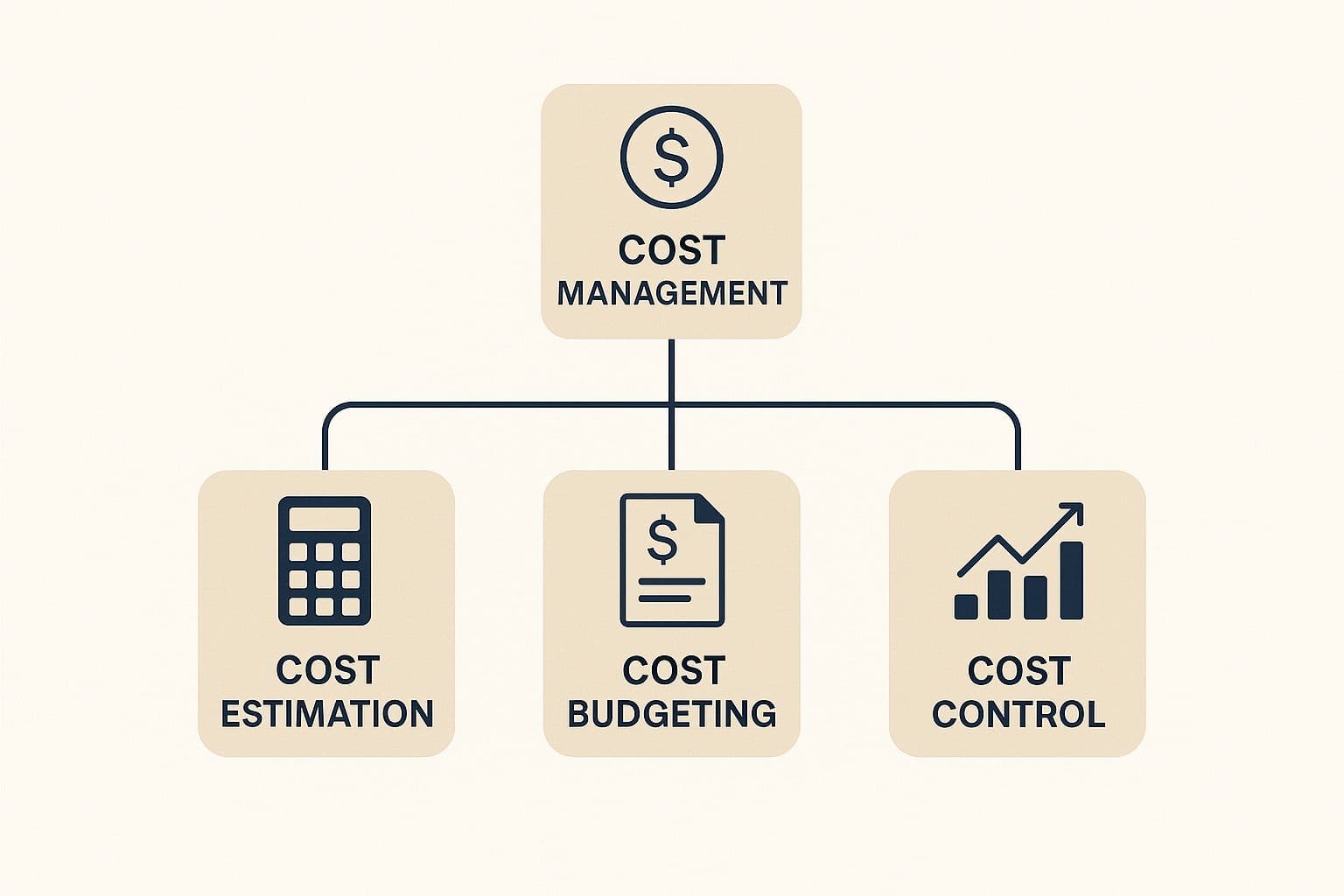
The lifecycle has four connected phases. Each builds on the previous one and together they form a defensible financial plan.
The four pillars of project cost management
| Pillar | Objective | Key activity |
|---|---|---|
| Cost estimation | Predict total cost with reasonable accuracy | Analyze scope, resources, and risks to forecast expenses |
| Cost budgeting | Allocate the estimate to work packages and set a baseline | Create a formal, approved budget that becomes the cost baseline |
| Cost monitoring | Track actual costs against the baseline | Gather expense data and compare to the plan in near real time |
| Cost control | Manage factors that create cost variances | Apply corrective actions to bring spending back in line |
Understanding how these pillars interact is the first step to steering your project with financial confidence.
Use modern data, not last-year spreadsheets
Market volatility and supply-chain disruption make static budgets risky. Teams that adopt automation, clean data, and modern tools make faster, more accurate decisions and save money. Cost management isn’t just cutting expenses; it’s cost visibility — knowing where every dollar goes so you can make smarter trade-offs. Many organizations are reshaping supply chains and procurement strategies to reduce cost shocks.2
Spreadsheets are useful, but they’re error-prone and hard to scale for complex projects. Move routine aggregation and reporting into tools that tie estimates to real market data.3
Estimation: the foundation of your budget
A defensible estimate reduces uncertainty and gives stakeholders confidence. Start broad, then add detail as scope becomes clearer.
Common estimation techniques
- Analogous estimating: Use similar past projects as a quick reference. Fast but less accurate.
- Parametric estimating: Base estimates on unit costs (cost per square foot, per feature, etc.). Good when reliable unit rates exist.
- Bottom-up estimating: Break work into small tasks, estimate each, and roll up. Most accurate but time-consuming.
In practice, combine methods: start with an analogous estimate, then refine with bottom-up detail as scope solidifies.
Use the right tools and market data
Modern tools connect you to broader datasets and automate repetitive work. For construction or material-heavy projects, a materials pricing tool helps avoid surprises. For region-specific pricing benchmarks and alternatives, try the Construction Material Cost Predictor.
Turning estimates into a realistic budget
An estimate shows what the project might cost. A budget tells you what it should cost and when you will spend it. Converting estimates into a time-phased, defendable budget creates the cost baseline you measure performance against.
Cost aggregation and alignment
Aggregate detailed estimates to summary-level totals that mirror your Work Breakdown Structure. That ensures every scope item has a budget and reduces the chance of missed costs.
Time-phased budgeting and cash flow
A time-phased budget maps spending across the project timeline. It’s crucial for cash flow and financing. Knowing you need $40,000 in month one versus $100,000 spread evenly makes planning easier.
Tools to automate budgeting
Spreadsheets are error-prone. Modern platforms automate aggregation, generate cash flow projections, and produce defendable baselines. For event or fixed-scope budgeting, try the Event Planning Budget Allocator. These tools let you import estimates, auto-aggregate line items, generate cash flow, and present a clean budget for stakeholder sign-off.
Proactive cost control: steer the project in real time
Cost control is where planning meets reality. It’s about catching deviations early, diagnosing causes, and applying corrective actions before small variances become big problems.
Key performance metrics (EVM and beyond)
Earned Value Management ties scope, schedule, and cost into one performance view. These metrics provide early warning of trouble and a clear signal for action.4
| Metric (abbr.) | What it measures | Formula | If value > 1 means... |
|---|---|---|---|
| Schedule Performance Index (SPI) | Progress efficiency vs plan | SPI = EV / PV | Ahead of schedule |
| Cost Performance Index (CPI) | Budget efficiency | CPI = EV / AC | Under budget |
| Estimate at Completion (EAC) | Forecasted total project cost | EAC = BAC / CPI (one method) | Project will cost less than planned |
| Variance at Completion (VAC) | Forecasted surplus/deficit | VAC = BAC - EAC | Project will finish with surplus |
Start by tracking CPI and SPI weekly. They give powerful, actionable insight with minimal overhead.
Real-time dashboards and what-if analysis
Dashboards let you spot issues as they appear and run what-if scenarios to evaluate corrective options. Example use cases:
- A task trending 15% over budget due to overtime — model hiring a temporary crew to compare costs.
- A shipping lane price spike — model alternative routes and carriers using a logistics tool.
For logistics scenarios, try the Logistics Shipping Cost Predictor. Real-time tools turn you from a reactive bookkeeper into a proactive financial manager.
Navigating economic headwinds
Projects don’t exist in a vacuum. Inflation, supply disruptions, and labor shortages can erode margins quickly. Build resilience by planning contingencies and using market data to anticipate shifts.5
Build intelligent contingency
Contingency shouldn’t be arbitrary. Use scenario modeling to calculate contingency for identified risks (for example, a 5–15% material price surge) and reserve funds accordingly.
Monitor market data and lock prices
Where possible, lock prices with suppliers or buy critical materials early if market indicators point to increases. Use materials and logistics tools to test the impact of inflation scenarios on your budget.
Be agile with finances
When surprises happen, modern tools let you re-run budgets and compare vendor packages quickly. That lets you make the best trade-offs without losing momentum.
Practical starting steps
If you’re formalizing cost management for the first time, follow this three-step starter plan:
- Standardize estimates: use one simple, shared template across the team. See the /templates/estimate-template for a starting format.
- Establish approvals: define how budgets are reviewed and signed off.
- Track key metrics: pick one or two (start with CPI) and review them regularly.
Once these basics are in place, add automation to reduce manual errors and speed reporting.
Suggested internal links
- Construction Material Cost Predictor — link from Estimation and material pricing sections
- Event Planning Budget Allocator — link from Budgeting and time-phasing sections
- Logistics Shipping Cost Predictor — link from Logistics and what-if analysis sections
- /blog/earned-value-management — link from the EVM and metrics section
- /templates/estimate-template — link from Practical starting steps and Estimation sections
FAQ
What is the difference between cost management and cost control?
Cost management is the end-to-end financial plan for a project. Cost control is the day-to-day activity of tracking spending against that plan and taking corrective action when needed.
How do I budget a project with many unknowns?
Use rolling wave planning: produce a detailed budget for near-term work and higher-level estimates for later phases. For uncertain projects, increase contingency (for example, 15–20%) and refine it as risks become known.
What are the first steps to a formal cost management process?
Start small: standardize estimates, set an approval flow, and track a couple of metrics regularly. Then add tools to automate aggregation, time-phasing, and dashboards.
Quick Q&A — common concerns
Q: How soon should I start tracking CPI and SPI?
A: Track CPI and SPI as soon as you have a baseline and initial earned value data, typically after the first reporting period. Weekly tracking is a practical cadence.
Q: How large should contingency be?
A: Base contingency on quantified risks. For low-uncertainty work, 5–10% might suffice; for uncertain projects, 15–20% is common until risks are resolved.
Q: What tools give the fastest ROI for cost management?
A: Start with tools that automate estimate aggregation and time-phasing. For many teams, material pricing and shipping predictors provide quick wins.
Three concise Q&As
Q: What’s the single most important thing to start with?
A: Standardize estimates and agree a simple approval flow so you have one source of truth.
Q: How do I stop small overruns from growing?
A: Track CPI weekly, use dashboards to spot trends, and run what-if scenarios to choose corrective actions early.
Q: When should we move from spreadsheets to a tool?
A: Move when you can’t tie estimates to market data reliably or when aggregation and cash-flow projections become manual and error-prone.
Summary and next steps
Good cost management combines reliable estimation, clear budgeting, proactive monitoring, and decisive control. Modern tools and key metrics help you reduce uncertainty, protect profit, and deliver projects on time and under budget.
Explore these recommended tools to get started:
- Construction Material Cost Predictor
- Event Planning Budget Allocator
- Logistics Shipping Cost Predictor
Ready to move from guessing to data-driven budgeting? Use the tools above to run scenarios, create time-phased budgets, and set a defendable baseline for your next project.
Author: (same as original) — Published: (same as original)
1.
Project Management Institute, Pulse of the Profession: “Organizations that invest in proven project practices waste 21% less of their investment,” Pulse of the Profession report, Project Management Institute, 2021, https://www.pmi.org/learning/library/pulse-of-the-profession-2021-11120.
2.
McKinsey & Company, “Reimagining global supply chains,” McKinsey Operations, 2020, https://www.mckinsey.com/business-functions/operations/our-insights/reimagining-global-supply-chains.
3.
Raymond R. Panko, “What We Know About Spreadsheet Errors,” 2008, http://panko.shidler.hawaii.edu/ssr/Mypapers/whatknow.htm.
4.
Project Management Institute, Practice Standard for Earned Value Management, PMI, https://www.pmi.org/pmbok-guide-standards/practice-standards/earned-value-management.
5.
U.S. Bureau of Labor Statistics, Consumer Price Index (CPI) overview, accessed 2025, https://www.bls.gov/cpi/.
Ready to Build Your Own Tools for Free?
Join hundreds of businesses already using custom estimation tools to increase profits and win more clients
✨ No coding required • 🚀 Ready in minutes • 💸 Free to create